 Guide On Map
Novgorod Kremlin and Torg: Who Held the Power in Novgorod
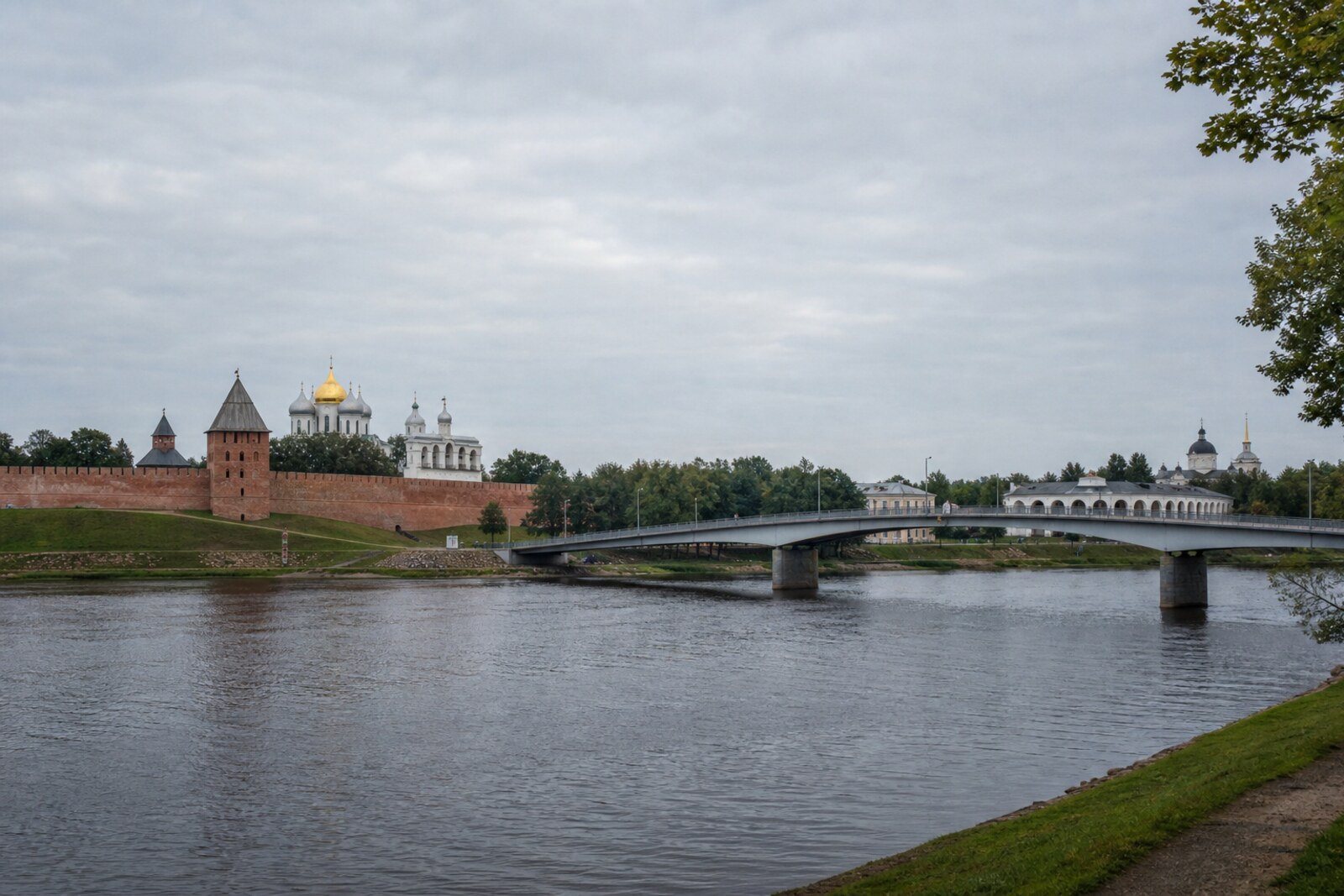
From Sofiyskaya Square through Novgorod Kremlin and across the Volkhov River to Torg
Guide On Map on your phone
Open the walk like a regular app
It takes about 10 seconds to install. No app store needed.
The whole path
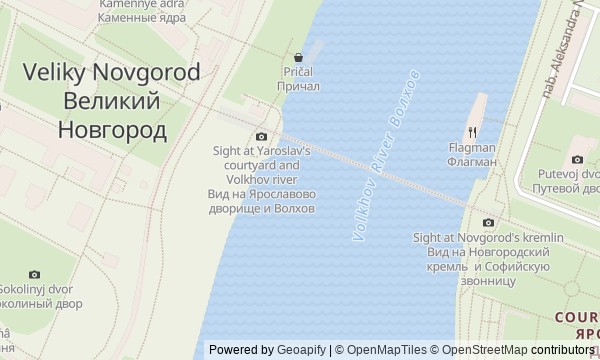
Route map
About the walk
You will enter Novgorod Kremlin through an arch whose name is older than its stone. Then you will pass between the city's main cathedral, the Archbishop's Court, and a monument that once lay dismantled in the snow. The road will bring you to the Volkhov River. Across the Volkhov Pedestrian Bridge, you will move from the Sophia Side to the Market Side—from Kremlin decisions to the prince's court, the Novgorod Veche square, and a merchants' church.
You will not be learning the workings of the republic from a textbook. Instead, you will follow particular clashes. Why will the prince need priests of his own? What will keep armed townspeople from fighting? Why will a church hold scales and an ell?
The story will unfold calmly and precisely. A legend will remain a legend, and a disputed version will remain disputed. By the end, you will be able to explain Novgorod's power through things along the route: gates, a place of prayer, a bridge, a princely seal, and trade measures.
Why this order
First, you will enter Novgorod Kremlin through its western opening, where the name preserves the memory of a vanished church. At the monument standing inside, you will continue the conversation about the fate of the city's memory through dismantled bronze. In St Sophia Cathedral opposite, you will move from a state image to the clash between Ivan IV and the archbishop, while in the nearby Faceted Chamber you will see why the church court was also a place of city decisions. From the chamber, the route will head toward the Volkhov River: on the bridge, the history of government will meet the public punishment of a posadnik. On the Market Side, Yaroslav's Court will become the setting for a conflict between the prince and an official chosen by the city. In the nearby St Nicholas Cathedral, that same dispute will narrow to the relationship between the prince and the archbishop. The northern part of the complex will lead to the Church of St John the Baptist at Opoki, where the right to decide will pass to the merchants' court, measures, and duties.
Those who want to understand Novgorod Veche through actions and conflicts Those who value careful qualifications over ready-made legends Those who enjoy connected routes across both sides of a river
Those looking for an overview of architectural styles and church interiors Those who want a walk without political and church conflicts
Before you go
Check the current availability of museum rooms and churches on the day of your walk: access indoors may depend on services, exhibition schedules, or restoration work. St Sophia Cathedral remains an active church, so during a service it is best to pause the audio and avoid disturbing worshippers. Confirm visiting arrangements for the Faceted Chamber in advance; its interior matters for its Gothic vaults, but you can still follow the main thread of the route from outside. On the Market Side, do not count on the old churches necessarily being open: the stories at St Nicholas Cathedral and the Church of St John the Baptist at Opoki are designed first and foremost to work with the site and its facades. Bring headphones—on the bridge and near busy squares, phone audio is easily lost.
When to go
If you want to see the interiors, begin after checking their opening arrangements and leave time before museum sites close. For a fully outdoor version, any daylight hours will work; try not to rush across the bridge and through Torg, because the position of the riverbanks explains half the story.
Backup plan
If you cannot get into the Faceted Chamber, spend a little longer by its facade and picture the building's connection with St Sophia Cathedral and the Archbishop's Court—the political meaning of the stop does not disappear. If a church interior is unavailable, listen to the story outside rather than trying to replace it with a random neighboring site. In rain, shorten your stops on the bridge and in open Torg, but keep the crossing of the Volkhov River itself: without it, the walk loses its spatial logic. In strong wind, listen to the bridge chapter before heading onto the crossing, then stop only briefly in the middle to look at both banks.
Route conditions
Surface. Paved — 1.6 km (data covers 92% of the route)
Facilities. Toilets — 3; drinking water — 1
Elevation. Ascent — 22 m; descent — 20 m
OpenStreetMap extract of July 2, 2026: database data, not a check on the ground. Data © OpenStreetMap contributors, ODbL licence
Walk plan
Open in maps ↗- 1
Resurrection Arch
Here begins the story of how a vanished structure left the city with the name of a military victory. - 2
Monument to the Millennium of Russia
The dismantled monument shows how state memory was literally assembled piece by piece. - 3
St Sophia Cathedral
The cathedral shows how years of loyalty to the tsar did not protect a church ruler. - 4
Faceted Chamber
Here, the ecclesiastical residence will become the place where the fate of city government was decided. - 5
Volkhov Pedestrian Bridge
The bridge will show how a public punishment might not put an end to a political career. - 6
Yaroslav's Court and the Torg
The Court helps show where the prince's retinue clashed with the city's right to choose its posadnik. - 7
St Nicholas Cathedral
The cathedral will reveal the boundary between the prince's authority over his own court and the bishop's authority over the clergy. - 8
Church of St John the Baptist at Opoki
The final stop will explain why the church on the Torg served at once as a storehouse for standards of measure and a merchants’ court.
Route features
Everything you need stays in the browser
Progress, saves and your trip plan are stored on this device.
Add Guide On Map to your home screen so the walk opens outside the browser.
How we handle sources, maps and corrections: our editorial standards