 Guide On Map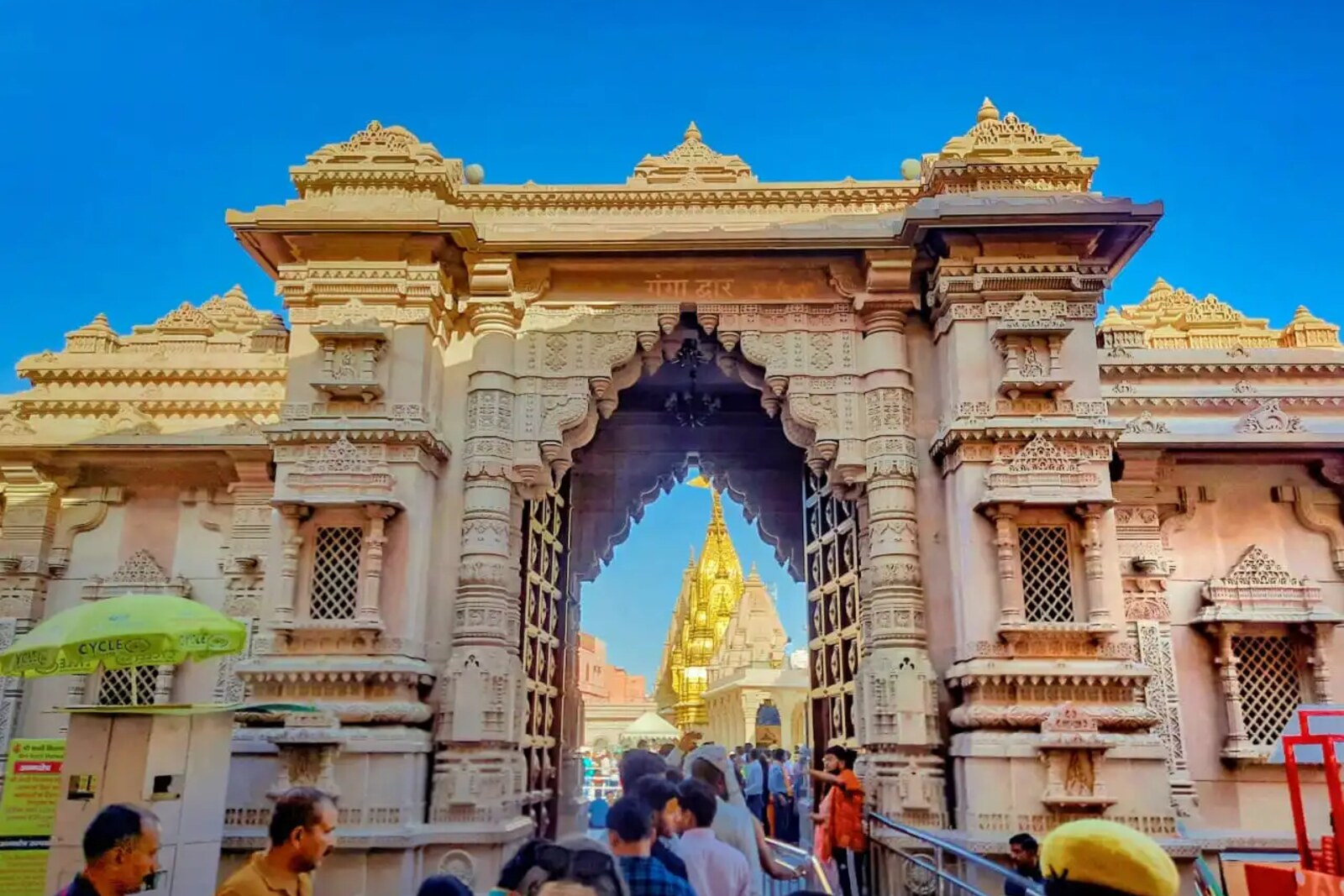
Look around first
What to notice
- The open courtyard of Mandir Chowk
- The square’s galleries
- The gates of the temple enclosure
The story of the place
Here, “Dham” refers to the entire pilgrimage complex, while Mandir Chowk literally means “temple square.” The present open courtyard was laid out on the direct route from the Ganges to the shrine: pilgrims gather here before entering and line up for darshan—a meeting with the deity. In the small temple, Shiva is venerated as Vishwanath, “Lord of the Universe,” in the form of one of the twelve Jyotirlingas—sacred lingams associated with Shiva’s manifestation as an endless pillar of light.
A special post for a professional musician once existed at the temple entrance. In seventeen eighty-five, Warren Hastings, Governor-General of the East India Company’s territories, ordered the recently built temple to be supplemented with a naubatkhana. The local tax collector and administrator Muhammad Ibrahim Khan carried out the order. A naubatkhana is a room above the gate, from where temple musicians accompanied rituals by playing drums and the shehnai, a wooden double-reed wind instrument.
A century later, the shehnai player Ali Bux "Vilayatu" Khan served at the temple. Music was his profession, not a festive pastime. His nephew Bismillah Khan grew up in a family of the same kind: the boy’s father received a musician’s salary at the court of the prince of Dumraon. Mastering the shehnai meant acquiring a trade that could provide a living. Bismillah came to Varanasi, then commonly called Benares, and became his uncle’s pupil at Kashi Vishwanath Temple.
Ali Bux "Vilayatu" Khan taught his nephew the repertoire for which the shehnai was usually employed: music accompanied temple ceremonies, weddings, and other auspicious occasions. The pupil went further. At just fourteen, he performed at a major music conference in Allahabad, and then adapted the shehnai’s breathing, drawn-out introductions, and rapid passages for a full classical concert. The instrument, previously associated chiefly with ritual, began to be heard from the stage. Bismillah Khan made his living from concert music for more than seventy years and in two thousand one received India’s highest civilian award—the Bharat Ratna.
The present Mandir Chowk did not yet exist then. Old plans and court inventories place the naubatkhana above the northern gate of the former temple enclosure, not amid the square’s new galleries. The open courtyard now receives pilgrims; the place where the temple employed Ali Bux "Vilayatu" Khan and gave his nephew a profession remained at the old entrance.
Useful on site
The temple trust's information lists the temple as 03:00–23:00; darshan is usually 04:00–11:00, 12:20–19:00, and 20:30–21:00. The Ganges-side entrance to the corridor is listed as 06:00–21:00. Queues, holidays, and security affect actual access.
Checked: June 28, 2026. Check the official source before visiting.Follow the complex’s current rules, and do not expect to be able to carry electronics freely or take photographs in all its parts.