 Guide On Map
Kashi's Temple Lanes: From Godowlia to Manikarnika
From Godowlia through the Vishwanath quarter to Manikarnika Ghat
Guide On Map on your phone
Open the walk like a regular app
It takes about 10 seconds to install. No app store needed.
The whole path
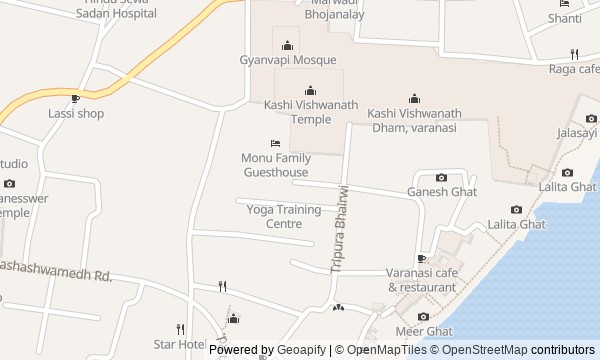
Route map
About the walk
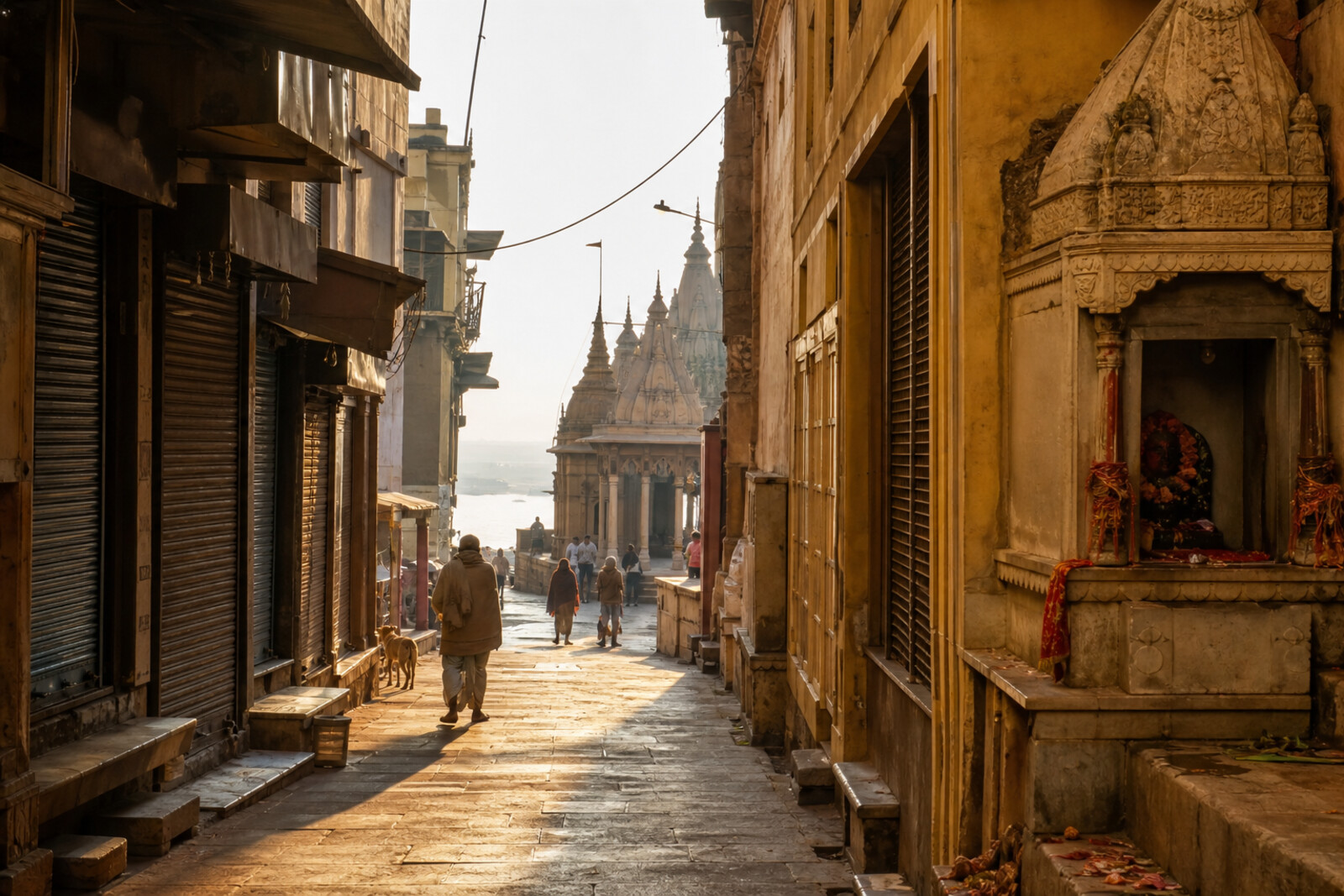
You will enter old Varanasi at Godowlia, where the city road narrows into temple lanes. First you will pass a well and a trading gali, then make your way through the shrines of Vishwanath, Annapurna, and Vishalakshi. Beyond the tight-knit quarter, the road opens onto the Ganges, the Nepali Temple, and Manikarnika Ghat.
This is not a walk along the ghats' ceremonial waterfront. You will move through the pilgrimage city itself: where a temple turned a residential passage into a market, rulers paid for water and food, and a temple musician gained a profession. The stories will turn on decisions and their tangible traces. Why were dozens of pillars placed around an old well? Why will one shrine retain two figures of the goddess? And what right will still be unlocked with a key?
By the end, you will be able to explain how the lanes between Godowlia and Manikarnika Ghat came together through donations, trade, temple service, and family obligations.
Why this order
From Godowlia, the route enters the temple quarter along the line of a vanished watercourse. Gyanvapi Chowk comes first because the well gave its name to this stretch and to the entrance to Vishwanath Gali. In the gali itself, you will see what living beside a shrine brought about: a residential passage became a market for pilgrims. Annapurna follows, adding not simply another temple to the route, but food for those same people. From here, the road leads to Mandir Chowk, the place around which both the trading street and temple professions took shape. After the main complex, the small Vishalakshi Temple reveals another community and another way of sustaining a shrine. Then the lanes lead down to the Ganges: the Nepali Temple continues the theme of faraway patrons, while neighboring Manikarnika Ghat brings it to a close with a site acquired not by a ruler, but by a family for its own rite.
Those who want to understand the temple quarter, not just see the Ganges Those who care about human stories behind the shrines Those ready to move carefully through narrow lanes and ghat steps
Those looking for a walk only along the waterfront Those who prefer broad streets and a quick pace Those who find it difficult to be near an active cremation ghat
Before you go
Leave bulky items at home, and expect checks and changing restrictions near the temple complex. Do not mistake a shop's offer to hold your belongings for an official service without first clarifying the terms: in the old lanes, storage has traditionally been tied to buying offerings. Dress and behave appropriately for active shrines, and treat local guidance as more important than advice from old guidebooks. At Gyanvapi, do not get drawn into political or religious arguments. At Manikarnika Ghat, keep clear of processions and people at work, do not photograph bodies or relatives, and do not turn the rite into a spectacle.
When to go
Set aside at least several hours: a walk that looks short on the map slows down in queues, at passageways, and on the stairs to the river. An early start usually makes it easier to take in the lanes, though no time guarantees empty streets. Do not plan Manikarnika Ghat in a rush, and save some energy for the way back after an emotionally charged ending.
Backup plan
If security closes a passage or a queue to a shrine stops moving, do not try to get around barriers or argue: listen to the story from an accessible public point, then continue to the next stop through the open lanes. A closed inner courtyard does not diminish the route—many of its themes can be read from outside, in the flow of people, the shops, and the changing urban fabric. If you cannot get close to Manikarnika Ghat or what is happening feels too difficult, stop earlier by the riverbank or end the walk at Lalita Ghat.
Route conditions
Surface. Paved — 764 m (data covers 39% of the route)
Elevation. Ascent — 22 m; descent — 30 m
OpenStreetMap extract of June 18, 2026: database data, not a check on the ground. Data © OpenStreetMap contributors, ODbL licence
Walk plan
Open in maps ↗- 1
Godowlia
The intersection will mark the threshold between the city roads and the pedestrian temple quarter. - 2
Gyanvapi Chowk
The pavilion will show how a personal donation became part of the daily pilgrimage route. - 3
Vishwanath Gali
Here it will become clear how the constant flow to the temple changed a residential lane. - 4
Annapurna Temple
This stop will link the veneration of the goddess with the free meal that continues to feed visitors. - 5
Kashi Vishwanath Dham — Mandir Chowk
The square will introduce the history of temple musicianship, from which the concert profession grew. - 6
Vishalakshi Temple
One ritual mistake explains the unusual proximity of two images in one shrine. - 7
Lalita Ghat and the Nepali Temple
The temple will show how a queen’s final request took Nepali form on the bank of the Ganges. - 8
Manikarnika Ghat
The finale will examine how a family dispute over a fee secured a separate stretch of the riverbank for a community.
Route features
Everything you need stays in the browser
Progress, saves and your trip plan are stored on this device.
Add Guide On Map to your home screen so the walk opens outside the browser.
How we handle sources, maps and corrections: our editorial standards