 Guide On Map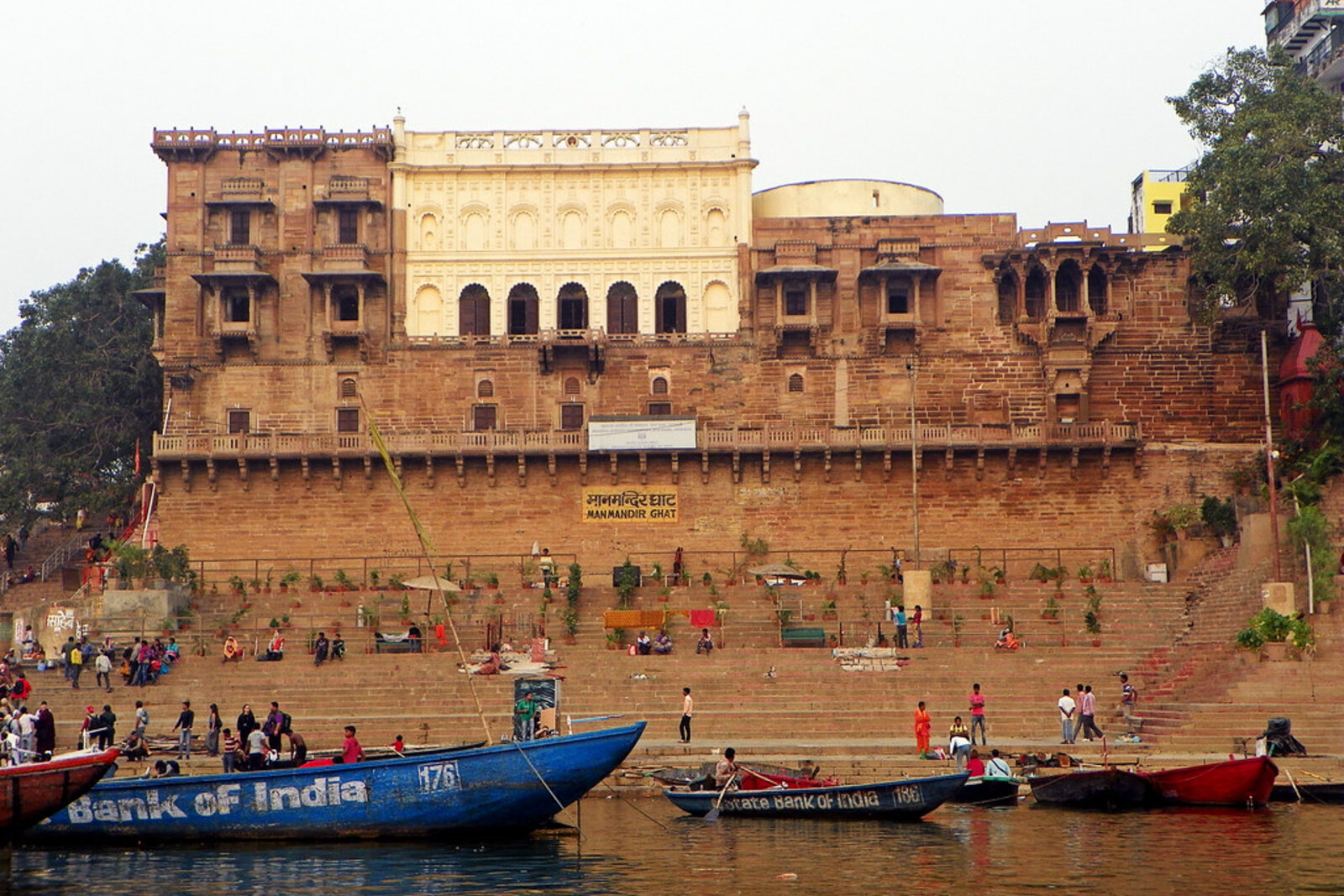
Look around first
What to notice
- The palace above the ghat
- Samrat Yantra
- Digamsa Yantra
- Marble plaque
The story of the place
Above the steps of Man Mandir Ghat stands the palace that Raja Man Singh built above the Ganges together with a temple and a descent to the water. On its roof remain a sloping stone wall, circular platforms, and double marked enclosures. They were not used on their own: an astronomer climbed up here, watched the shadow, and took readings by hand. Below, the palace is still connected to the steps by the river; above, it preserves traces of another daily task—observing the sky.
Sawai Jai Singh II, the ruler of Jaipur and an astronomer, found that the widely accepted Indian, Islamic, and European tables did not agree with observations. The error was especially noticeable when calculating the appearance of the young moon. The dates of religious rituals, eclipses, and important state affairs depended on such calculations, so Jai Singh brought the problem before the Mughal emperor Muhammad Shah. The emperor instructed him to gather Muslim, Hindu, and European experts and bring calculation into agreement with the sky.
Jai Singh decided to compare observations made at several points far from one another. He built five observatories; one was placed in Varanasi, an ancient center of learning. The palace of his ancestor Man Singh, the Raja of Amber and a military commander of Emperor Akbar, already stood here. Around sixteen hundred, Man Singh built a palace above the Ganges and established a ghat and a temple. His name became attached both to the building and to the steps by the water: Man Mandir Ghat is named specifically after Man Singh.
In seventeen thirty-four, Jai Singh ordered an observatory installed on the roof of the ancestral palace. The plan was drawn up by Pandit Jagannatha Samrat, the court astronomer and the ruler's tutor. Small brass instruments could shift and wear out, so Jai Singh and Jagannatha turned the necessary angles and scales into stone walls, arcs, and circles.
Each structure on the roof had a precise function. In the Samrat Yantra, the sloping face of the triangular wall is aligned parallel to the Earth's axis; its shadow falls on marked arcs and shows local solar time. The Digamsa Yantra, with two concentric walls and a central pillar, determined the direction toward a celestial body. The two circular planes of the Nadi Valaya made it possible to mark the equinoxes. Astronomers had to climb above the ghat, watch the shadow, and read the divisions by hand: the stone produced a result only together with the observer's work.
After Jai Singh's death, observations ceased, and the instruments fell into disrepair in the nineteenth century. In nineteen eleven, Sawai Madho Singh II, the ruler of Jaipur, ordered the restoration of his ancestor's observatory. The work was directed by his court astronomer Gokul Chand Bhavan. He restored the form of the scales and walls, so the instruments did not disappear along with the practice for which they had been built.
A museum now operates in the palace, and the large and small Samrat Yantras, the Digamsa Yantra, the Nadi Valaya, and other stone instruments remain on the roof. A marble plaque recording the restoration has been installed on the wall. Below them lie the steps named after Man Singh, who built the palace here more than a century before its roof was needed by astronomers.
Useful on site
The ghat itself is accessible as a public space; interior access to individual upper sections and viewing areas is not guaranteed and may depend on the site's current operating arrangements and actual condition.
Checked: June 17, 2026. Check the official source before visiting.The instruments cannot be seen in full from the lower steps. Visiting the roof is a separate part of the site; check access to it separately rather than relying on passage through the ghat.