 Guide On Map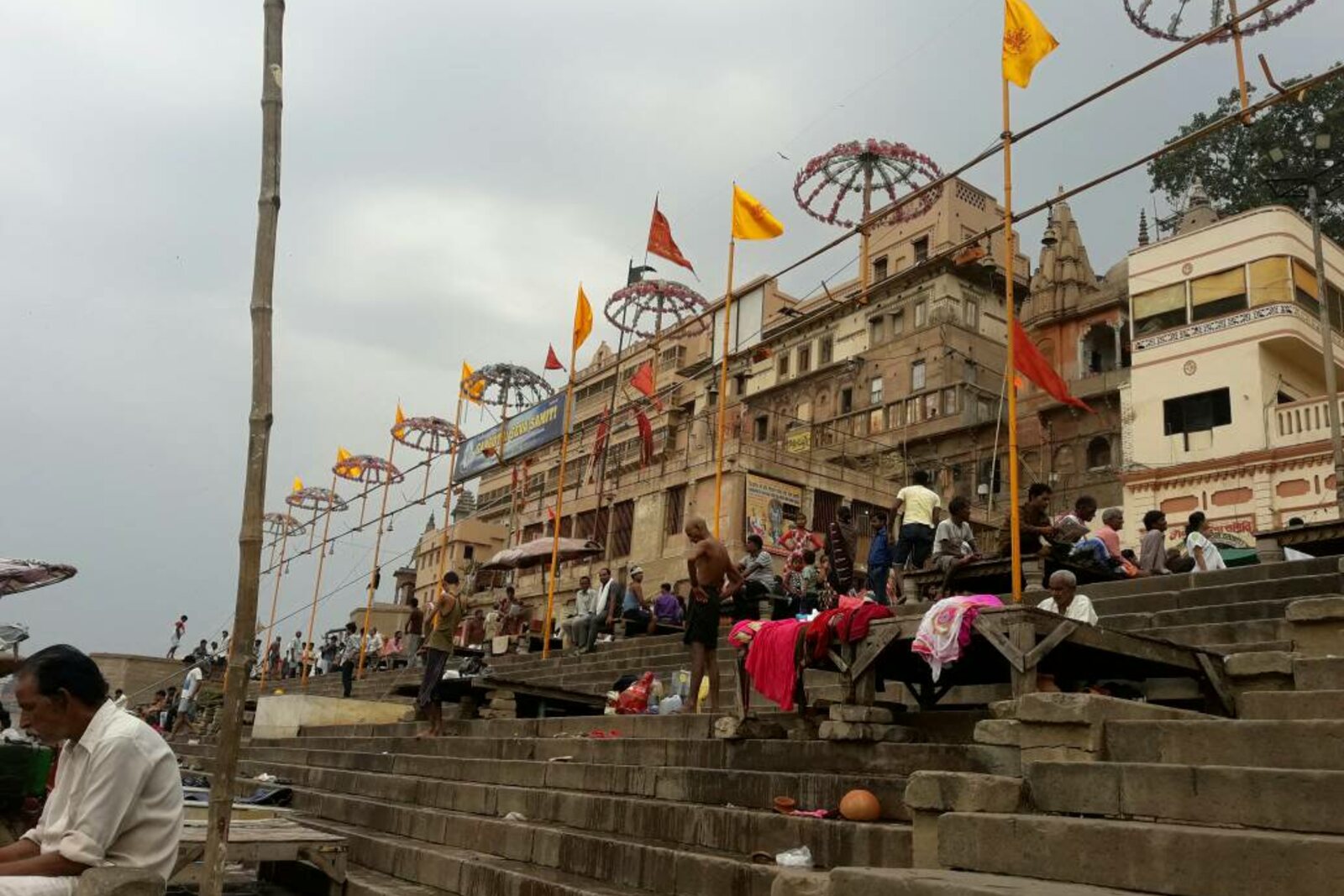
Look around first
What to notice
- Wide steps
- Platforms for arati
- Large multi-tiered lamps
- Shri Ram Temple
The story of the place
The riverside staircase connects the temple quarter of Varanasi with the Ganges; pilgrims descend it to the water before visiting Kashi Vishwanath Temple. Broad stone steps are interrupted by platforms, Shri Ram Temple stands above them, and during floods the lower tier is under water. The ghat's name refers to a religious tradition: Brahma performed ten royal horse sacrifices here in honor of Shiva's arrival in Varanasi, although no chronicle confirms this.
The large evening ceremony on these steps emerged quite recently. In nineteen ninety-one, Pandit Satyendra Mishra—a scholar-brahmin and expert in rituals—led local priests who had decided to perform morning and evening arati here every day. Worship of the Ganges itself had existed long before them; Mishra gave it its present public form, with a line of performers and large multi-tiered lamps.
He was a man of this particular ghat. Mishra was born in nineteen fifty-one into a family of pandits, graduated from Banaras Hindu University, and lived at Shri Ram Temple directly above Dashashwamedh Ghat. The family's social standing depended on knowledge of sacred texts, conducting rituals, and the trust of pilgrims. Here he was known as Munnana Maharaj.
According to the foundation he created, Mishra and his like-minded associates were concerned that townspeople were increasingly treating the Ganges as an ordinary river. They chose arati—the offering of light to a deity. In a temple, fire is carried before an image of a god; at the ghat, priests turn the lamps toward the water itself, because the Ganges is a goddess for believers. The performers' identical movements allow the thousands assembled to take part in one ritual, even if they stand far away on the steps or sit in boats.
Mishra called the organization “Ganga Seva Nidhi”—a foundation for service to the Ganges. The service did not end with the ceremony. Participants pulled flower offerings, plastic, and other trash from the water, tried to stop discharges from drains, and after floods cleared away silt left by the river. At first they worked only at Dashashwamedh Ghat, then expanded to other stretches of the riverbank. An image of their evening arati appeared on state tourism posters, and the ritual became one reason enormous crowds come here every evening.
Mishra also chose this ghat because pilgrims had long descended to the river here before visiting Kashi Vishwanath Temple. The name itself explains the reverence for this spot. “Dasha” means “ten,” “ashva” means “horse,” and “medha” means “sacrifice.” According to legend, Brahma performed ten ashvamedhas—royal horse sacrifices—here in honor of Shiva's arrival in Varanasi. In such a ritual, a horse was released to wander under the guard of warriors; whoever stopped it challenged the king's claim. The story of the ten rituals is religious tradition, not a verified chronicle.
Satyendra Mishra died in two thousand thirteen. His son Sushant took charge of the foundation, while the organization's address remained the same: Shri Ram Temple above Dashashwamedh Ghat. During a flood, when the lower steps and platforms go under water, the performers move the arati higher, sometimes onto the roof of this building. The lamps then rise to the place from which the Mishra family once brought the ceremony down to the river.
Useful on site
Public ghat, usually accessible around the clock; for evening ceremonies and major religious days, crowds increase sharply, passageways may become crowded in advance and be regulated in places.
Checked: June 17, 2026. Check the official source before visiting.During arati, do not block the passageways and leave participants space to work. A place in a boat is a separate service, the terms of which should be discussed directly with the boatman you choose.