 Guide On Map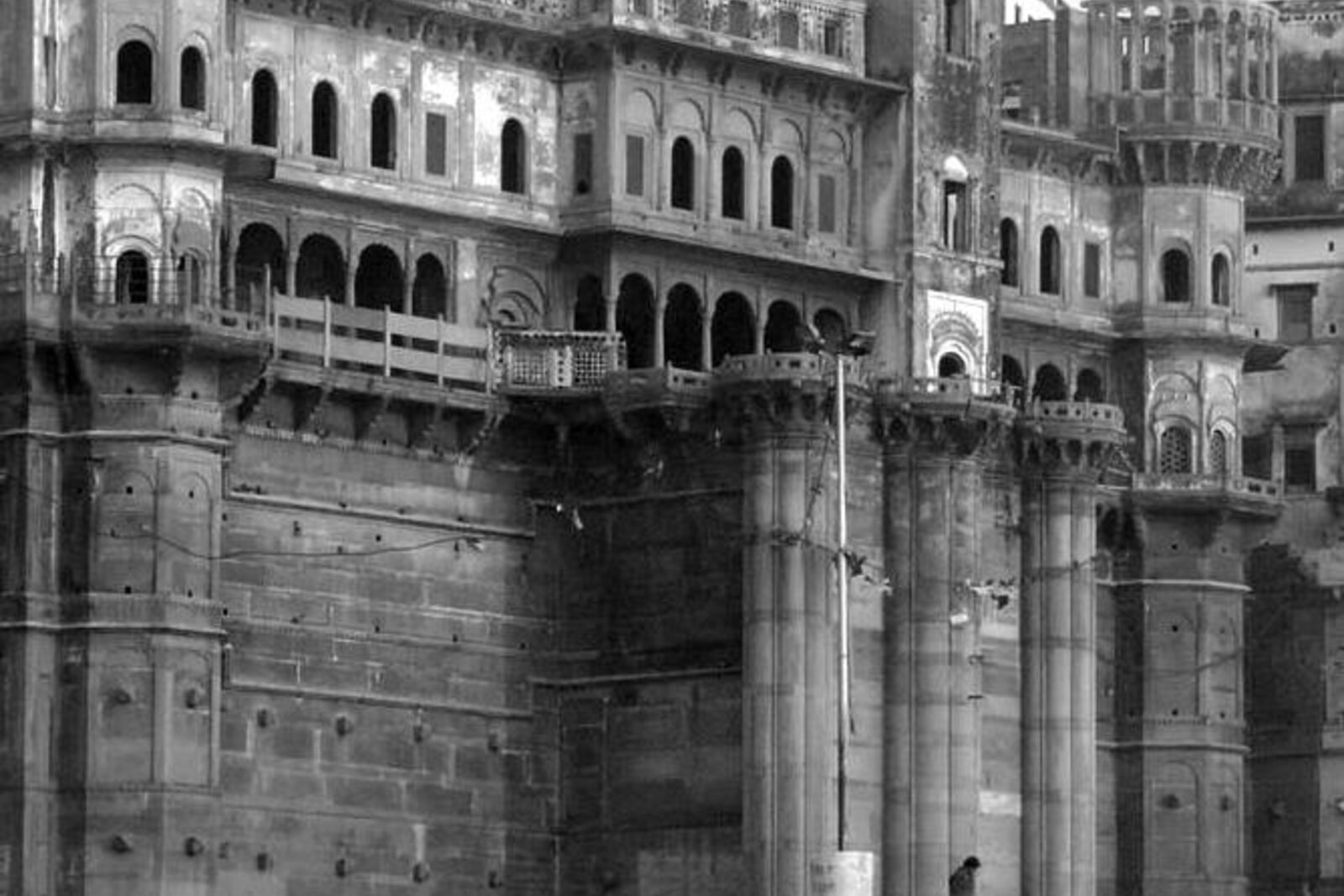
Look around first
What to notice
- Sandstone palace facade
- Stone steps
- Palace arches
- River entrance
The story of the place
The sandstone facade rises above the stone steps; its arches mark the stories of the former palace facing the Ganges. Old lanes have squeezed it so tightly from the city side that a car cannot get through to the river. A boat remains the way to reach this entrance: from the water, people once went here into the palace, to the temple, and to bathe. Now hotel guests are brought to the staircase, and a lift takes them up.
In eighteen twelve, Shridhara Narayana Munshi left his post at the court of the Bhonsle in Nagpur and settled in Varanasi. Before that, he had lived through his service: he managed the finances of the Maratha state, meaning that he administered the raja’s revenues. On the bank of the Ganges, the former minister built a stone descent to the water, a temple, and a fortified sandstone palace. The ghat was named after him—Munshi Ghat. He lived in Varanasi for another twelve years and died here in eighteen twenty-four.
The steps served as the river entrance to his estate. From a boat, they led into the palace; one could also descend to bathe or walk to the temple. From the side of the old city, the palace is hemmed in by narrow lanes, so the facade facing the Ganges was ceremonial, and the ghat was its landing place and staircase.
In nineteen fifteen, the palace was acquired by Rameshwar Singh Bahadur, the maharaja of the princely state of Darbhanga in Bihar. His builders added a second story, new decorations, and a lift: the owners and guests somehow had to be raised from the water itself to the residence on the high bank. The purchased and enlarged section of the ghat came to be called Darbhanga Ghat—after the maharaja’s domains. The old name did not disappear: the neighboring section of steps remained Munshi Ghat. Thus one palace staircase received two names from two owners.
After Rameshwar Singh’s death, the palace gradually fell into disrepair. In nineteen ninety-four, a hotel company acquired it. Arvind Kumar, who undertook to return the building to use, commissioned the strengthening of the walls, the rebuilding of damaged arches and ceilings, and the restoration of the interior murals. The work continued for nearly two decades; in two thousand sixteen, the BrijRama Palace hotel opened here.
Cars still cannot reach the river facade through the narrow streets. Guests are brought along the Ganges, set down at the palace steps, and taken up to the hotel by lift. The river entrance for which Munshi built the ghat once again leads inside; the names of Munshi and Darbhanga have remained on neighboring sections of the staircase.
Useful on site
The ghats themselves are accessible as public space; entry into the palace’s interior spaces and private areas is not guaranteed and depends on the buildings’ actual use.
Checked: June 17, 2026. Check the official source before visiting.The facade can be seen from the riverfront, but the building is used as a hotel. The interiors and balconies are not part of the unrestricted route and require separate agreement with the owners.