 Guide On Map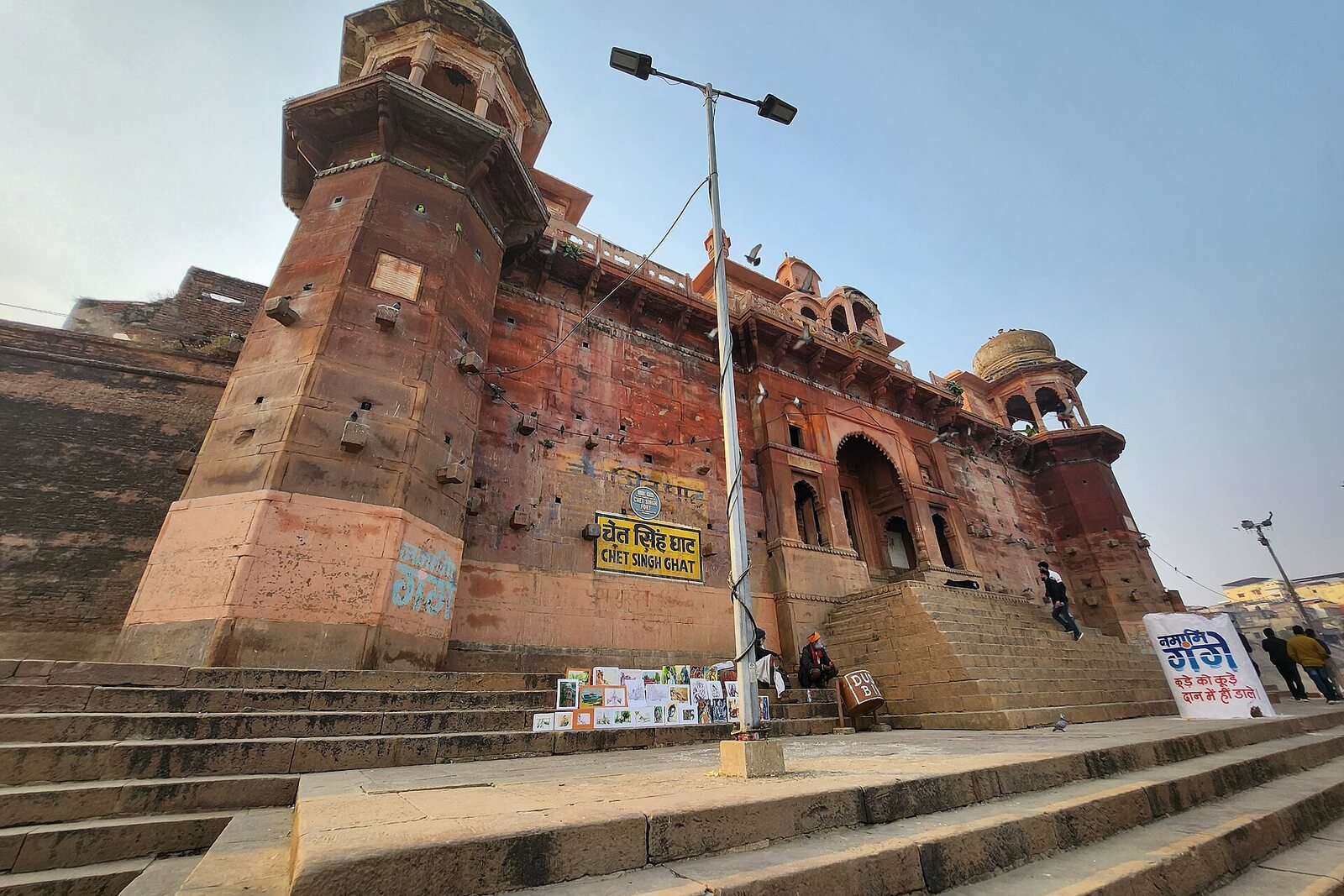
Look around first
What to notice
- The palace's red walls
- Monumental gates
- Corner pavilions
- Octagonal domes
The story of the place
On August sixteenth, seventeen eighty-one, Chet Singh left his residence above this ghat, a stepped descent to the river, over the river-facing wall. A rope was tied from turbans and lowered to the Ganges, where a boat was waiting for the raja below. By then, the gates had been blocked by soldiers sent to arrest him.
Chet Singh was the hereditary ruler of Benares and the extensive area around the city. Land revenues supported his court and army, and from them he also paid an annual tribute. In seventeen seventy-five, the ruler of neighboring Awadh transferred control over Benares to the British East India Company, a trading corporation with its own army. The Company confirmed Chet Singh in possession of his territories and set a fixed payment.
The two sides understood this arrangement differently. Chet Singh regarded the set sum as the limit of his obligations. Warren Hastings, the Governor-General of Bengal, treated him as a dependent landholder who could be required to provide additional money and soldiers. The Company was fighting wars, and from seventeen seventy-eight onward Hastings demanded, three times, an additional five lakh rupees—half a million—on top of the usual tribute. Chet Singh paid late, objected, and did not provide as much cavalry as was demanded of him.
Hastings decided to punish the raja in person and came to Benares. Chet Singh received him submissively: he took off his turban and placed it on the Governor-General's knees, placing himself at his mercy. The gesture proved insufficient. The following morning, a Company representative came to this palace and declared its master under arrest.
Chet Singh did not resist. He offered to surrender his lands, forts, treasury, and even his own life, but asked for the guard to be withdrawn. For a hereditary ruler, imprisonment in front of his subjects meant the loss of honor and, with it, the ability to collect payments and command men. Hastings reinforced the guard.
Supporters of the raja began gathering around the palace. Chet Singh himself tried to calm them at least twice. That is why the later account of an uprising prepared here in advance is too certain: historians still dispute whether the raja directed the first attack. Something else is established. A crowd burst into the courtyard, while two companies of sepoys—Indian soldiers in the Company's service—were out of ammunition. Almost the entire guard, together with the British officers, was killed.
In this confusion, Chet Singh reached the wall above the river, climbed down by the rope of tied turbans, and crossed to the other bank. Already from his refuge, he sent Hastings a letter assuring him of his submission. The Governor-General refused to reply and then fled from Benares himself to Chunar Fort.
His escape did not restore Chet Singh's possessions. The Company sent reinforcements, defeated the forces assembled by his supporters, and put his nephew on the throne, increasing the annual payment to almost twice its former amount. Chet Singh went to Gwalior and lived there in exile until his death in eighteen ten. Hastings returned to Benares; later, the raja's arrest became one of the charges at his lengthy trial in Britain, which ended in acquittal.
The palace and the ghat remained with the British. In eighteen ninety-five, Prabhu Narayan Singh, a descendant of the rajas of Benares, returned the residence to the family, and the name of Chet Singh became attached to this section of the riverbank. Today, people once again descend the steps to the Ganges for bathing, while above them stand the palace's red walls, monumental gates, and corner pavilions beneath octagonal domes.
The exact place where the rope of turbans was secured is not marked. The spatial connection itself remains: the palace terrace above the Ganges, the wall, the ghat at its foot, and boats below. Chet Singh lost Benares forever by escaping from here to the river; his name returned to these steps before the palace returned to his family.
Useful on site
Public ghat, usually accessible around the clock; individual stairways and platforms may be temporarily occupied by local activities and trade.
Checked: June 17, 2026. Check the official source before visiting.The main features are clearly visible from outside, from the steps, or from the river. Do not take an open passage as an invitation into the residence's interior rooms.