 Guide On Map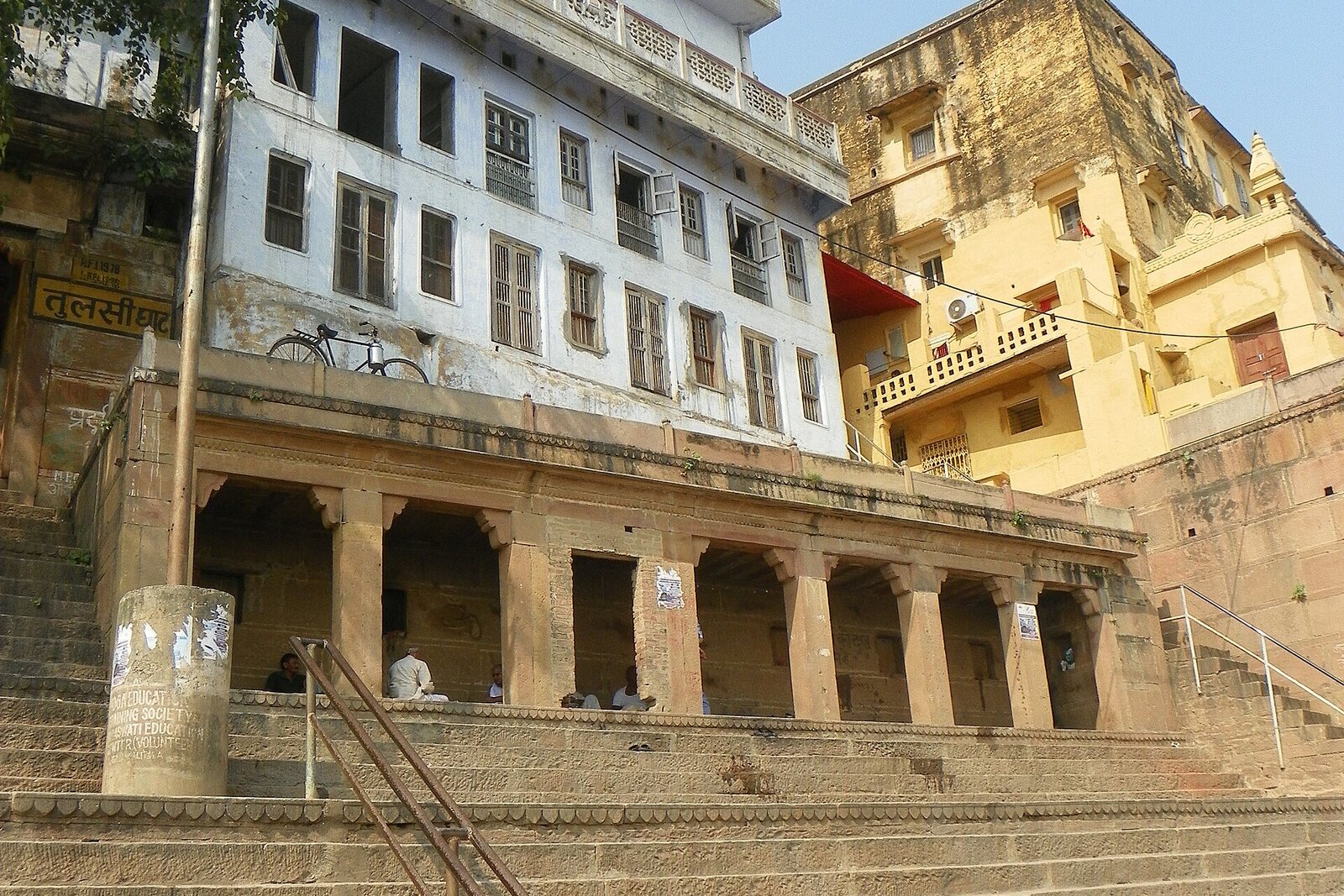
Look around first
What to notice
- The ghat steps
- The small Hanuman Temple
- The rooms above the steps
The story of the place
The steps here descend to the river, and above them stand close together the small Hanuman Temple and the rooms of the temple community. In these rooms, a family of local temple custodians kept a collection of old texts and relics handed down to them by the closest circle of a revered poet. One of the copies was long thought to have been written in his own hand, but the custodians knew otherwise: it was an early copy made after his death.
This stretch of riverbank was once called Lolark Ghat. Its present name is associated with Tulsidas, a monk-poet who retold Rama's story in Awadhi, understandable far beyond the circle of Sanskrit scholars. He spent his final years here. Local tradition links the rooms above the steps with work on the Ramcharitmanas, while the Hanuman Temple and the akhara wrestling school trace their origins to Tulsidas himself.
After the poet's death, his disciples handed the collected texts over to a family of local temple custodians. Among them was a mid-seventeenth-century manuscript of the Ramcharitmanas. It was often called authorial, although the custodians themselves clarified that Tulsidas did not write it: it was an early copy made after his death. At this stop, the distinction matters. What people preserved here was not the handwriting of a famous poet, but a text that had passed through his closest circle.
On December twenty-second, two thousand eleven, a priest locked the temple after the afternoon service. Three hours later, he found the bolt on the back door torn off. The manuscript had disappeared along with the temple relics.
Veer Bhadra Mishra was responsible for the collection—a mahant, meaning the head of the temple community, and the hereditary custodian of the family collection. He earned his living as a professor of hydraulic engineering at Banaras Hindu University, while here he was responsible for the items his ancestors had received from Tulsidas's disciples. After the theft, both the safety of the collection and the family's reputation were called into question.
Mishra's two sons set out across the country to look for the manuscript. They traveled through twenty-five cities and also collected other old copies of Tulsidas's works. Meanwhile, the missing volume remained in Varanasi itself. Seven months later, police detained two men in an alley near Gopal Temple and returned the stolen items.
After that, the family placed the manuscript and relics in a fireproof, bulletproof safe weighing about three hundred kilograms. They are no longer displayed on ordinary days. The safe is opened to the public only once a year, on Tulsidas's birthday. Above the steps still stands the small Hanuman Temple; the poet's name can always be read on the ghat, the stepped riverbank, but the old manuscript for which the temple's back door was broken into is almost impossible to see.
Useful on site
Public ghat, usually accessible around the clock; on days of major rituals and morning bathing, some sections may be more crowded than usual.
Checked: June 17, 2026. Check the official source before visiting.Lolark Kund is narrow and deep: approach the edge carefully and do not disturb those taking part in the ritual. During Nag Nathaiya, spectators fill the riverbank and the boats.