 Guide On Map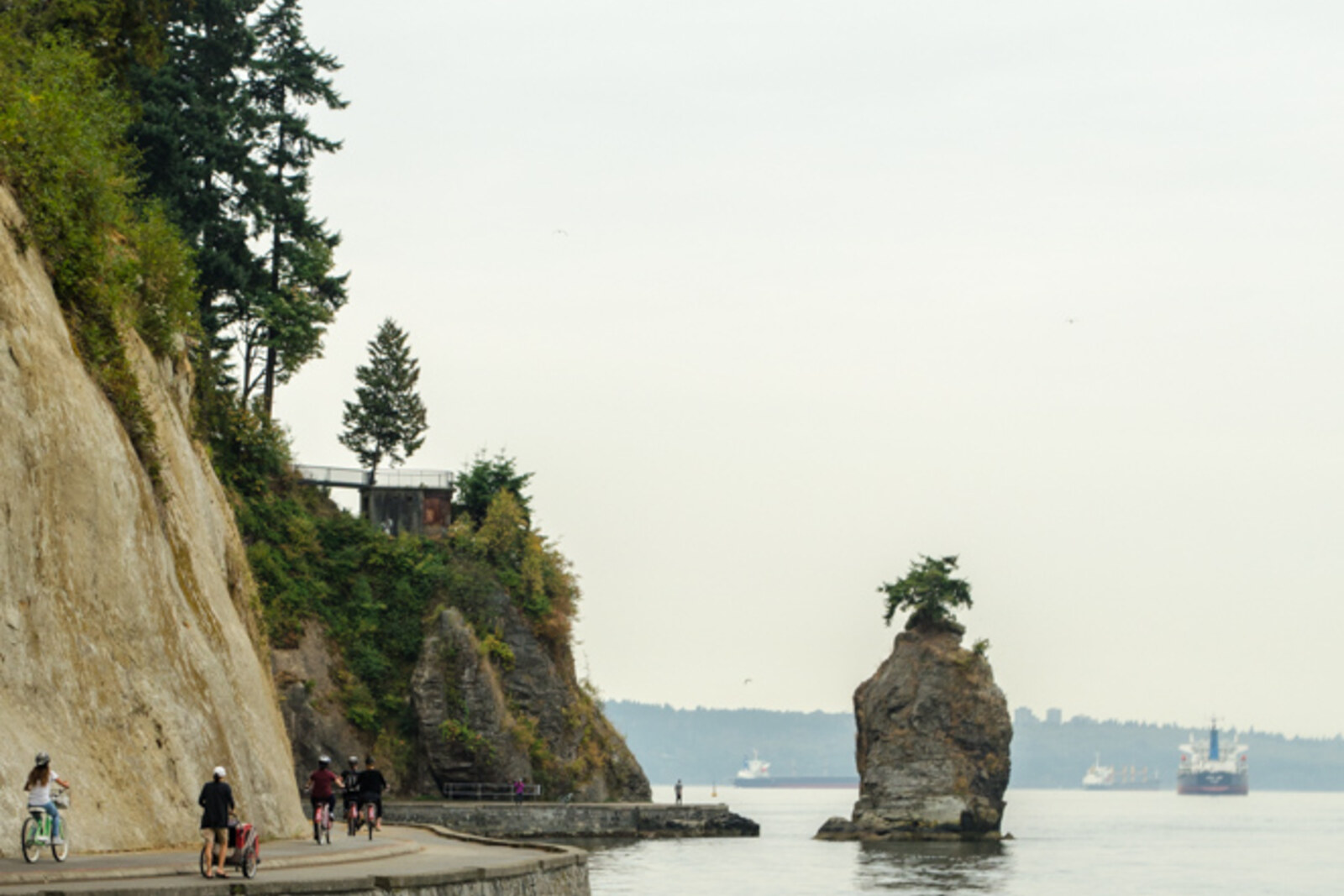
Look around first
What to notice
- Stone pillar by the water
- Two neighboring boulders
- Plaque with the names
The story of the place
Before the western cliff stands a fifteen-meter sea stack. About thirty-two million years ago, molten rock solidified here amid sandstone. Waves gradually eroded the softer cliff, while the sturdy stone pillar remained apart from the shore.
On maps, it is marked as Siwash Rock: the first word came from the Pacific Coast trade jargon and meant an Indigenous person. The Squamish people have a more precise name—Skalsh, “the standing man.” This name refers to a legend. A plaque by the rock calls him Skalsh the Selfless, transformed into stone by Q'uas the Transformer.
In the detailed version of the legend recorded by Pauline Johnson, Skalsh was a young chief, hunter, and warrior. When his wife was preparing to give birth, the couple came to the water at the mouth of the inlet. By custom, parents-to-be had to purify themselves by bathing: the rite was considered complete when even a wild animal could not smell a human presence. His wife soon left to give birth beneath the trees, while Skalsh continued swimming for the sake of the child.
A boat with four messengers of the supreme spirit was approaching along the inlet. They could turn living beings into fish, a tree, or a stone, and they demanded that he clear their path. Skalsh refused to come out of the water. He knew what he was risking, but an interrupted rite would mean that the child would begin life with the father’s impurity.
The messengers could not touch the swimmer with an oar or the boat: contact with a person would deprive them of their supernatural power. Skalsh remained in their path. While they were deciding what to do, the child was born. Then the senior messenger saw the reason for the disobedience and declared the transformation a reward: the father who had placed the child’s future above his own fate would stand here forever. When Skalsh reached the shore, he became stone. According to the same legend, his wife and infant were turned into two nearby boulders so that the family would not be separated.
Right beside the Stanley Park Seawall, a solitary stone pillar still stands, and the plaque still bears the names of Skalsh and Q'uas.
Useful on site
Open portion of Stanley Park; park hours are usually 06:00-22:00. Before counting on this section, check current detours on the Stanley Park Seawall and closures due to rock climbing.
Checked: June 26, 2026. Check the official source before visiting.View the rock from the permitted path: there is no need to descend to the water or try to approach it over the rocks here.