 Guide On Map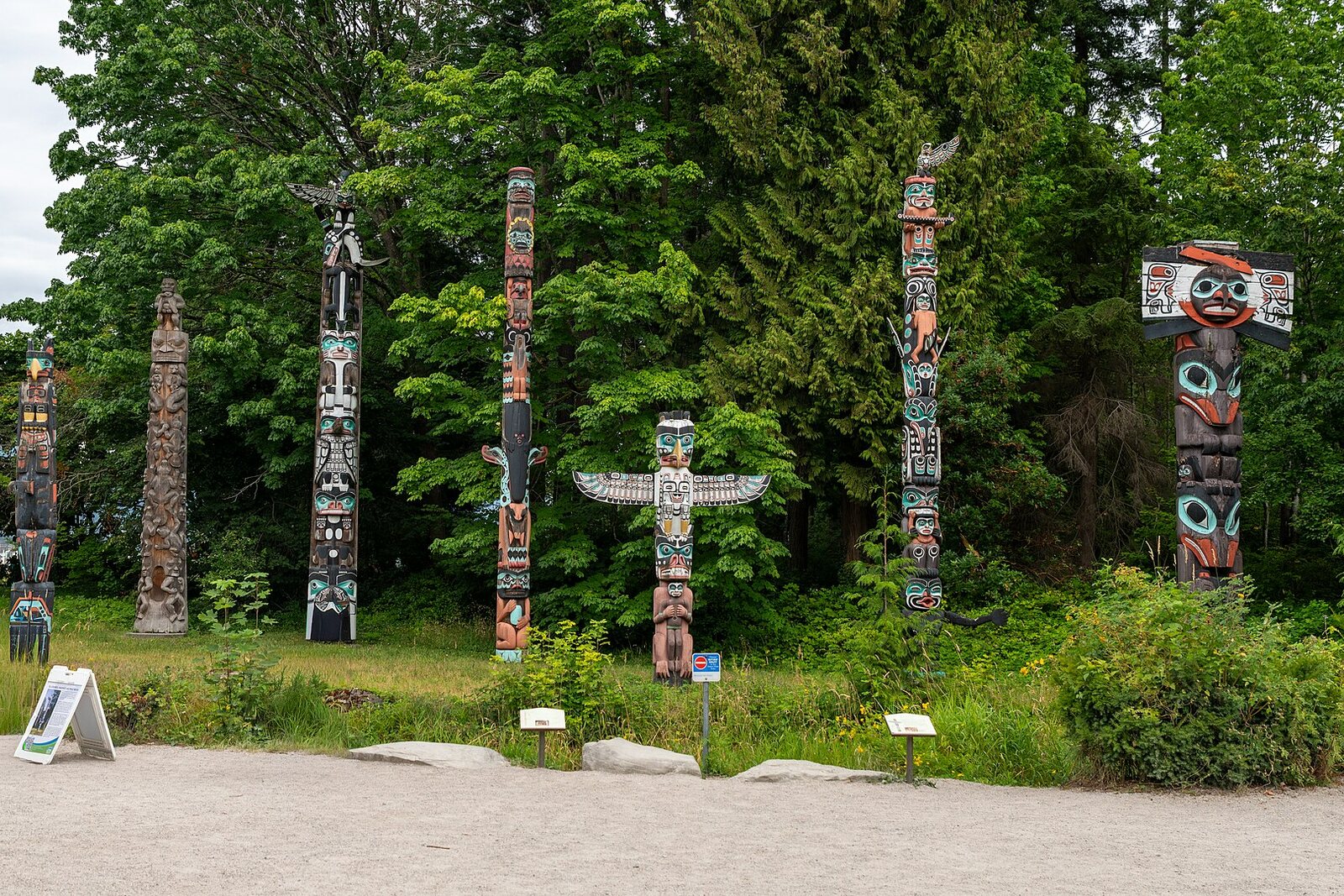
Look around first
What to notice
- Carved wooden poles
- Painted figures
- Open plaza
The story of the place
The row of totem poles at Brockton Point took shape as a park attraction for visitors: carvings were brought here from the north and central part of the coast. Later, the collection was moved to an open plaza so visitors could approach the poles more easily; over time, the old wooden originals went to museums, while copies and new works by artists from different peoples remained outdoors. The painted figures on carved wooden trunks show that this row follows rules other than museum rules.
In the nineteen forties, Ellen Neel sold small carved poles near Brockton Point. She was a Kwakwaka'wakw carver and learned carving from her grandfather in Alert Bay. After her husband suffered a severe stroke in nineteen forty-six, her work became the only income for a large family. Among the professional carvers of her time, Neel was the only known Indigenous woman. Customers in the park enabled her to support her children through her craft.
By then, the Vancouver Park Board was already collecting totem poles for visitors. In nineteen twenty-four, its staff bought four poles in Alert Bay, on the north of Vancouver Island, and installed them by Lumberman's Arch. Later, they added works from Haida Gwaii and Rivers Inlet. Officials at the time preferred them to local Coast Salish carving: poles from the northern and central coast seemed more spectacular to them for tourists. Neel first sold her work near Brockton Point, then beside the collected poles at Lumberman's Arch.
In those years, the federal government banned the potlatch—ceremonial gatherings with gifts, speeches, and confirmation of family rights, during which such poles could be raised. The ban was lifted only in nineteen fifty-one. Tourist demand gave Neel commissions throughout that time. She opened a family workshop, Totem Art Studios, at Ferguson Point. Her children learned from her, carving and painting works alongside their mother.
In nineteen fifty-five, Woodward's department store commissioned the family to make five large poles for a shopping center in Edmonton. Ellen made one of them, the six-meter Kakasolas, with the help of her three sons. The pole is known by its name in the Kwakwaka'wakw language: “Kakasolas” means “people come from afar for her advice.” A Thunderbird with a whale on its chest occupied the top, and a raven was carved at the base. The work was installed outside the store in Edmonton.
In the early nineteen sixties, the Vancouver Park Board moved the entire collection to Brockton Point for easier visitor access. Ellen Neel died in nineteen sixty-six and did not see her own work join this row. In nineteen eighty-four, Woodward's gave Kakasolas to the Museum of Anthropology at the University of British Columbia. Ellen's son Robert, by then a carver himself, restored his mother's work. A year later, it was raised at Brockton Point—where Ellen had once sold her small poles. The old wooden originals were later given to museums, while copies and new works by artists from different peoples were placed outdoors.
Kakasolas stood here for almost forty years. When the wood aged and carpenter ants were found in it, Ellen's family asked for the pole to be returned to the museum and for the agreement with the park not to be renewed. On September fourth, twenty twenty-four, it was lowered and taken away. Kakasolas is no longer in the row at Brockton Point: Ellen Neel's work is at the Museum of Anthropology.
Useful on site
Open part of Stanley Park; park hours are usually 06:00-22:00, unless otherwise stated.
Checked: June 26, 2026. Check the official source before visiting.Do not limit yourself to a general photograph: walk around the plaza and read the available labels for individual works.