 Guide On Map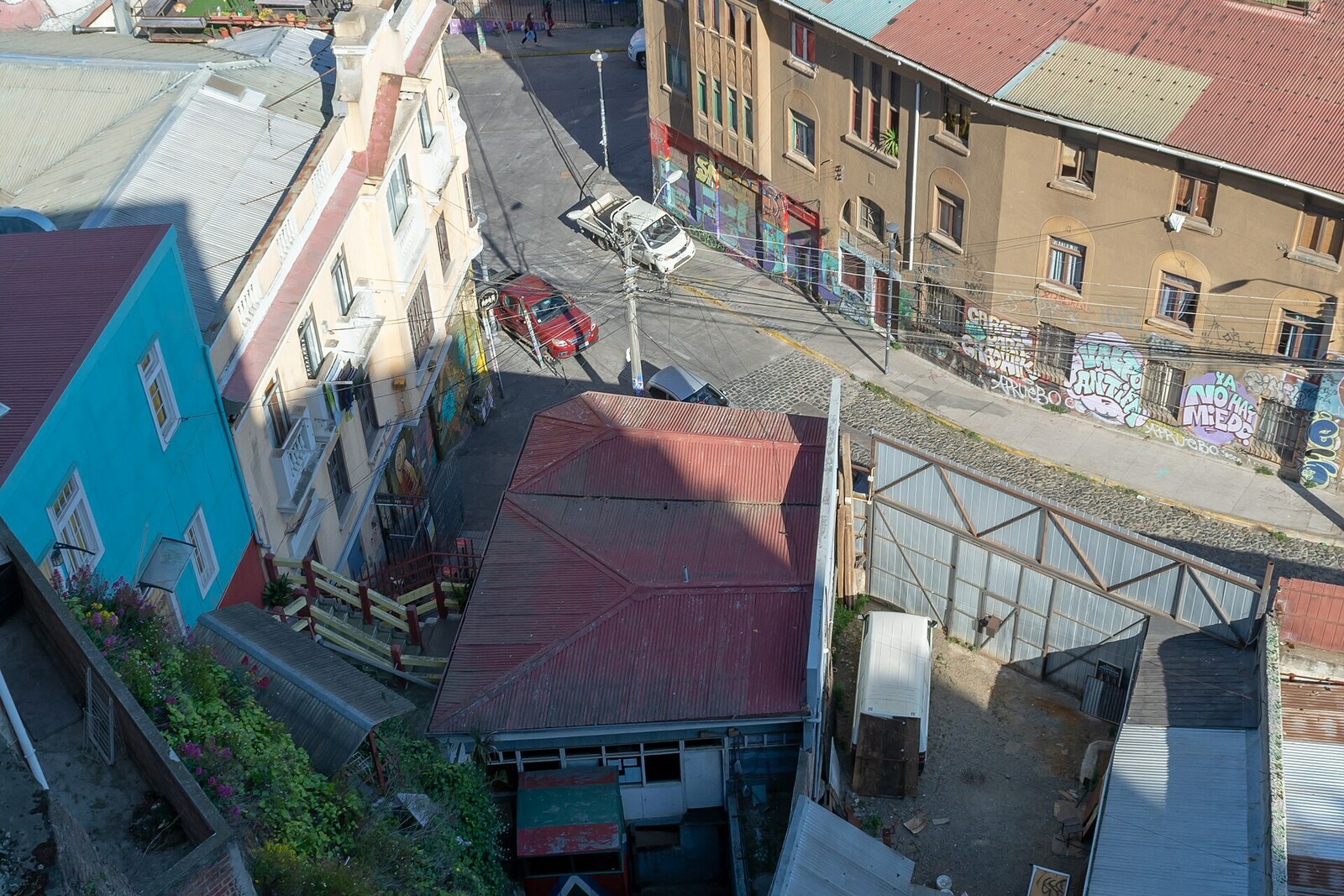
Look around first
What to notice
- Two rail tracks
- Upper station
- Bridge above the slope
- House beside the passage
The story of the place
Paseo Dimalow runs from the upper station of Ascensor Reina Victoria to Almirante Montt Street, and above the steep slope the route continues by bridge. The house beside the passage belonged to a tradesman who made his living from contracts for gas pipes, plumbing, and household bells; his surname remained in the name of the passage. Elías Alley lies below, with two rail tracks running between it and the station, so the funicular’s entire route can be read in full. Water no longer serves as a counterweight for the cars: an electric motor has replaced it.
Federico Page came to this slope with the daily passenger in mind. Valparaíso’s population was moving up into the hills, while institutions, shops, and the port remained on the flat—the city’s level lower part. Page made money from paid funiculars: the money invested had to come back a few coins at a time, with every ride.
Together with Manuel Valenzuela, he laid two rail tracks across private land from Elías Alley to Paseo Dimalow. The line was short—about forty meters—but its gradient reached fifty-seven degrees. The first cars were moved by a water counterweight. Workers filled a tank beneath the upper car; the heavier cabin descended and pulled the other one upward by cable. At the bottom, the water was drained and then pumped back to the upper station. Every trip required passengers, water, and people at both ends of the line.
On March fourth, nineteen oh three, Page opened the ascensor. It became the second funicular serving Cerro Alegre and neighboring Cerro Concepción. Residents gained a direct descent to the city center, while Page gained a profitable extension of his business. Over the next thirteen years, he was already operating six funiculars in Valparaíso. Not even the earthquake of nineteen oh six stopped his new projects.
The line was named in memory of the British Queen Victoria, who had died two years before it opened. The Queen herself had never visited Valparaíso. This posthumous dedication was chosen because many people from Britain lived nearby. In that same year, nineteen oh three, the British community installed a memorial organ to Queen Victoria in the nearby St. Paul's Church. The name Cerro Alegre is also linked to the homes of English settlers: their gardens gave the slope the “cheerful” appearance for which the hill came to be remembered.
Page brought the upper station out to an existing passage and linked it to the station by a bridge. The passage was built in eighteen seventy and named after James Dimalow’s surname. In the city’s English-language newspaper, his name was printed as James Dimalow. He made his living from contracts for gas pipes, plumbing, and household bells, and sold light fixtures and paraffin lamps. In eighteen sixty-seven, Dimalow installed the first lighting on Victoria Square, and later built a house here for his family, beside the future upper station. This house survives, and the townspeople attached its owner’s surname to the entire passage.
Paseo Dimalow remains a short pedestrian link between the ascensor and Almirante Montt Street. An electric motor replaced the water tanks, but Page’s arrangement can still be read in full: Elías Alley below, two rail tracks on the slope, and above them the station, bridge, and passage named after the gas fitter’s house.
Useful on site
Streets and the promenade are open; the Ascensor Reina Victoria page lists service from 7:00–21:30, status “operating,” and a fare of 200 pesos for locals and 1000 pesos for foreign tourists.
Checked: June 24, 2026. Check the official source before visiting.Check that the line is operating before descending, and do not approach the tracks outside the passenger area. If the ascensor closes, choose an accessible, busy pedestrian route.