 Guide On Map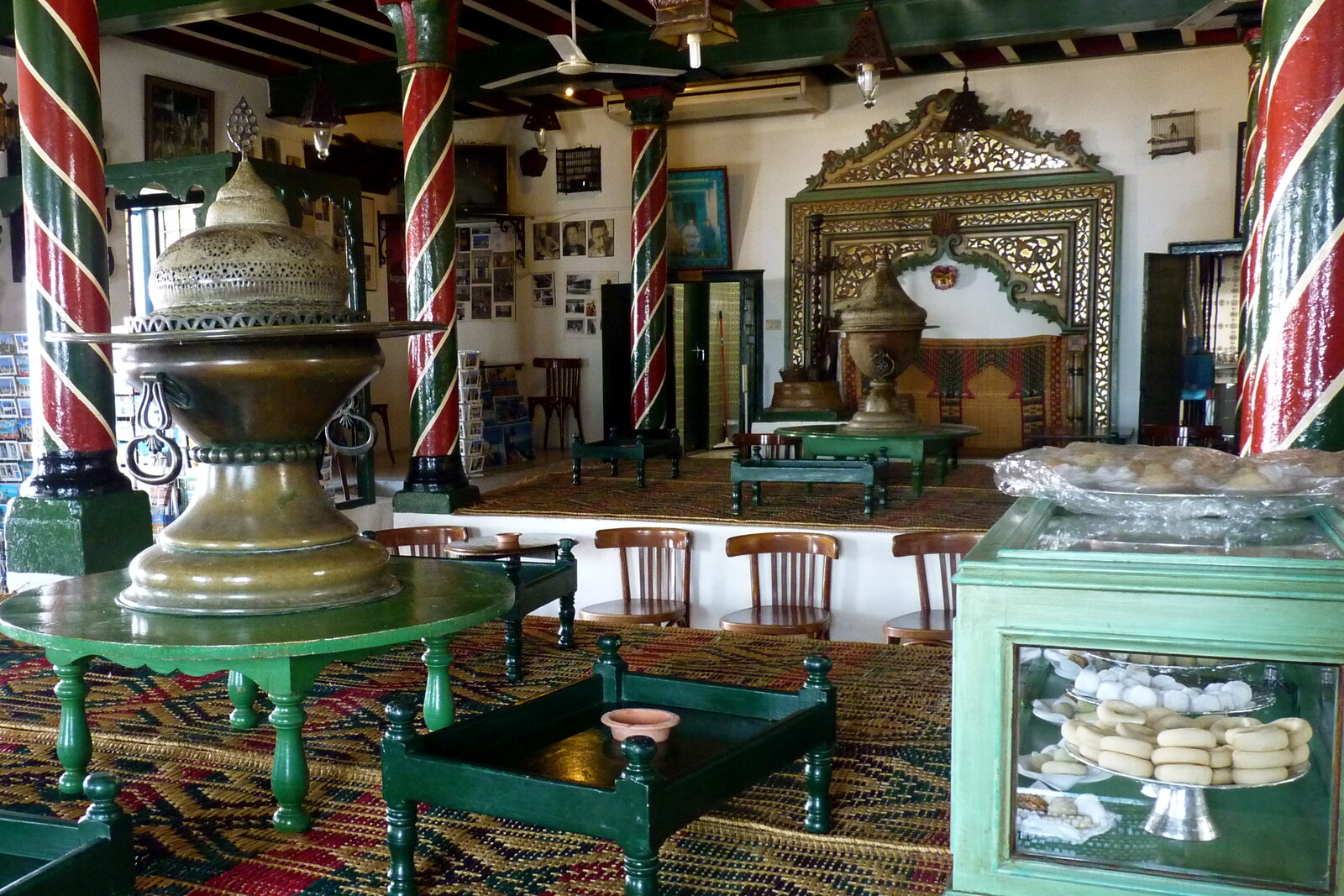
Look around first
What to notice
- Wide staircase
- Covered entrance
- Colorful woven mats
- Stone benches
The story of the place
At the lower steps of the ascent is a café that locals call Kahwa al-Aliya, the upper café. The French name, Café des Nattes, comes from the colorful woven mats: regular visitors settled on them beside the stone benches. The covered passage below and the room with mats keep the café within this stairway space, and above there is a terrace with a view over the village.
Before tables appeared, the wide staircase served as the ceremonial entrance to the mosque and the zawiya—the sanctuary at the tomb of Sidi Bou Said. In the early eighteenth century, Husayn Bey ibn Ali, ruler of Tunis and founder of a new dynasty, sought recognition from religious scholars and the patronage of revered saints. He ordered a mosque, a minaret, and a zawiya built around the tomb, along with this stairway entrance to them.
Coffee formed part of the rituals of Sufi brotherhoods, so it was probably served at the sanctuary even then. Later, the space was occupied by a café. Tunisians call it “Kahwa al-Aliya”—the upper café. The French name, “Café des Nattes,” means “the café of mats”: regular guests sat on colorful woven mats and stone benches. The staircase explains why the café is here: it occupied the sanctuary’s former threshold.
In April nineteen fourteen, the German artist August Macke sketched the lower part of this staircase. He was looking for a way to build a painting with pure colors, but could not afford a trip to Tunisia. Five hundred marks were offered by Bernhard Koehler, a Berlin manufacturer, collector of new painting, and the uncle of Macke’s wife. At that time, not a single museum had yet bought a single painting from the artist; his work depended on a few private patrons.
Macke was guided through Tunisia by the Swiss artist Louis Moilliet, who already knew the country. It was Moilliet who later clarified that Macke’s album included the covered entrance at the foot of the stairs leading to the famous Café des Nattes. The artist recorded it in considerable detail, but after returning to Bonn, he discarded almost all the details. In the painting Turkish Café, only a blue wall, a green figure at a table, a red fez, a yellow chair, and a doorway made of orange and violet planes remained. Macke painted two versions and gave one to Koehler, who had paid for the journey.
He had only a few months to work on the Tunisian sketches. After the start of the First World War, Macke was mobilized, and on September twenty-sixth, nineteen fourteen, he was killed in France at the age of twenty-seven. His wife, Elisabeth, was left with two young sons and took up the preservation of her husband’s paintings.
Koehler’s version is now in Munich’s Lenbachhaus. What remains in Sidi Bou Said is the spatial connection itself: the covered entrance recalled by Moilliet stood at the bottom step of the present ascent. The room with mats and the view from the upper terrace did not make it into Macke’s painting.
Useful on site
Private coffeehouse. Commercial guides publish long daily hours, but because it is privately managed and there have been past disputes over the terraces, it is more reliable to check the hours, prices, and access on the sign there.
Checked: June 29, 2026. Check the official source before visiting.The staircase remains a passageway, even when visitors are sitting on it. Ordering tea is not necessary; if the café is closed or full, inspect the entrance from the square.