 Guide On Map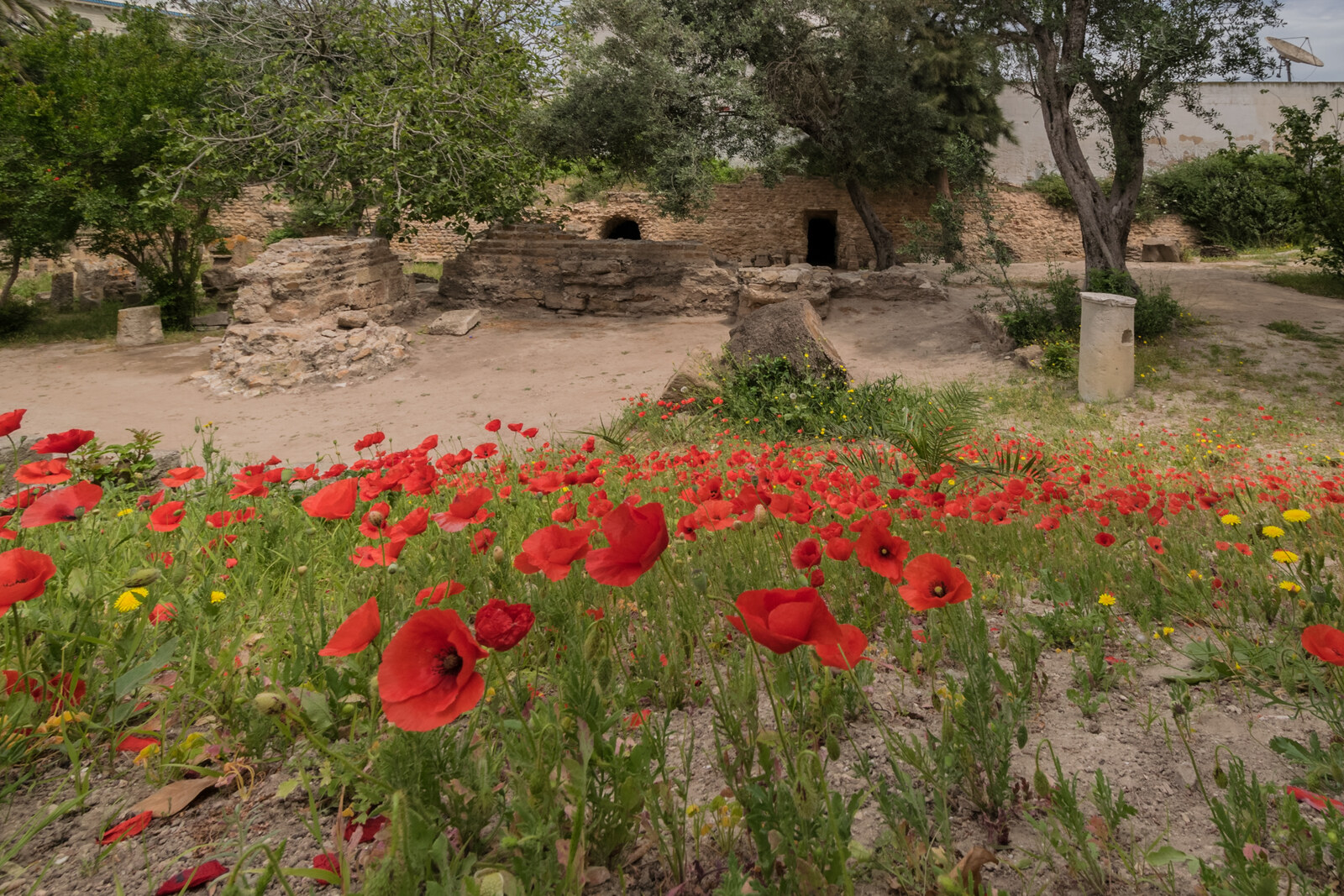
Look around first
What to notice
- Stone stelae
- Ceramic urns
- Inscriptions on the stelae
The story of the place
The Tophet of Salammbô is an excavated sanctuary. In December nineteen twenty-one, Paul Gielly, a municipal employee of Carthage, was offered a limestone stela more than a meter high. Gielly collected antiquities in his time off from work. Carved on the stone was a man in a long garment and a headdress considered priestly; in the crook of his arm, he held a swaddled child.
The stela had been obtained secretly. Such finds were sold one at a time, and no one recorded the depth at which they had lain or the objects beside them. Gielly discovered the excavation site and invited François Icard—an inspector with the police in Tunis and a self-taught archaeologist who spent his free time excavating. They bought a plot near the commercial harbor and began digging in January.
Beneath the stelae were ceramic urns. They contained cremated bones of infants and small children, as well as the bones of lambs, kids, and birds; sometimes human and animal remains were found together. First, the body or animal was burned on a funeral pyre. Then some of the bones were gathered into a vessel, lowered into a pit, and marked with a stone sign placed above it. On many of the markers, the donor addressed Baal Hammon and Tanit, stating that he had fulfilled what was promised because the deity had heard his request and blessed him.
When the first burials appeared here, this strip of land lay south of the earliest settlement, by a marshy shore. The Carthaginians separated the sanctuary from residential quarters and ordinary cemeteries. Later, the city expanded, a harbor was created nearby, and people continued to bring urns here. Old markers were covered with imported earth, and new ones were set on top. In this way, the Carthaginians used the site for about six centuries—from the end of the eighth century BCE almost until the city’s destruction in one hundred forty-six BCE.
The cremated bones gave archaeologists a precise answer to what was done with the bodies, but they did not explain how the children died. Greek and Roman authors accused the Carthaginians of child sacrifice. Some researchers believe that the inscriptions, animal remains, and ancient accounts confirm at least individual cases of this. Others point out that those buried included children not yet born and children who died soon after birth, and that their ages correspond to the high infant mortality of an ancient city. No enormous bronze statue, into whose hands living children were supposedly placed, was found here. Gustave Flaubert popularized this image in the novel Salammbô.
Even the modern name already suggests the most terrible answer. The Carthaginians did not call the sanctuary a tophet. The word was taken from the Bible, where Tophet was the name of a place near Jerusalem associated with the burning of children. Salammbô is the name of Flaubert’s fictional heroine, which passed to this district and then to the excavated sanctuary.
Gielly and Icard stopped the trade in stones on the plot they had bought, but they did not control the find for long. The Antiquities Service transferred scientific leadership to its own specialists, leaving the discoverers with the day-to-day work, and later Gielly and Icard sold the land to the next director of excavations. The stelae and urns were dispersed among museum collections. That meter-high stela that led Gielly to this site is not among the stones: the stela depicting the “priest with a child” is now kept at the Bardo National Museum.
Useful on site
Included in the unified Carthage ticket; AMVPPC publishes the archaeological park’s seasonal hours.
Checked: June 28, 2026. Check the official source before visiting.Treat the site as a burial place: do not touch the stones, and do not take a single interpretation as conclusively proven.