 Guide On Map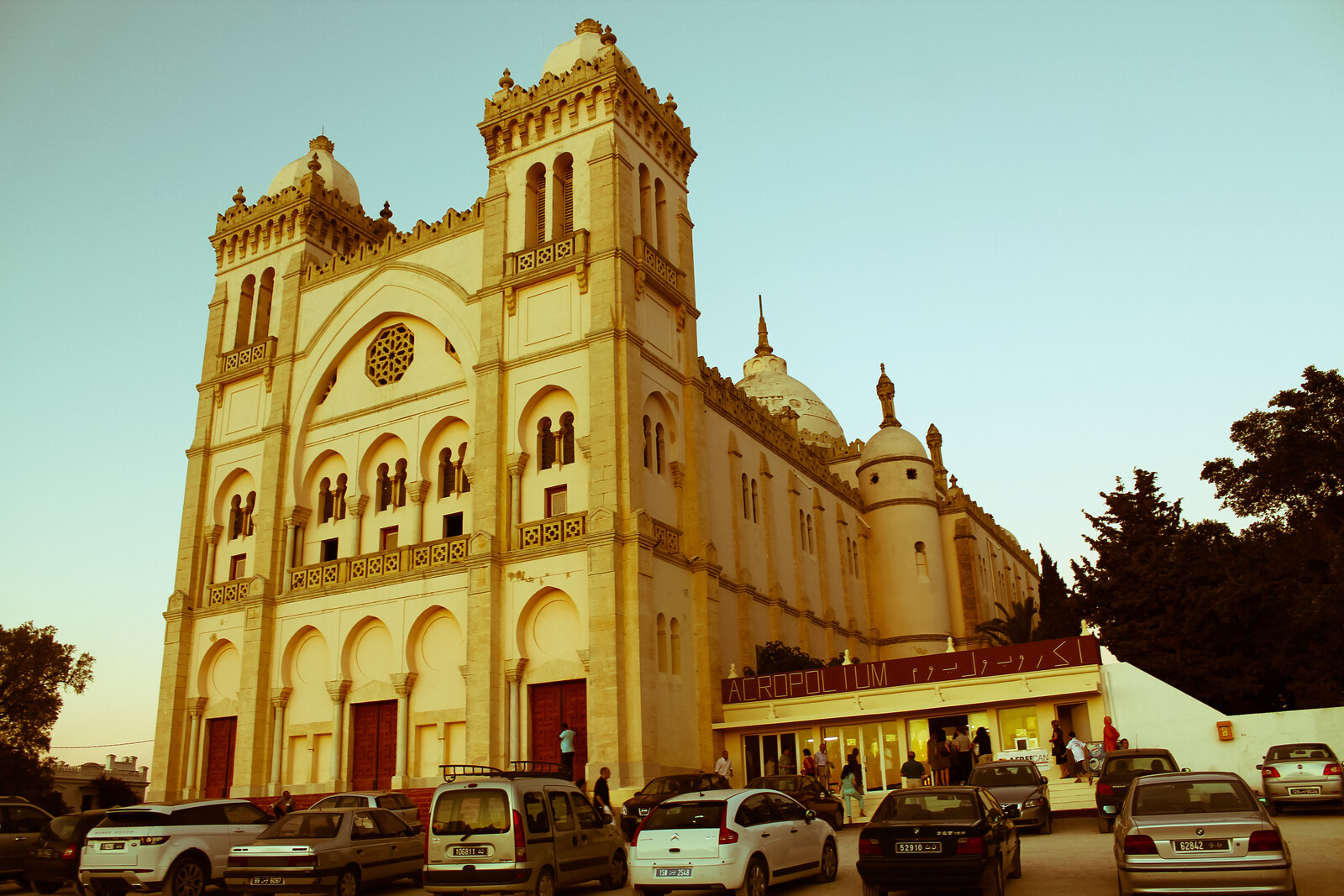
Look around first
What to notice
- The former cathedral building
- The nave of the Acropolium
- Rows of marble coats of arms
The story of the place
The man whose name remained on the cathedral arrived at Carthage as the French King Louis IX (Saint Louis). He was declared a saint only twenty-seven years after his death.
In the summer of twelve seventy, Louis led a crusading army to Tunis. He hoped to persuade the Hafsid ruler Muhammad al-Mustansir to be baptized and to gain a base for further war in the east. Al-Mustansir intended to preserve his city and his state. The French landed at Carthage, took a fortification among the ancient ruins, and made camp. Louis ordered them to wait for his brother: Charles of Anjou, King of Sicily, was leading reinforcements, without which it was too dangerous to begin the decisive assault.
The king put his own family at risk. His sons were with him, including his heir, Philippe III. At the beginning of August, illness spread through the camp. On the third of August, twenty-year-old Jean Tristan, Louis's younger son, died. The king himself and Philippe III fell ill; there were fears for the heir's life as well. On the twenty-fifth of August, when Charles of Anjou finally reached Carthage, Louis died. He did not live to enter the main battle.
Philippe III became French king in the sick camp. Charles took command, and then Charles and Philippe III agreed to a treaty with al-Mustansir. The crusaders were paid to leave, the merchants had their former trading rights restored, and the army left Tunis. The ruler did not convert to Christianity, and the city was not conquered; al-Mustansir kept his throne.
The exact location of the royal tent and of Louis's death is unknown. Chronicles place the camp near Carthage, but do not allow its boundary to be drawn across the summit of Byrsa Hill. This summit was linked with the king's death much later. In eighteen thirty, the Tunisian bey Husayn II Bey ceded a plot in ancient Carthage to the French king for a monument to Louis, and French representatives chose Byrsa Hill. Thus a later tradition acquired a specific address.
A small chapel was built here first. Then Cardinal Charles Lavigerie, head of the restored Catholic see of Carthage, decided to establish a major religious center on Byrsa Hill. By then, Tunisia was under the French Protectorate of Tunisia. Lavigerie collected money from families who considered themselves descendants of participants in Louis's last campaign. Construction of the cathedral began in eighteen eighty-four; six years later, it was consecrated. In its foundations, the builders laid stones from the ruins of the early Christian Damous el Karita Basilica. In the nave, they fixed two hundred thirty-four marble coats of arms bearing the names of donors—the descendants of crusaders paid for the church on a site they took to be their ancestors' camp.
The first chapel was demolished in nineteen fifty. In nineteen sixty-four, Catholic priests stopped holding Mass here, and the building was handed over to the Tunisian state. Since nineteen ninety-three, the former cathedral has been called the Acropolium and used for exhibitions and concerts. The old chapel is gone, the location of the king's death remains a conjecture, and the marble coats of arms inside still explain who turned this tradition into a cathedral.
Useful on site
The interior depends on events and exhibitions; check the schedule on site.
Checked: June 28, 2026. Check the official source before visiting.Do not count on free entry: the building is used as a cultural venue and may be accessible only during a separate event.