 Guide On Map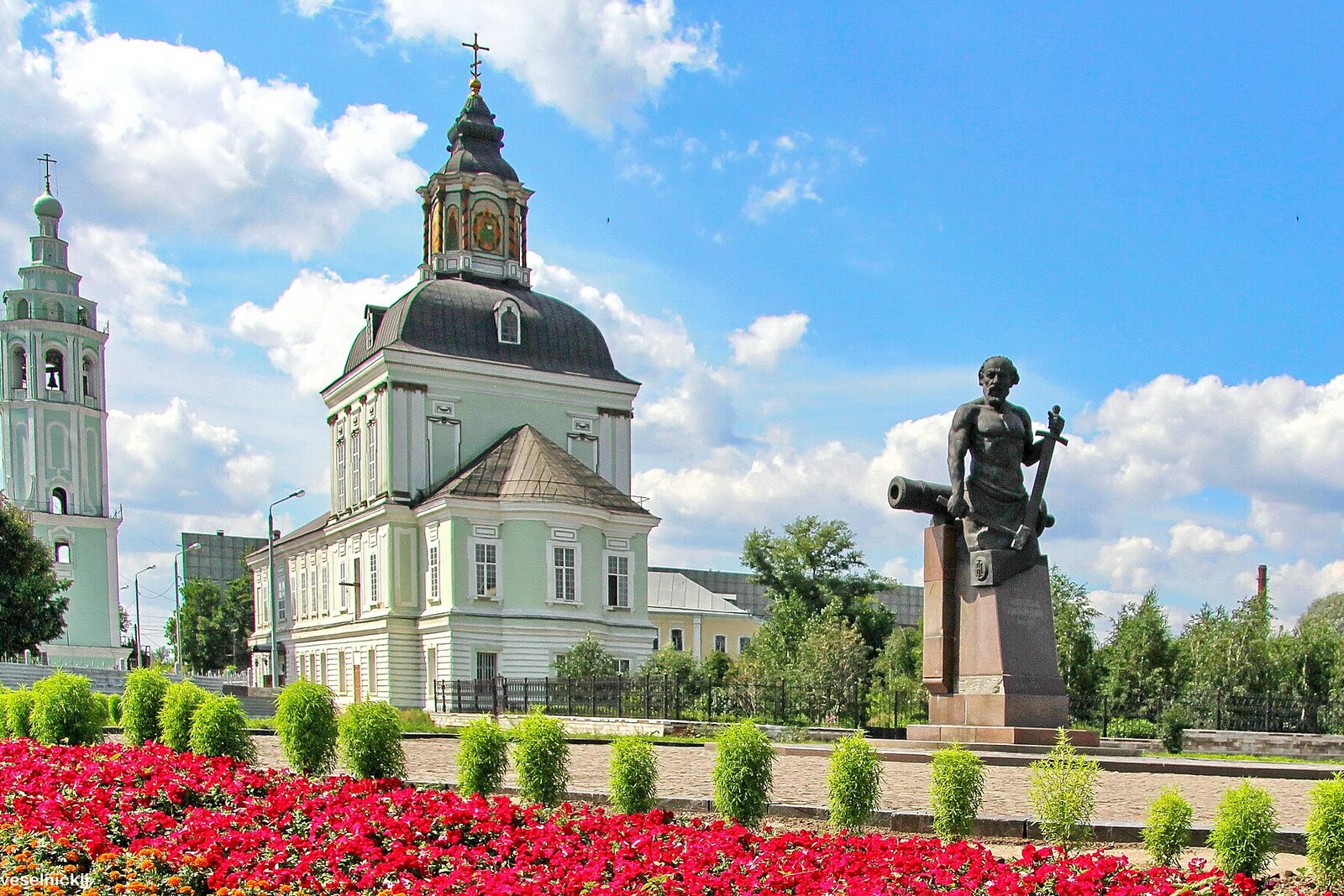
Look around first
What to notice
- Two-story church
- Freestanding bell tower
- Oruzheyny Lane between the buildings
- Stone crypt
The story of the place
The church's two levels served different purposes: downstairs, in the warm church, prayers were offered to Nikolai the Wonderworker, while upstairs, in the unheated one, the Nativity of Christ was celebrated. That is why it has the official name Nikolo-Zaretsky Church and the familiar Tula name Nikolo-Zaretsky Church. The name recalls Kuznetskaya Sloboda, the armorers' settlement across the Upa, on the bank opposite the city center. A stone crypt was arranged beneath the building's western part: the old grave markers there have disappeared, and individual burials can no longer be distinguished.
Akinfiy Demidov, heir to the Tula and Ural plants, began building this stone church beside his father's grave. Historians suggest that he shifted the building's footprint so that his father's burial would lie inside the western part of the church, beneath the planned bell tower.
His father, Nikita Demidov, earned his living by welding iron strips into gun barrels. In Tula's Kuznetskaya Sloboda, he became a factory owner, received noble status and the surname Demidov, and then developed metallurgical production in the Urals. Nikita died in Tula in seventeen twenty-five. He was buried beside the wooden parish church that stood here. The grave's exact location was later lost.
Akinfiy replaced the old church with a two-story stone church. The lower level housed the warm Church of Nikolai the Wonderworker, and the upper level the unheated Church of the Nativity of Christ. That is why it had two names: the official Nikolo-Zaretsky Church and the name familiar to Tula residents, Nikolo-Zaretsky Church. It was called “Zaretsky” because, from the center of Tula, the church stood across the Upa, in the armorers' settlement.
On October third, seventeen thirty, the bell tower being built over the western part broke through the vaults and collapsed. Fifteen people died under the rubble, and another nine were maimed. Church authorities banned services. Akinfiy submitted a petition to resume them, and permission was granted on December nineteenth.
They did not restore the bell tower in its former place. It was erected separately, on the opposite side of the lane, and later connected to the church's upper floor by a covered iron gallery. The gallery was destroyed in a fire, while the bell tower remained across the road. This arrangement arose after the disaster, not from the builders' original design.
A stone crypt was preserved beneath the western part of the church. Several generations of the family were buried there: Akinfiy himself, his wife Evfimiya, his son Grigory, and other relatives. Akinfiy died in seventeen forty-five on the way from Tula to the Urals; his body was brought here, to the family vault he had arranged beside his father's grave.
Services are now held in the church, and visits to the crypt are organized by Demidovs' Historical and Memorial Museum. The old grave markers have disappeared, so individual graves can no longer be distinguished. The bell tower stands across Oruzheyny Lane, and beneath the spot where they tried to erect the first bell tower lie the first generations of the Demidovs.
Useful on site
Church services are held daily: liturgy 8:00, evening service 17:00. Demidovs' Museum: Mon closed; Tue–Thu and Sun 10:00–18:00; Fri–Sat March–October 10:00–20:00, November–February 10:00–19:00; the last Wednesday is a sanitation day.
Checked: June 25, 2026. Check the official source before visiting.The necropolis is inside and cannot be seen from the street; check separately whether visits are possible and observe the rules of the active church. Outside, focus on the connection between the church, the bell tower, and old Zarechye.