 Guide On Map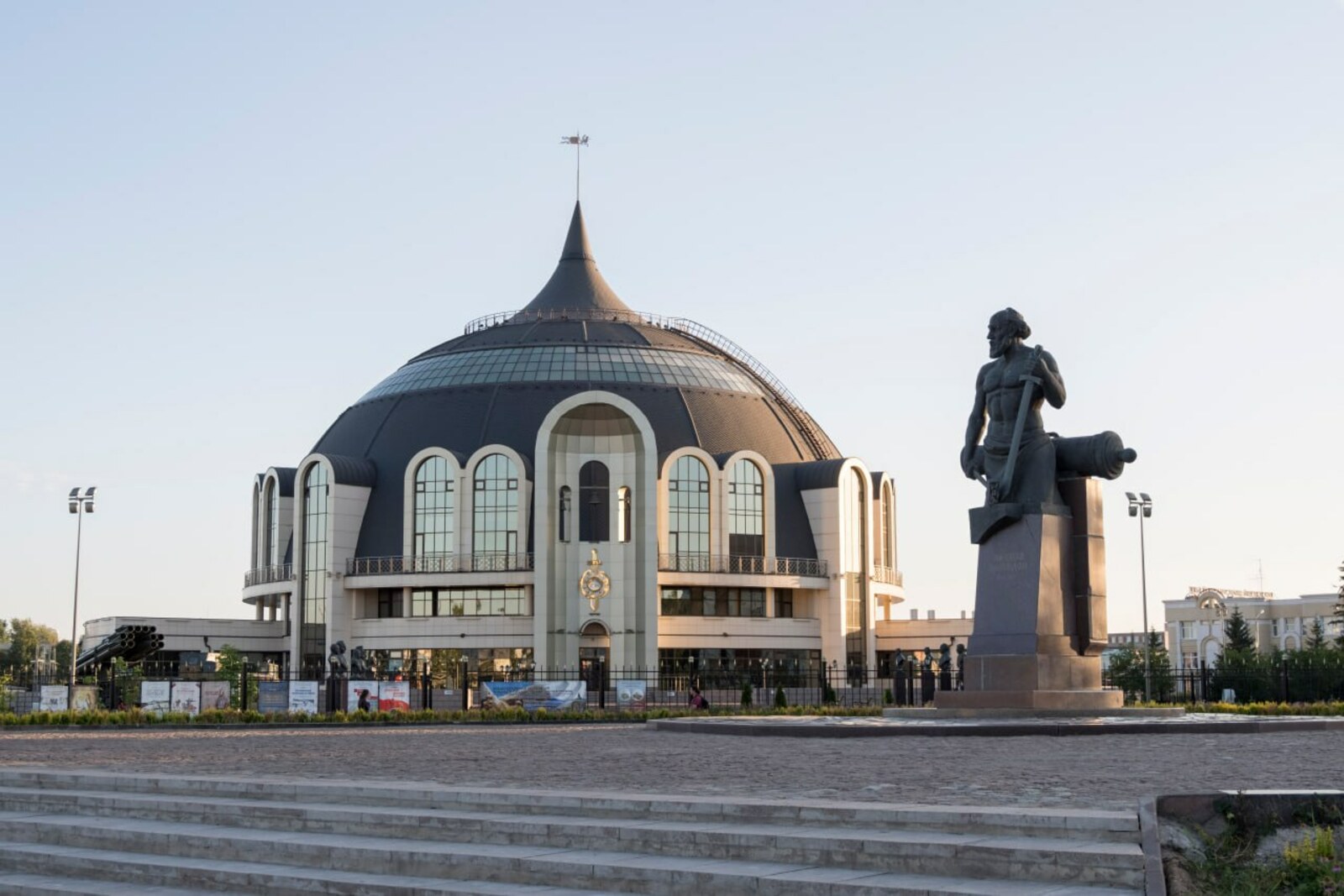
Look around first
What to notice
- Round building
- Sphero-conical dome
- High spire
- Military equipment outside
The story of the place
Vladimir Aleksandrovich Paramonov came to the museum from arms manufacturing. He worked at the Tula Arms Plant for forty-one years, rising from process engineer to chief designer and taking part in the creation of dozens of series-produced items. In nineteen ninety-two, he exchanged the design bureau for the museum director's office.
At that time, the collection was housed in the former Epiphany Cathedral. About a third of the collection fit into the exhibition; the rest remained in storage. Paramonov sought independence and a dedicated complex for the museum. In nineteen ninety-six, the museum was separated from the arms plant, made into a state institution, and a decision was made at the same time to build a new building.
A site was allocated in Zarechye. In the seventeenth century, Oruzheynaya Sloboda stood here: blacksmiths lived as a separate community and earned their living by making firearms. The beginning of this community is linked to a charter issued by Tsar Fyodor Ivanovich in fifteen ninety-five. The blacksmiths themselves asked to be organized into a special sloboda; in return for work on state orders, they were exempt from posad taxes and zemstvo duties. Historians do not know the exact location of their first homesteads, but in the following century the sloboda already occupied the Zarechye bank of the Upa. The museum was therefore built among the streets where arms makers once lived and worked, opposite the plant buildings on the other bank.
Tula architects chose for the building the shape of a shishak, an ancient sphero-conical helmet with a high finial. The round building became its lower part, the dome its crown, and the spire completed the silhouette. Construction began in two thousand, but the plan on paper took a long time to become a museum. During the first five years, funding was sufficient mainly for the foundation, the basement floor, and a separate energy block.
Vladimir Ignatkov, the museum's deputy director, was responsible for construction on the museum's side. After several departmental transfers, funding had to be secured anew: in two thousand five, work could be paid for only from October, and the following year the project was not included in the federal construction program at all. The contractor guarded the unfinished building so that construction could continue at any moment. Ignatkov and museum staff prepared appeals to ministries, the governor of Tula, and deputies. Two letters from the regional leaders and the Ministry of Culture reached the chairman of the government and his deputy. After favorable decisions, construction was returned to the program, and floors began to rise in place of the basement.
In June two thousand eight, builders installed the spire. Paramonov saw the museum he had conceived already in the outline of a helmet, but still without completed halls. He died in September of the same year. The staff continued what he had begun: they sought a revision of the cost estimate, underwent another review, and again assembled documents for the missing funds. The final two hundred million rubles arrived only in September two thousand eleven.
On March third, two thousand twelve, the building was commissioned. Its exhibition area proved to be about five times larger than the previous one. Storage facilities, restoration and technical workshops, and rooms for receiving and temporarily storing objects were added. The collection was moved gradually; the permanent exhibition opened in two phases, in two thousand fifteen and two thousand seventeen. Weapons are now displayed here in chronological order, studied and restored, while large military equipment is exhibited outside.
Paramonov lived to see the spire above the unfinished building. He never entered the completed halls beneath it.
Useful on site
Mon–Wed and Sun 10:00–18:00; Thu–Sat 10:00–20:00; ticket office closes an hour before; the last Monday of the month is a sanitation day. The nearest announced sanitation day is 29.06.2026.
Checked: June 25, 2026. Check the official source before visiting.The architectural concept and the connection with Zarechye are clearly visible from outside. Allow extra time for the large exhibition; at the entrance, be prepared for museum inspection of your belongings.