 Guide On Map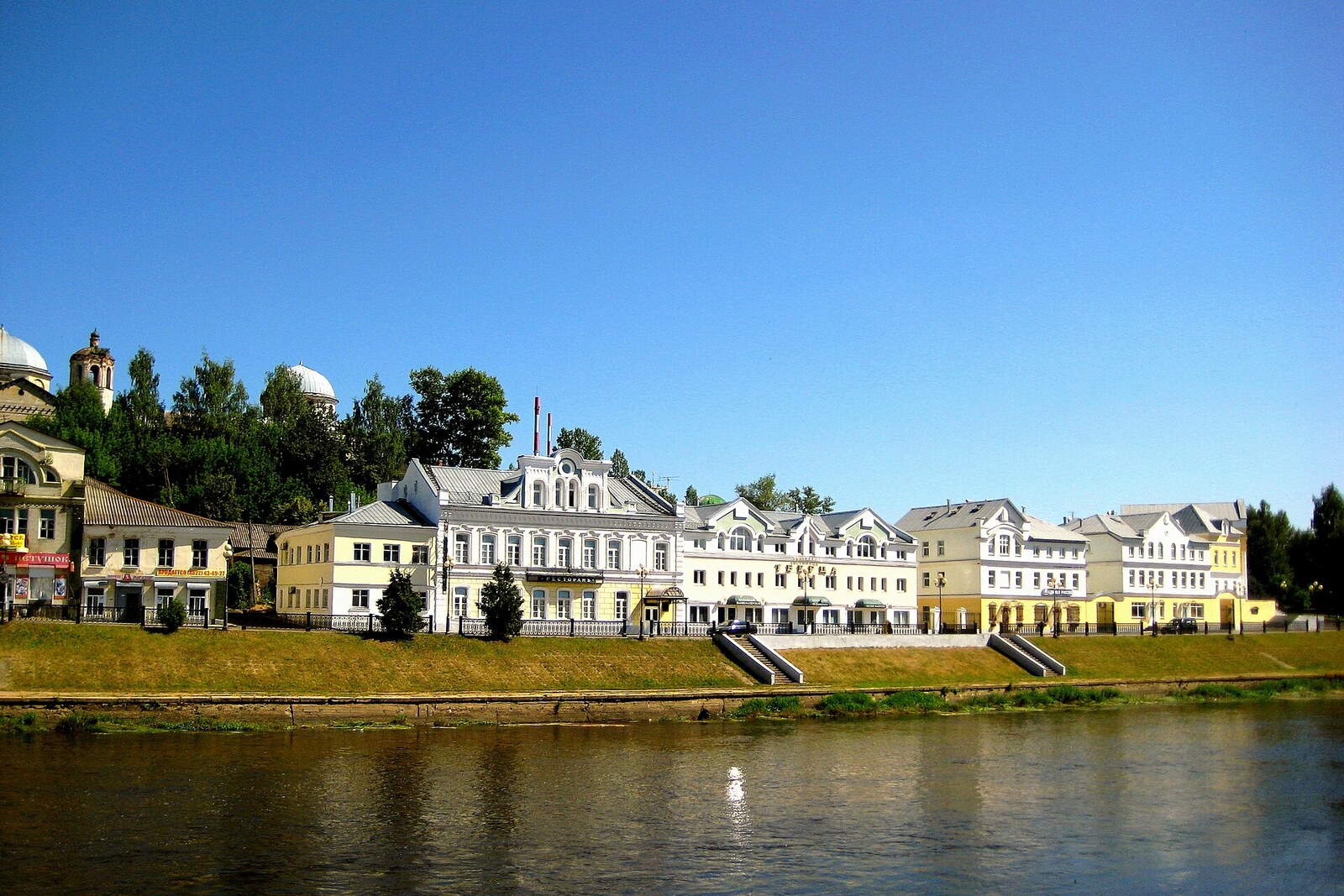
Look around first
What to notice
- Suspended span
- Bridge supports
- Tvertsa
- Row of two-story houses
The story of the place
Along the present suspension crossing, pedestrians walk between the square on one bank of the Tvertsa and Tvertsa Embankment on the other. A floating crossing used to stand here: a wooden walkway lay on connected supports, and at night it was opened for river vessels. In the spring flood, the deck was removed altogether, and people were carried across the river by ferry, pulled along a cable. In the two-story houses along the embankment, traders kept shops downstairs and lived upstairs, so the connection between the banks was part of their daily business.
The first permanent bridge at this spot was assembled from a structure that railway officials had rejected for another river.
Until the second half of the nineteenth century, the banks of the Tvertsa were connected by a pontoon bridge—a wooden deck on linked floating supports. At night, it was opened to let vessels through. In spring, when the river flooded, the bridge was removed, and ferrymen pulled a ferry along a cable. The crossing depended on the water precisely where dependence on it was especially inconvenient. In the houses on Tvertsa Embankment, merchants kept shops downstairs, lived upstairs, and earned money from goods that had to be delivered from one bank to the other. The river served as a route for vessels, while the floating bridge blocked that route for overland traffic.
In the early eighteen eighties, the people responsible for municipal affairs in the Torzhok Administration decided to establish a permanent crossing. The railway department had already manufactured a suitable metal structure for a bridge across the Logovezh, a tributary of the Tvertsa, but then rejected it. The Administration paid thirty thousand rubles for it—a substantial sum from municipal funds—and in eighteen eighty-one and eighteen eighty-two, builders installed the bridge here. Merchants, haulers, and customers gained a permanent route between the commercial part of the town and the left bank; there was no longer any need to open the crossing at night or use a ferry in spring.
During the Great Patriotic War, the bridge was bombed several times. There were no direct hits, but explosions and heavy traffic shifted the structure on its supports. In nineteen forty-six, repair workers straightened it without stopping traffic. Then there were so many cars that, in the late nineteen sixties, builders erected a new road bridge nearby. The old crossing was left for people without cars and was later dismantled.
The present suspension bridge was completed in two thousand three. No spans from the structure purchased by the Administration remain here: the alignment of the crossing itself has survived—from the square on the right bank to Tvertsa Embankment. The row of houses opposite is not entirely old either: some of the facades were recreated in the late nineteen nineties from the historic development, with the dimensions and outlines of the buildings altered in places. Beneath the present deck runs the same line for which Torzhok merchants and the municipal administration once risked thirty thousand rubles.
Useful on site
A publicly accessible urban space with no established opening hours.
Checked: June 24, 2026. Check the official source before visiting.Do not obstruct the passage on the bridge, and beware of the slippery surface in wet weather. The best views open up during an unhurried crossing, with no required entry into buildings.