 Guide On Map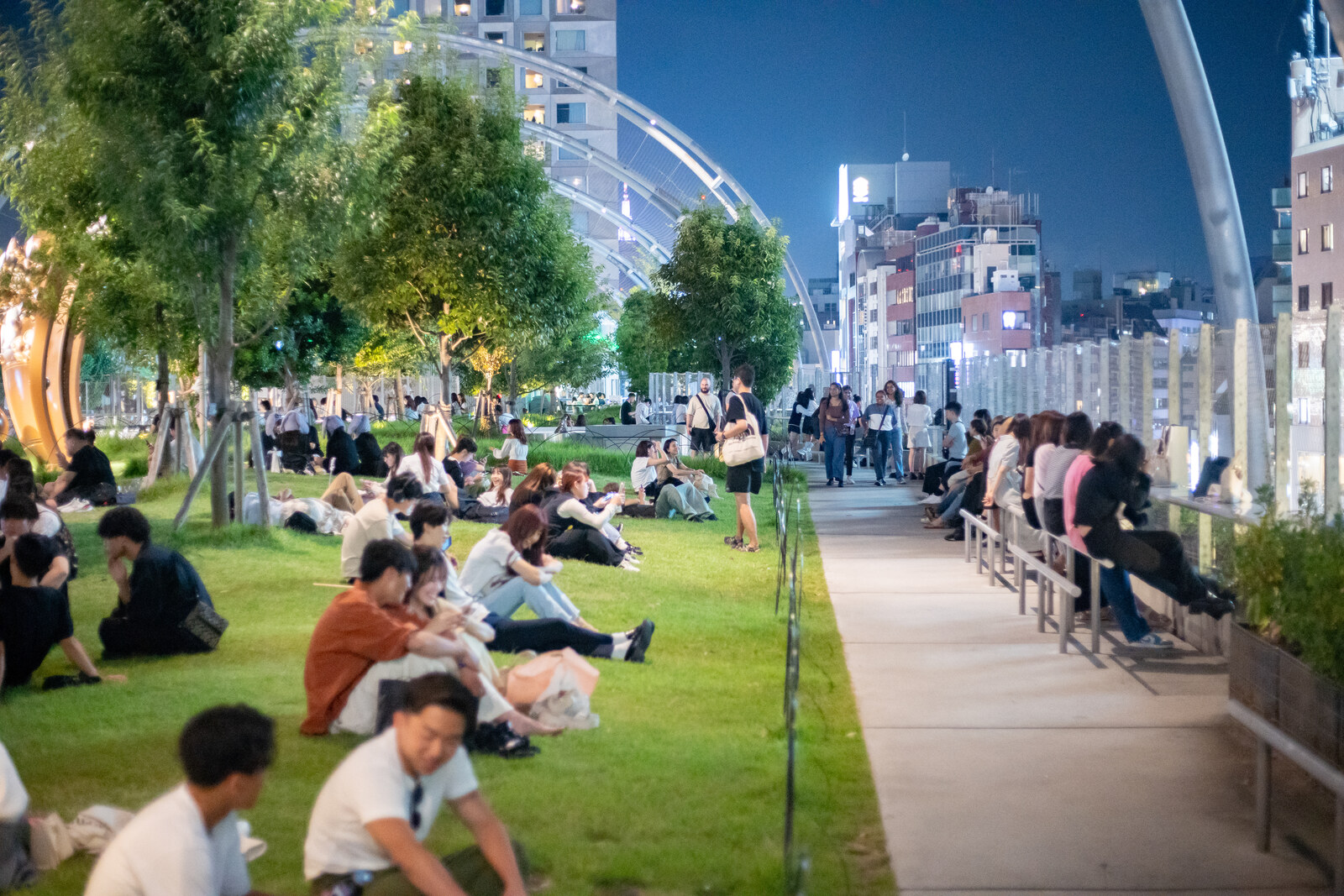
Look around first
What to notice
- Lawn on the roof
- Skate park
- Bouldering wall
- Sports court with a sand surface
The story of the place
On the roof above three commercial floors is a city park with a lawn, a skate park, a climbing wall, and a court with sand. Its public area covers about a hectare, although shops, restaurants, and parking operate below, while a hotel occupies the northern section above. The ward leases the lower spaces to a private company while retaining the garden and sports areas in municipal ownership. Its name came from a vanished district below the estate of one branch of the imperial family; current addresses no longer remember it.
In the mid-nineteen sixties, the paid-parking operator Nihon Auto Parking was looking for a site for a large garage near Shibuya Station. Between the Yamanote Line and Meiji-dori lay a long municipal park, opened in nineteen fifty-three. A collector sewer ran underground, so it was difficult to put the parking facility below ground. The company proposed a different arrangement to Shibuya Ward: cars on the first floor and the park raised to the roof of the second.
The ward agreed. Builders began work in nineteen sixty-five, and a year later Tokyo got its first public rooftop park. The paid parking facility occupied the lower level; trees, paths, and benches returned above. That was when the rule took shape that still defines this place: the commercial function pays for part of the structure, while the upper level is retained as a city park.
The name is older than this structure. “Miyashita” came to the park from the former Miyashita-cho district. On a nearby rise stood the enormous estate of the Nashimoto-no-miya family, a cadet branch of the Japanese imperial house. The land below the estate was called “Miya-shita,” meaning “below the princely residence.” The old district name has disappeared from modern addresses, but it remains with the park.
Half a century later, the first deck needed replacing. The trees had grown and added weight to the structure, the old supports raised questions about seismic stability, and getting up there without using stairs was difficult. Masayuki Akashi, an employee of Shibuya’s parks department, had been involved in preparing the new project since nineteen fourteen. The ward wanted to rebuild the park without shifting the entire cost onto residents, and it offered private companies an almost unrestricted competition.
The development company Mitsui Fudosan won. It was granted part of the municipal land on a thirty-year lease: the company received space for shops and a hotel, while the ward received rent and a new park above them. Engineers had to calculate repeatedly whether footsteps and sports loads from the fourth floor would transmit vibrations to the neighboring railway tracks. Only after these checks did the project receive permission.
In the summer of two thousand twenty, the park opened on the roof above three floors of shops. Builders connected its northern and southern sections with a platform above the street, retained the skate park and the bouldering wall, and created a sports court with a sand surface and a lawn. All of this remains a municipal park of Shibuya, although the lower floors belong to the shopping complex and a hotel rises above the northern section.
The boundary here runs horizontally: ticket counters, restaurants, and parking below; about a hectare of public land above them. Miyashita still means “below the princely estate,” although over more than sixty years the park itself was raised first to the second floor and then to the fourth.
Useful on site
The rooftop park is usually open 8:00–23:00; sports areas, the lawn, events, and individual facilities operate according to current official notices.
Checked: June 27, 2026. Check the official source before visiting.You may walk across the roof as a public space, observing the operator’s rules. Check access conditions for the sports areas separately, and do not enter the courts while they are in use.