 Guide On Map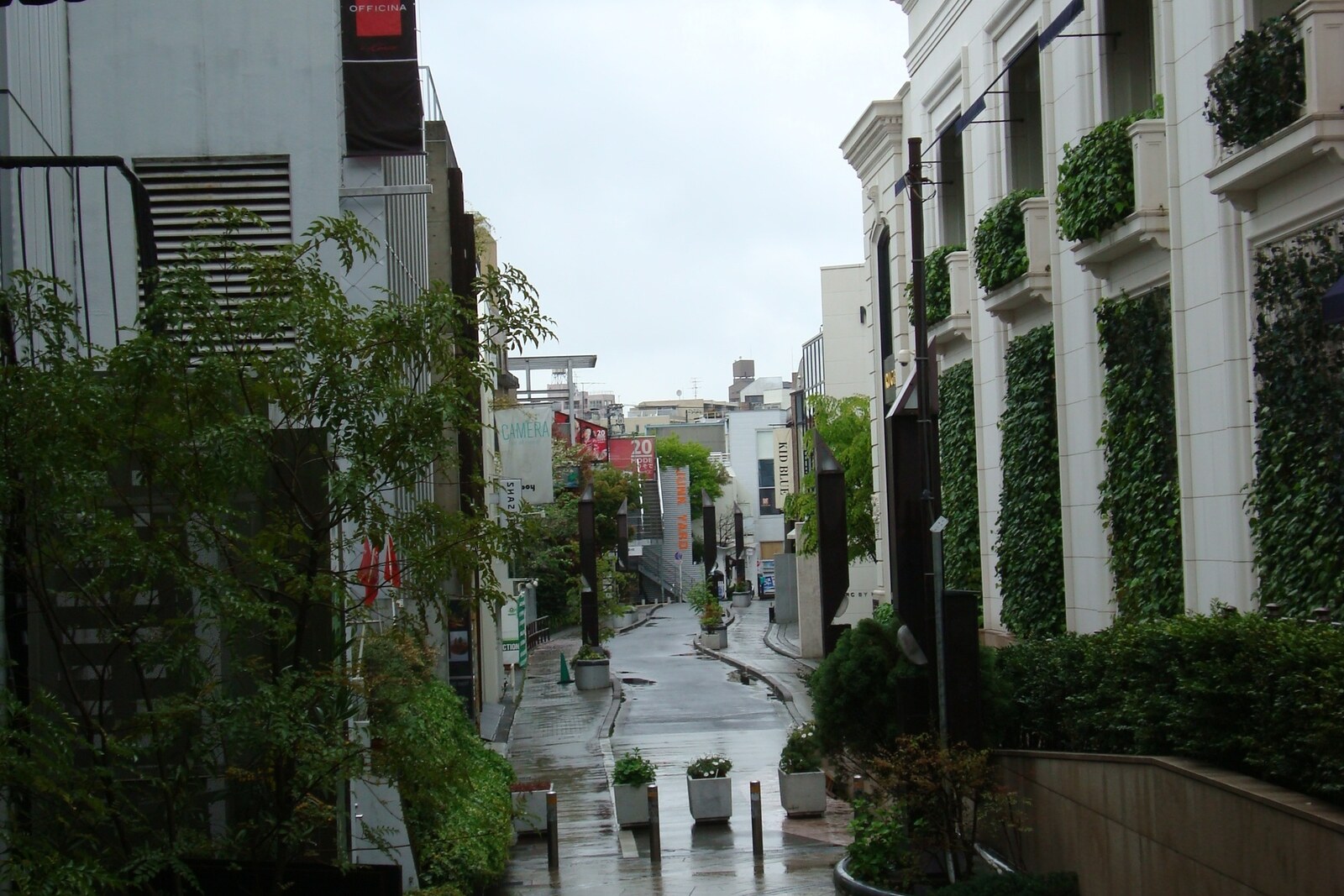
Look around first
What to notice
- The stone pillar “Onden Bridge”
- The bends of the street
- Movable bollards at the entrances
The story of the place
Cat Street took shape in separate sections at the end of the last century and now serves as a pedestrian link between Harajuku and Shibuya. The narrow passage is occupied by shops and a stream of visitors, while entrances are blocked by movable bollards managed by local commercial associations. Near Omotesando stands a stone pillar inscribed “Onden Bridge”—a surviving sign of the former bridge. The bends of the street here are not accidental.
Peasant families from the village of Onden operated several water wheels on this stretch of the river. The current drove machinery for hulling rice and milling grain—this work provided the residents with their livelihood. Around eighteen thirty-one, the artist Katsushika Hokusai included one of these wheels in the series Thirty-six Views of Mount Fuji. In his print, two men climb toward a mill, bent under sacks of grain, while two women work by a diversion channel. Mount Fuji is placed in the distance; almost the entire foreground is occupied by people whose daily earnings are provided by the river.
This current was the upper part of the Shibuya River and was called the Ondengawa here. The particular wheel in the print cannot confidently be tied to one of today’s facades: there were several mills. Yet Hokusai left precise evidence of the district’s former layout. Where shops now stand, there were rice fields; grain was carried to the water because the current did the mechanical work.
When the fields were built over, the former order collapsed. The mills disappeared, and household wastewater from the new houses flowed into the river: rapidly growing Tokyo lacked sufficient sewerage. People who had once made their living from this water gave way to residents for whom the open channel became a sewage ditch.
Preparations for the nineteen sixty-four Olympics gave the city’s engineers a hard deadline. Between nineteen sixty-one and nineteen sixty-three, they covered the Ondengawa with a concrete vault and incorporated its channel into the Sendagaya Trunk Sewer. By the year of the Games, the share of homes connected to the sewerage system in the Shibuya district had risen from three to sixty percent. Families received wastewater drainage, but the water, banks, and mills disappeared from the surface.
The present-day pedestrian street appeared much later. The Shibuya district developed it in separate sections from nineteen ninety-four to nineteen ninety-nine. The engineers retained the bends of the old riverbed: the trunk sewer remained below and set the boundaries of the work. When shops and visitors filled the new passage, local commercial associations took responsibility for the movable bollards at the entrances and restricted vehicle traffic. Thus the former river became a pedestrian link between Harajuku and Shibuya.
Cat Street’s official name is “Former Shibuya River Promenade.” Near Omotesando, a stone pillar survives with the inscription “Onden Bridge”—“Onden Bridge.” It bears the date December nineteen fifty-five. The bridge served for only a few years: at the beginning of the following decade, builders covered the river, while its pillar was left standing beside the road laid directly along the former riverbed.
Useful on site
Open public urban alley; shops, cafés, and galleries keep their own schedules, and in the evening part of the street becomes noticeably quieter.
Checked: June 27, 2026. Check the official source before visiting.The street is narrow in places and shares its space with bicycles. Observe street fashion discreetly and ask permission before taking portraits.