 Guide On Map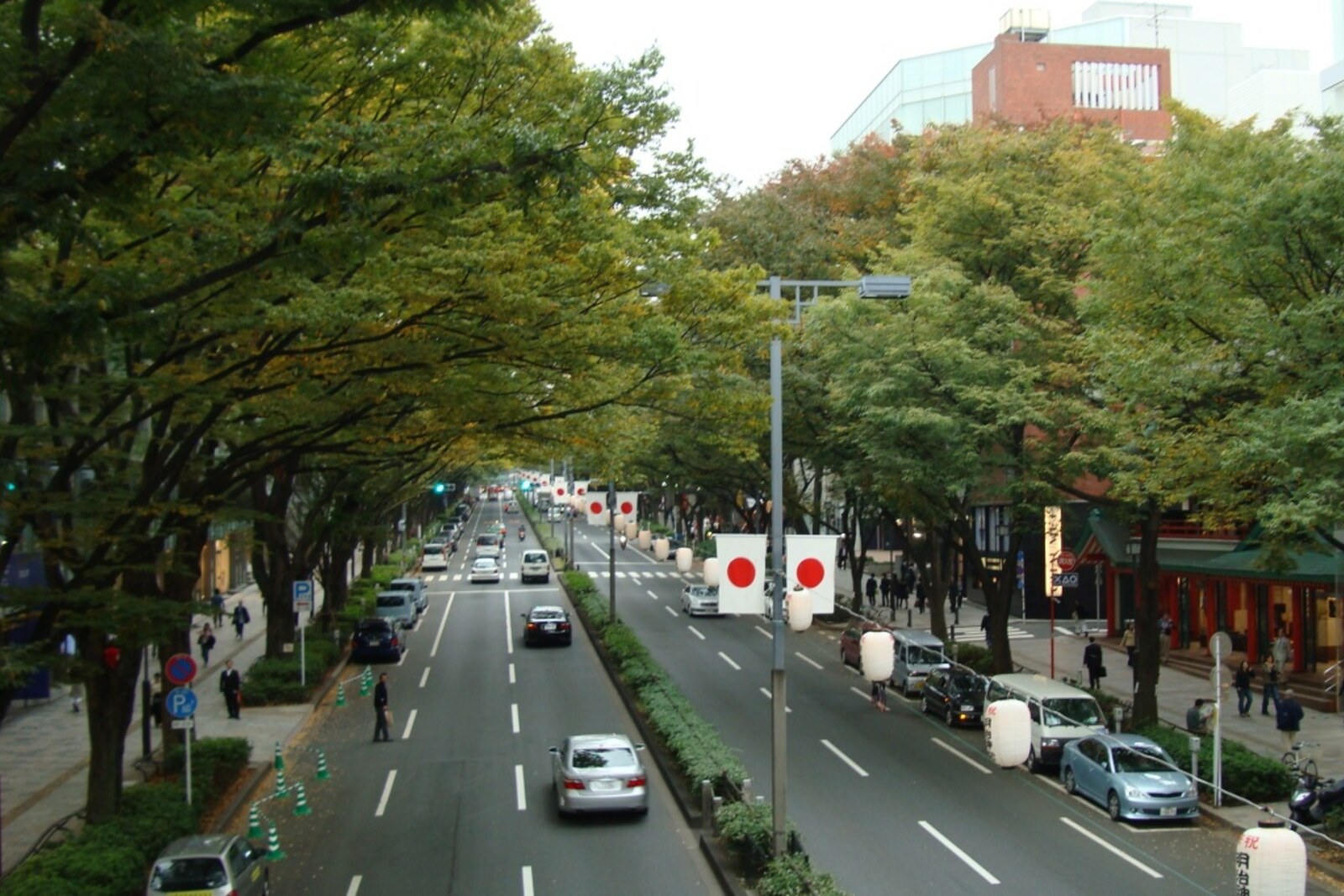
Look around first
What to notice
- The three-story facade of the Dojunkan
- The gallery’s transparent door
- The old heavy door
- The spiral ramp
The story of the place
At the eastern edge of Omotesando Hills, the three-story Dojunkan follows the line of the old street, while behind its facade the shopping complex descends underground along a long spiral ramp that repeats the street’s slope. Before the present building, the Dojunkai Aoyama Apartments stood for almost a quarter of a kilometer along the road to Meiji Shrine, built to restore the city after the Great Kanto Earthquake. They had electricity, gas, running water, and sewage—domestic infrastructure rare in Tokyo at the time. Later, the rooms became studios, shops, and galleries, with goods displayed from the windows and no signs.
In nineteen seventy-four, Mitsuko Murakoshi, a housewife who decided to start her own business after her son began school, opened a gallery here. At the time, “here” meant an apartment in a three-story building, not a space in a shopping complex.
Murakoshi chose this building long before opening the gallery. As a teenager, she walked along Omotesando to paint irises in the garden of Meiji Shrine, saw the gray Dojunkai Aoyama Apartments, and circled them on a map in red pencil: someday, she would live right here. Several years later, a newspaper carried an advertisement for an apartment for sale. She had no money of her own. Her father-in-law sold a plot of land and gave her the necessary sum; in Murakoshi’s later recollection, the apartment cost about as much as a detached house with land. She and her husband lived here for several years, then her husband set up a design office in the rooms, while in other years they rented out the apartment.
The Dojunkai Aoyama Apartments were built by Dojunkai, an organization founded after the Great Kanto Earthquake of nineteen twenty-three with donations to restore housing. New residents were offered something rare in Tokyo at the time: reinforced-concrete apartments with electricity, gas, running water, and sewage. They stretched for two hundred fifty meters along Omotesando—the “ceremonial road to the shrine,” laid out to Meiji Shrine.
After the war, the apartments were sold to their residents. They formed their own association and prohibited additions projecting beyond the line of the windows. When studios, shops, and galleries began opening along the street, this violated the former rule that the apartments were for residential use only. The residents found a compromise: commercial spaces remained, but their owners did without signs and exterior additions. Goods were displayed directly in the apartment windows. That is how small private rooms became commercial spaces before major fashion brands arrived here.
At first, Murakoshi made her apartment a meeting place for neighborhood women and children’s exhibitions. Six months later, Toko Shinoda, a renowned calligrapher and artist, offered to show sixteen of her prints, none of which had ever been exhibited anywhere. Murakoshi took the risk of holding the exhibition—and sold all sixteen works. After that, Shinoda exhibited prints here every year, and the apartment became the real Gallery 412.
By then, the owners were already discussing demolition of the aging apartments. The negotiations stretched for more than thirty years: for some, the building remained a home; for others, it was a studio, shop, or source of rental income. After the Kobe earthquake of nineteen ninety-five, concerns about the old concrete prevailed. The architect Tadao Ando, who was commissioned to design the new complex, tried to preserve the buildings’ height, the line of the zelkova trees, and the familiar slope of the street. A substantial part of the building had to be placed underground, with a long spiral ramp inside at almost the same incline as Omotesando.
In two thousand three, the former apartments were completely dismantled. Before demolition, Murakoshi and her assistant removed the heavy door of her gallery and took it away for storage. Three years later, Omotesando Hills opened on this site, and at its eastern end the architects rebuilt the three-story Dojunkan, reproducing the facade of the old apartments and returning some of the former railings, window details, and doors.
Gallery 412 once again occupied a space in the Dojunkan and still operates there today. Visitors enter through a modern transparent door. The old heavy door that Murakoshi removed before demolition is displayed beside it. The former building is no longer here; what returned to the same address were the gallery and the door from the apartment once circled in red pencil.
Useful on site
An open city boulevard; shops, galleries, cafés, and seasonal illuminations operate on separate schedules and may draw evening crowds.
Checked: June 27, 2026. Check the official source before visiting.All the main architectural details are visible from the street. If the interior spaces are open, the spiral ramp can be viewed without making any purchases.