 Guide On Map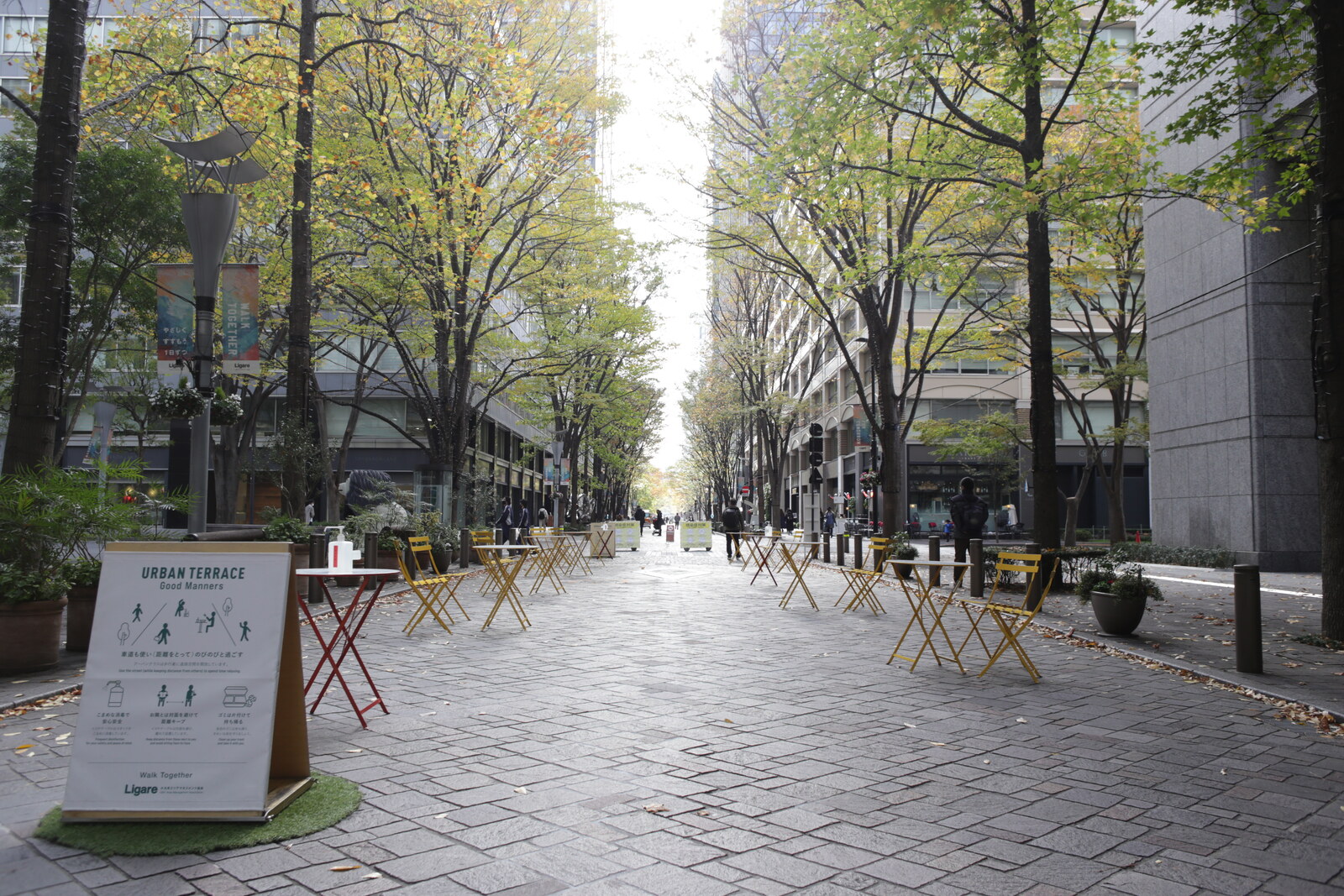
Look around first
What to notice
- Naka-dori paving stones
- Rows of trees
- Office facades
The story of the place
Paved Naka-dori runs among rows of trees and office facades. The name Marunouchi preserves the district's old map between the inner and outer moats of Edo Castle, inside the enclosure. Before the offices, the estates of feudal lords stood here, followed by barracks for the palace guard and a military parade ground. At the southern end, the red facade was assembled after the former building was demolished, using drawings, photographs, and precise measurements; there is no old masonry in it.
In March eighteen ninety, Finance Minister Matsukata Masayoshi came to Iwasaki Yanosuke with a request that Tokyo's largest entrepreneurs had avoided. Matsukata needed money for new army barracks in Azabu. He intended to obtain it by selling the land now crossed by Marunouchi Naka-dori.
Before the sale, barracks for the Imperial Palace guard stood here, along with a military parade ground. Earlier still, the area was occupied by the estates of feudal lords. They lay between the inner and outer moats of Edo Castle—hence the name Marunouchi, meaning “inside the enclosure.” Naka-dori means “middle street”: it runs north to south through the center of the district.
The military estimated the construction of the new barracks at about one and a half million yen—more than one-tenth of the army budget. The government divided the old land into sixteen lots and held an auction, but even the best bids combined did not reach the requested sum. Tokyo also refused: the price equaled three annual city budgets. Matsukata then asked Iwasaki to buy the entire area at once.
Iwasaki was the second head of Mitsubishi and was looking for a new line of business for the company. After its steamship business merged with a competitor, the firm lost its former source of income and invested in mines, shipyards, and real estate. The land by the palace cost one million two hundred eighty thousand yen, two to three times the market price at the time. Such a purchase could have destabilized even Mitsubishi.
Shōda Heigorō, the company manager who was on a business trip in the United Kingdom, helped Iwasaki make up his mind. He proposed turning the former parade ground into an office district modeled on the City of London. Iwasaki accepted Matsukata's terms. The government received money for military construction, while Mitsubishi received land that others considered too expensive and inconvenient.
Two years later, streets began to be laid out here and offices began to be built. In eighteen ninety-four, architect Josiah Conder completed Mitsubishi Ichigokan—the district's first modern office building. The company's next head, Iwasaki Hisaya, began leasing space to different firms. The first buildings were divided into narrow sections: each tenant had its own entrance, staircase, and restroom. This is how a district arose along the streets where the company earned money no longer by transporting goods, but by providing space for those who traded and managed them. Tokyo Station did not open until nineteen fourteen, twenty-four years after the purchase.
The current width of Naka-dori was given to it by the leaders of Mitsubishi Estate during postwar reconstruction. Beginning in nineteen fifty-nine, they abolished parallel private access roads and widened the street from thirteen to twenty-one meters: the width of the road determined the permitted height of new office buildings. The old red-brick buildings were dismantled, and in nineteen sixty-eight the original Mitsubishi Ichigokan was demolished as well.
The red building at the southern end of Naka-dori reappeared in two thousand nine. It was built on its former site using Conder's drawings, photographs, and measurements made before demolition. It is an exact reconstruction; none of the bricks laid here after Iwasaki's deal are in its walls.
Useful on site
The street is open around the clock; from 11:00 to 15:00 on weekdays and from 11:00 to 17:00 on weekends and holidays, it operates as a pedestrian Urban Terrace.
Checked: June 27, 2026. Check the official source before visiting.Even when part of the street is given over to pedestrians, watch for intersections and service vehicles; you do not need to enter the buildings for this account.