 Guide On Map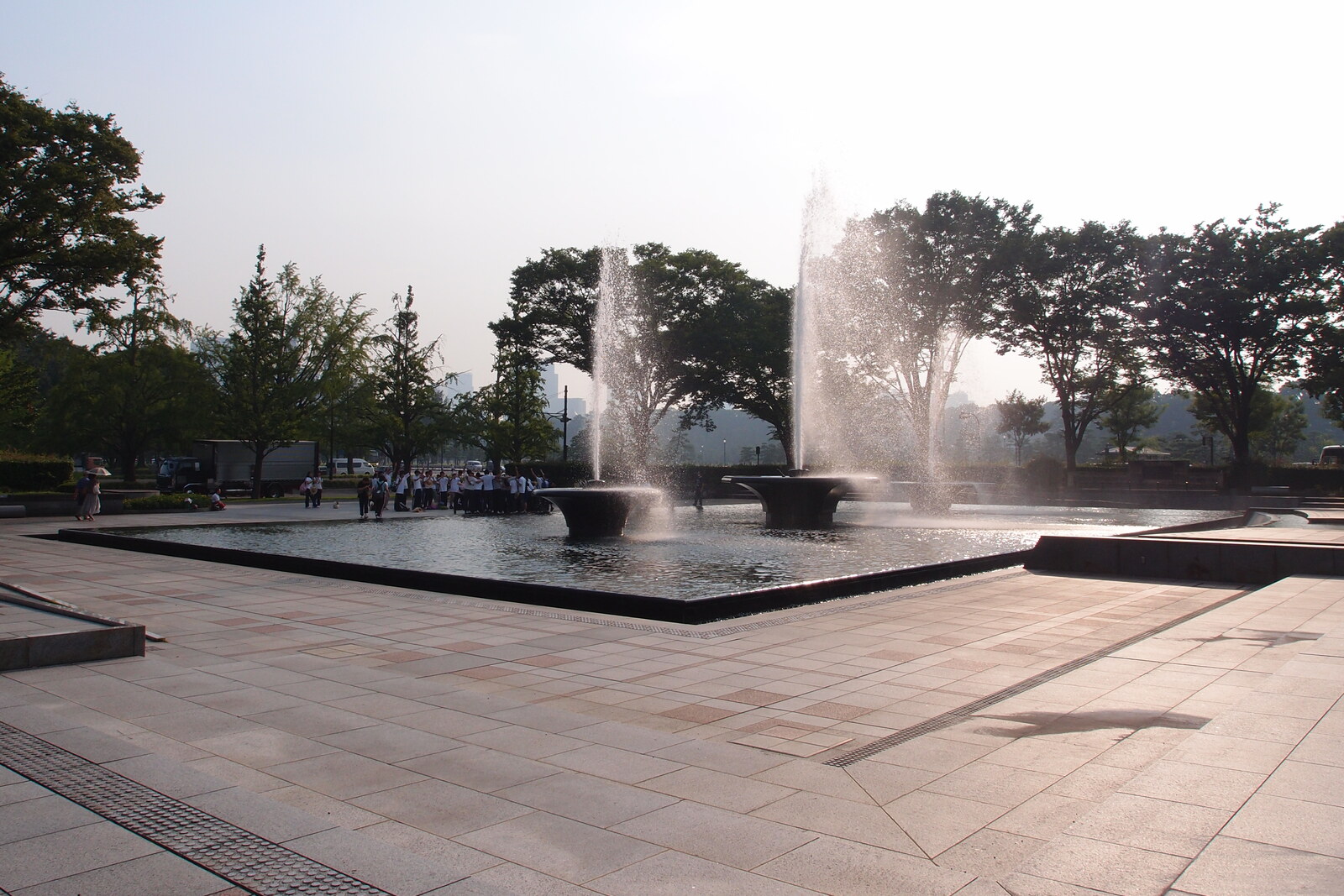
Look around first
What to notice
- Three central fountain groups
- Waterfall
- Glass footbridges
- Concrete bridge
The story of the place
Wadakura remembers the time when seawater reached this spot: at the Wadakura-mon Gate, a canal received supplies for Edo Castle, and the First Storehouse stood beyond it. The gatehouse buildings have disappeared, but the stone walls still mark the line of the former entrance; the nearby bridge only looks wooden, although it is made of concrete. A water park with fountain jets, a waterfall, canals, and glass footbridges now stands here.
Landscape architect Tamura Tsuyoshi declined to place sculptures or lavish decorations here. He was to turn the wedding of the heir to the throne into a public monument beside the stone walls of the former Edo Castle. Tamura chose Japanese stone, straight lines, and circles, making water itself the main material.
On April tenth, nineteen fifty-nine, Crown Prince Akihito married Michiko Shoda, the daughter of an industrialist. The marriage required the unanimous consent of the Imperial Household Council. After the ceremony, the couple rode in an open carriage across the square in front of the palace; around one hundred ten thousand people gathered here. Michiko became crown princess, and a year later the couple had a son, Naruhito.
In nineteen sixty-one, Tamura completed the fountain dedicated to the wedding. In the vertical jets, water from several nozzles collides, draws in air, and turns white. The slanting jets form a chrysanthemum flower and two buds—the emblem of the imperial household. Here, engineers used for the first time in Japan a combination of this water delivery with colored underwater lighting. Akihito later became emperor, but the three main fountain groups created for him remained in their original place.
When Naruhito married Masako in June nineteen ninety-three, the designers received the same task for the next generation. They preserved Tamura's work and arranged a waterfall, a spherical fountain, canals, and glass footbridges around it. Private donors paid for part of the structures and transferred them to the state. The renewed park opened in June nineteen ninety-five. That is why the central jets are dedicated to Akihito and Michiko, while the waterfall and the water features surrounding them appeared after the wedding of Naruhito and Masako.
The name Wadakura is older than both weddings. In the early seventeenth century, a sea inlet still reached this spot; supplies for the castle were delivered by canal. On a map from around sixteen oh two, the First Storehouse is marked beyond the gate, and the gate itself is called the Wadakura-mon Gate. That is where the name Wadakura comes from.
The gatehouse buildings have disappeared. Stone walls remain from the old entrance, while the bridge that looks wooden is in fact made of concrete during the nineteen seventy-four reconstruction. Beyond it stand Tamura's three fountains—the chrysanthemum and two buds; around them lies the water park added for the wedding of their son.
Useful on site
The park is open 24 hours; the fountains and lighting operate from sunset until 20:00, until 21:00 in summer, and may stop in strong winds.
Checked: June 27, 2026. Check the official source before visiting.The operation of the jets depends on the weather and technical schedule; even without water, the meaning of the place can be read in the layout of the pools and their proximity to the wall.