 Guide On Map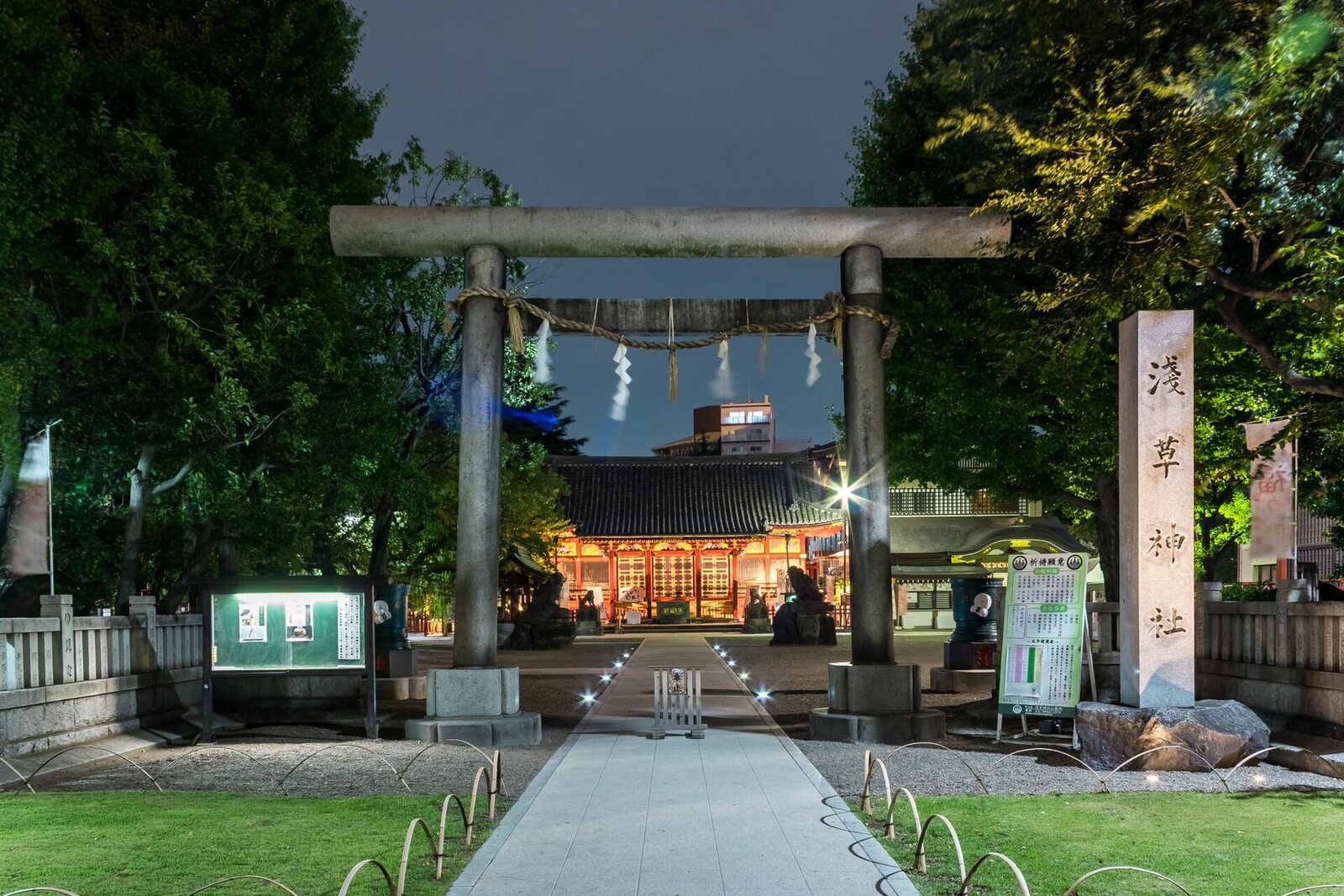
Look around first
What to notice
- Stone with three names
- Main pavilion
- Shrine entrance gate
The story of the place
Beside the Buddhist Sensoji Temple, a Shinto shrine gradually took shape and remained connected with the neighboring monastery for a long time. The main pavilion is a place for venerating local kami, while the shrine's old name remains in the name of Asakusa's major festival. Then three mikoshi are carried out from here, and the procession passes through forty-four neighborhoods of the district. The present palanquins appeared after the war, replacing those that burned.
On the stone to the left of the main pavilion are carved the names of the Hinokuma brothers, Hamanari Hinokuma and Takenari Hinokuma, who made their living by fishing, and Haji no Nakatomo, the head of the local settlement, who decided to preserve their unusual find. These three are venerated here as the principal deities.
According to temple tradition, on March eighteenth, six hundred twenty-eight, the brothers cast their net into the river, now the Sumida River, but pulled up a small statue instead of fish. They did not understand what they had caught, threw the figurine back several times, and changed locations. With no catch, they had nothing to live on, yet the net kept bringing up the same statue.
The fishermen brought the find to Haji no Nakatomo. He recognized an image of Kannon, the Buddhist bodhisattva of compassion. According to tradition, the brothers asked her for help and filled their boat with fish the next day. Haji made a decision with longer-lasting consequences: he shaved his head, became a monk, and turned his own estate into a temple where he kept the found image. Sensoji Temple grew out of this household sanctuary.
Asakusa Shrine appeared later. According to the same tradition, Kannon appeared in a dream to one of Haji's descendants and instructed him to venerate beside her hall all three people through whom the image had come here. The descendants built a shrine beside the Buddhist temple, and Haji, Hamanari, and Takenari became local guardian deities. The exact date of construction is unknown, but by the beginning of the fourteenth century, processions of this shrine were already mentioned in records.
It was called Sanja Gongen, after the three deified founders. Gongen was the name for a Shinto deity seen as a temporary manifestation of a Buddha. The monks of Sensoji Temple also served the neighboring shrine. In eighteen sixty-eight, government officials ordered Buddhist temples and Shinto shrines to be separated, and five years later they established the present name: Asakusa Shrine, the shrine of Asakusa. The old “Sanja” remained in the name of the district's main festival, Sanja Matsuri.
During the festival, priests transfer the spirits of the three founders into three mikoshi—portable sacred palanquins. Residents carry them through forty-four neighborhoods of Asakusa. The prewar mikoshi burned in an air raid; worshippers donated two new ones in nineteen fifty and a third in nineteen fifty-three. The first carries Haji no Nakatomo, the second Hamanari Hinokuma, and the third Takenari Hinokuma.
Useful on site
The grounds read as an open courtyard; the office is open on weekdays 9:00–16:00, and on weekends and holidays 9:00–16:30. Checked on the official Asakusa Shrine website 2026-06-29.
Checked: June 29, 2026. Check the official source before visiting.Observe the procedures of a Shinto shrine, and do not automatically apply temple gestures here. During Sanja Matsuri, the quiet courtyard turns into the center of a crowded procession, and the usual pace of visiting is impossible.