 Guide On Map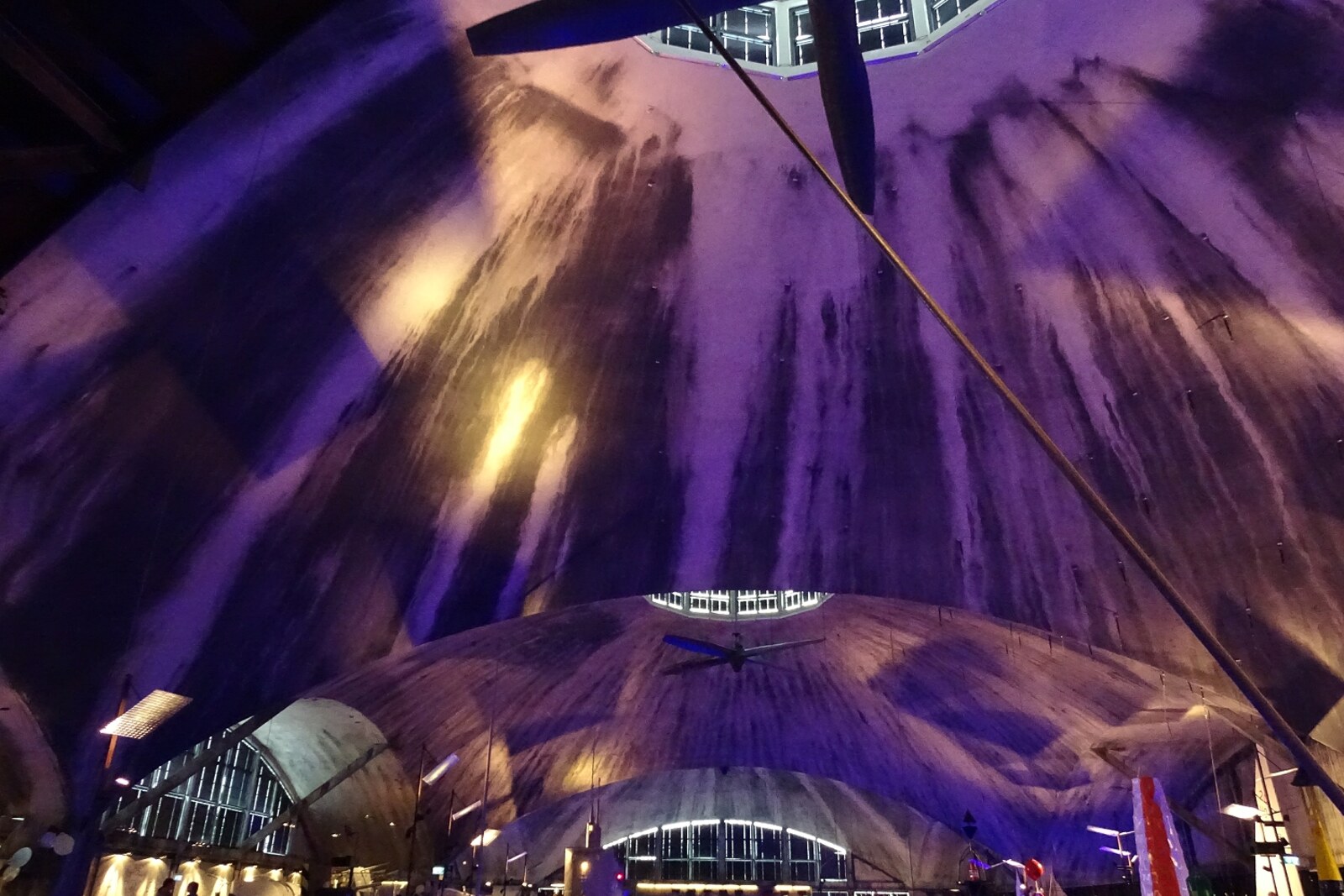
Look around first
What to notice
- Three reinforced-concrete domes
- The submarine Lembit
- Separate supports for the submarine
- An unobstructed floor without columns
The story of the place
Three reinforced-concrete dome shells hang over a hall with not a single internal column. The military of the Russian Empire was building a seaplane base here: aircraft were meant to be pulled out of the water along a wide slipway and rolled under cover. Each dome leaves more than thirty-five meters of floor unobstructed, although the layer of concrete at its very crown is only eight centimeters thick. When flights stopped, the building was occupied by naval aviators, a training unit, and warehouses; today a submarine stands on this unobstructed floor, resting on its own piles.
In the spring of two thousand eleven, Urmas Dresen, director of the Estonian Maritime Museum, was preparing to pull the six-hundred-ton submarine Lembit out of the water. It had remained afloat for seventy-five years—longer than any other submarine of its time—and was the only surviving ship of the prewar Estonian navy without major alterations. Dresen wanted to place it on land, inside the future museum. A mistake during the lift could have destroyed the main exhibit before the museum even opened.
The building itself had been created for different equipment. In nineteen sixteen, the military of the Russian Empire was building a seaplane base here to observe the Gulf of Finland. The aircraft needed to be pulled out of the water along a wide slipway and rolled under cover without hitting any columns. The Danish firm Christiani & Nielsen roofed the hangar with three interconnected reinforced-concrete domes. Each provided an unobstructed span of more than thirty-five meters, although the concrete at the top was only eight centimeters thick.
In the autumn of nineteen seventeen, the builders were ordered to stop. They did not have time to install the enormous doors or finish the slipways, but the concrete shells were already standing. Later, Estonian naval aviators, a training unit, and warehouses were housed here. After flights stopped, the military used the hangar as storage for decades and barely repaired the roof. Water reached the reinforcement, the metal rusted, the concrete flaked away, and the domes cracked and became deformed.
Engineers Karl Õiger and Heiki Onton had to determine whether people could be allowed in at all. They began their survey in two thousand one, sealed the most dangerous cracks in the central dome, and laid roofing, but there was funding only for the first stage. When preparations for the museum resumed, the engineers drew up a new project. During the repairs, they had to change their own decisions: the old builders had made joints that looked identical in different ways, and the damage inside them also differed.
Workers cleaned the rusted reinforcement, sealed and filled several kilometers of cracks with resin, fixed metal mesh in place, and applied a new layer of concrete. The domes were left on their original supports. Õiger and Onton ordered the heavy museum structures to be placed on separate piles, not connected to the old frame. The space for Lembit was designed with the same independent foundation.
On the night of May twenty-first, pontoons were placed beneath the submarine. An armored tractor with a tank winch pulled it along a specially built one-hundred-meter slipway. The operation lasted about twenty hours. Lembit was then cleaned and painted underneath, placed on air cushions, and moved the remaining two hundred fifty meters to the hangar over several more days.
Inside Seaplane Harbour, the submarine stands where Dresen’s team placed it in two thousand eleven. Its supports descend into its own piles, while above it lie the eight-centimeter crowns of the domes that once freed the floor for seaplane wings.
Useful on site
May–September: daily 10:00–19:00. October–April: Tue–Sun 10:00–18:00. Holiday reductions and closures are listed on the museum website. The last tickets are sold 30 minutes before closing; access to the icebreaker ends 15 minutes before closing.
Checked: June 30, 2026. Check the official source before visiting.The architecture of the hangars can be appreciated from outside; plan a visit to the submarine and the museum collection as a separate visit.