 Guide On Map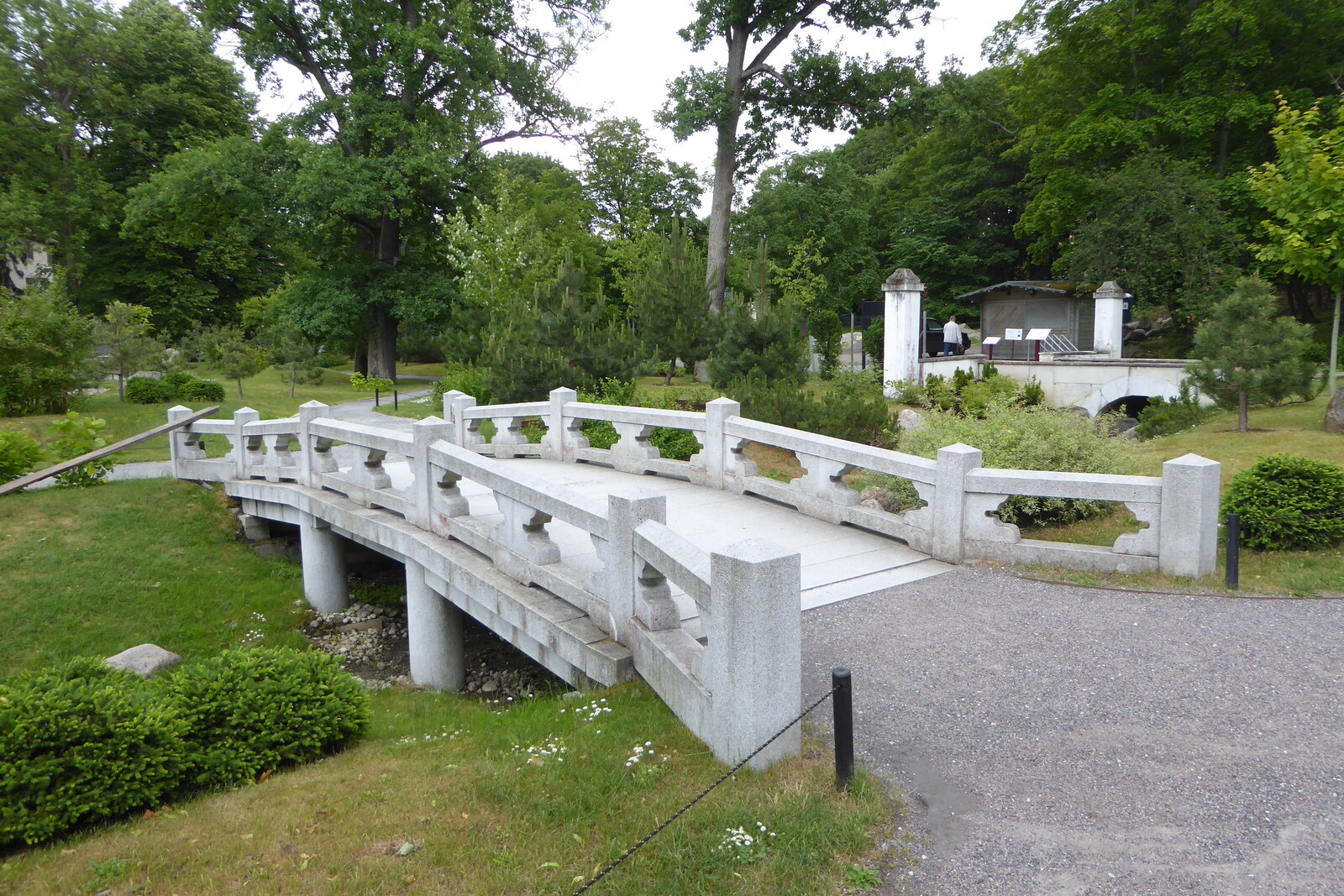
Look around first
What to notice
- Stone bridges
- Vertical boulders
- Pond
- Water drop
The story of the place
Before Ain Järve, director of Kadriorg Park, began looking for a master in Japan, he needed to understand who would care for the work several years later. Järve cited a cautionary example: a Japanese garden given to Moscow soon fell into such a state that, after just five or six years, it was called a failure. In Kadriorg, the director himself was responsible for the consequences. He wanted to lead walkers beyond Swan Pond, to the overgrown north-eastern corner of the park, and feared ending up with an expensive decoration that Tallinn gardeners would be unable to maintain.
The site for the new garden had already been half prepared by people who had worked here long before Järve. In the nineteen thirties, soil was taken from this part of the park to improve other areas. In the hollow that remained, they made North-East Pond and Small Wolf Ravine with a waterfall. Later, the slopes became overgrown again. By the start of the new project, there was water, large trees, rocky terrain, and a distant corner that visitors rarely reached.
Järve set a condition: the garden had to be designed by a Japanese person. Masao Sone, a garden master from Kyoto, was given the task of creating a genuine Japanese garden in this terrain, one suitable for Tallinn. This was precisely how he earned his living: he ran a family gardening firm and was responsible for the care of historic temple gardens in Japan. For him, the work continued after the drawing on paper—gardeners had to correct a wrongly placed stone or a poorly chosen plant for years.
Sone retained the pond, the change in elevation, and the old trees, and laid out paths around the water. Together with a Japanese crew, he assembled stone bridges brought from Japan and directed the placement of boulders. For each one, they sought out its front side, a stable position, and a flat place for a step. Sone arranged the vertical stones so that they would recall the towers of Tallinn Old Town, and the low ones its gabled roofs. The Japanese master was depicting here the city in which he was working.
The plan for the plants had to change. Initially, only Japanese species were intended for the garden. After long and changeable Estonian winters, many of them proved unsuitable, and park staff replaced them with plants able to withstand the local climate. Sone defined the garden through water, stone, the route, and constant care; the gardeners selected the botanical composition within that concept.
The first phase opened on the thirty-first of July, two thousand eleven. Fifteen years later, Sone returned to Kadriorg and reviewed his own garden here. The stones still form the silhouette of Tallinn roofs, Japanese bridges lie above local water, and nearby grow trees and shrubs that have passed selection by Tallinn winters.
Useful on site
The park is open around the clock, but the park’s official website warns that Japanese gardens usually close in winter; check the notices at the entrances.
Checked: June 28, 2026. Check the official source before visiting.Walk on foot and quietly, do not bring dogs, and do not leave the permitted paths. There are no benches or artificial lighting here, so judge your strength and allow for daylight.