 Guide On Map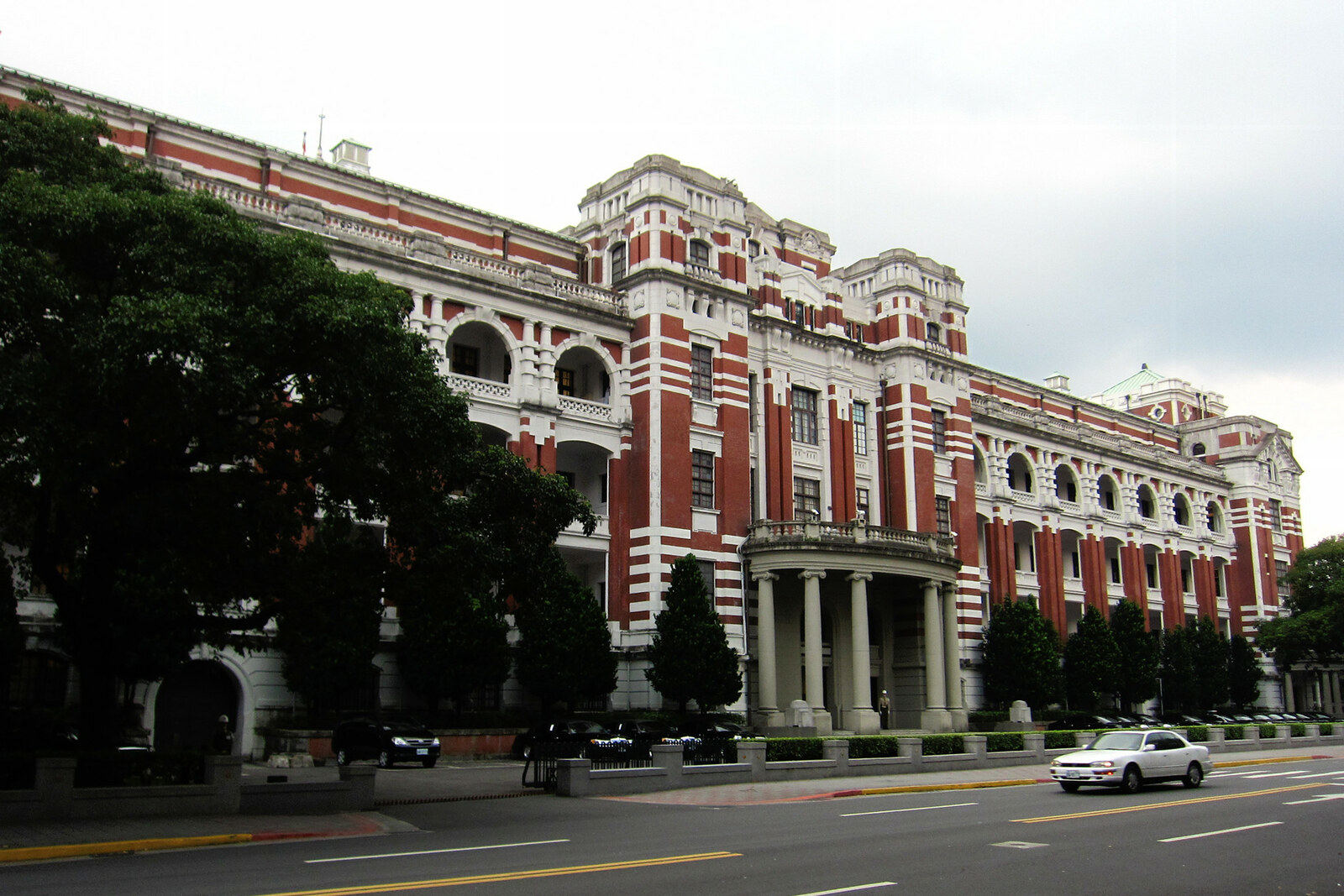
Look around first
What to notice
- Main façade
- Central entrance
- Flat roof above the central entrance
- Left wing
The story of the place
Behind the main façade with its central entrance stood the Taiwan Governor-General's Office of the Japanese colony. The island was governed from here; later, the same offices and halls became the presidential office, where the president and vice president work and where meetings and receptions are held. The flat roofline above the central entrance remains in place of the façade's former semicircular crowning feature.
In nineteen forty-seven, technician Li Chun-yao began removing charred beams, broken bricks, and parts of the floors from here. Clearing the building took about ten thousand ox carts. Li was assigned to supervise the restoration of the building where he himself had once begun his service.
At eighteen, he joined the construction division of Taiwan's Japanese administration as a technician. He earned his living drawing up plans, estimates, and supervising public construction projects. Standing before him at the time was the Taiwan Governor-General's Office—the colony's main administrative building, completed in nineteen nineteen. The president now works here but does not live here: it is an office building with the president's and vice president's offices, meeting rooms, and reception halls.
On May thirty-first, nineteen forty-five, during an American air raid, bombs struck the left side of the façade, the main entrance, the stairways, and the elevator shafts. The fire lasted three days; damage affected about eighty percent of the building. A month and a half later, Japan surrendered, the Taiwan Governor-General's Office ceased to exist, and Li found himself a specialist at an institution that no longer existed.
The new provincial administration retained Taiwanese technicians and some Japanese engineers who knew the building's structure. Chen Yi, head of the administration, ordered the building restored, and well-off Taipei residents began collecting donations. Li took on supervision of the work. The clearing and repairs required about eighty thousand worker shifts.
They did not restore the prewar appearance exactly. A semicircular crowning feature had once stood above the central entrance; after the bombing, it was replaced with a flat roof. Stone slate proved too expensive, so the roof was covered with metal. By the end of nineteen forty-eight, the rooms were again fit for use.
The building was named Jieshou Hall—the “Pavilion of Chiang Kai-shek's Longevity”: the fundraising campaign had begun for the sixtieth birthday of the head of the Republic of China. The first major event after the repairs was a provincial exhibition. Visitors were admitted to the former closed Taiwan Governor-General's Office, but the exhibition did not last long. After the defeat of the Kuomintang (KMT) in the civil war, the central government moved to Taiwan. On March first, nineteen fifty, Chiang Kai-shek resumed his presidential duties here, and the presidential office has been located in the building ever since.
Li Chun-yao continued to work on historic buildings and, decades later, received the Taipei Culture Award, including for his work on this building. The shape left by his first major postwar restoration can be seen from the street: above the central entrance, the flat roof remains in place of the lost semicircular top.
Useful on site
The exterior can be viewed at any time from public sidewalks. Open visits usually take place on working Mondays—Fridays 09:00—12:00, with entry until 11:30; photo identification and security screening are required.
Checked: June 29, 2026. Check the official source before visiting.Plan primarily for viewing the exterior. Check separately whether entry is possible, and observe the restrictions around an active government building.