 Guide On Map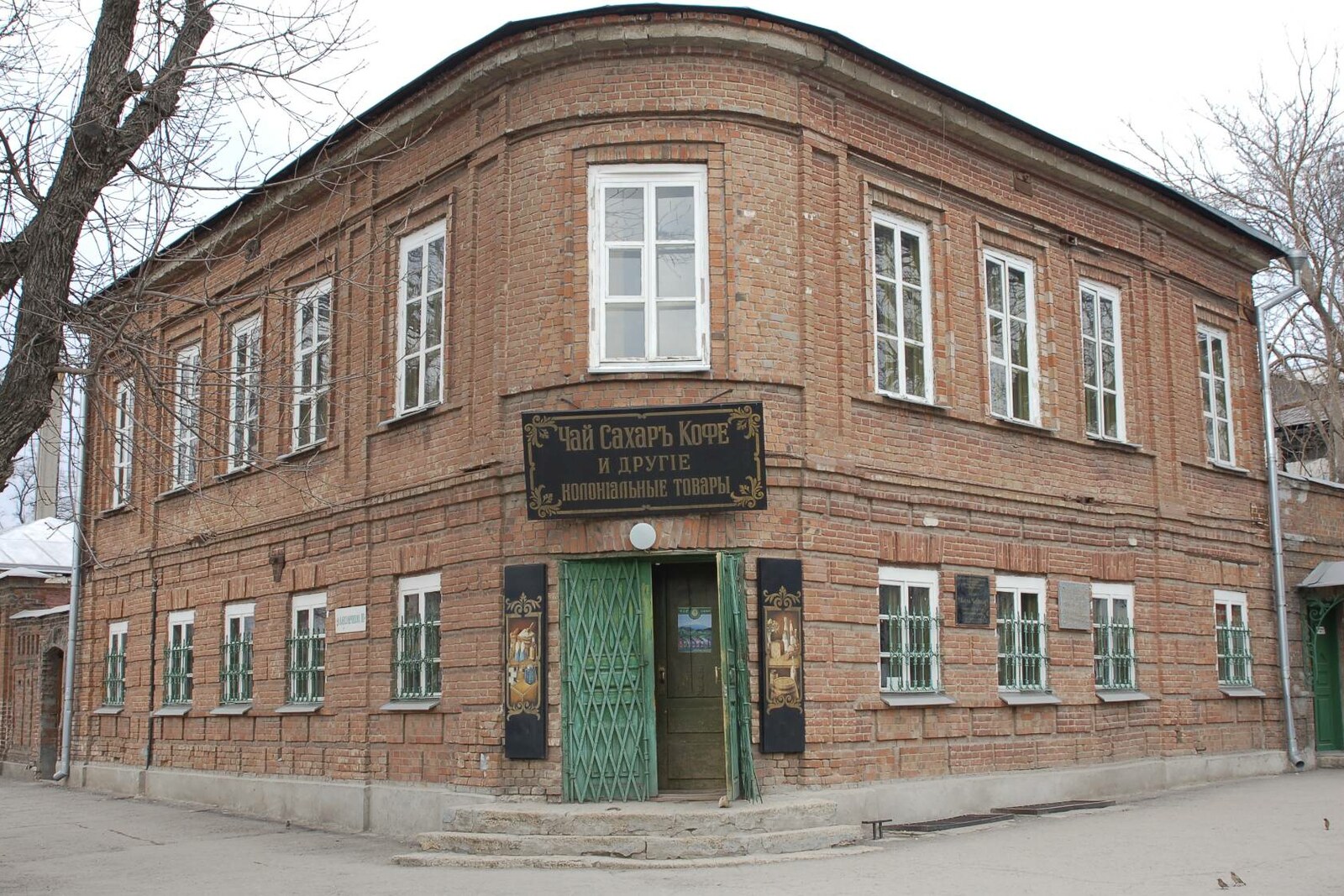
Look around first
What to notice
- Black sign with gold letters
- Trade scales
- Counter desk
- Crates and jars of goods
The story of the place
The commercial part of the house occupied the lower floor: goods were stored and handed out among the scales, counter desk, crates, and jars. The living rooms were upstairs, so the shop’s work was part of the family’s daily life rather than something behind a separate door. The exhibition opened on November third, nineteen seventy-seven, and was assembled from family recollections, documents, and antique objects; the original interior has not survived untouched to the present day.
In eighteen sixty-nine, the Taganrog merchant Pavel Yegorovich Chekhov was looking for a place where his business would bring in more money. He rented a two-story house from the merchant Moiseyev, near the new market, fairground squares, and the railway station. He opened a shop downstairs, kept stock in the basement, and housed his family upstairs. Above the entrance appeared a black sign in gold letters: “Tea, sugar, coffee and other colonial goods.” At the time, “colonial goods” meant imported products such as tea and coffee, but the assortment was much broader: flour, groats, soap, candles, kerosene, herring, medicines, and wine.
The word “Chekhovs” here refers to the entire Chekhov family. The father was the owner, but he put his sons Alexander, Nikolai, and Anton behind the counter. Pavel Yegorovich wanted to train nine-year-old Anton for commerce and make him his “master’s eye”: the boy was to hand out goods, count money, and keep an eye on the assistants.
Chekhov’s elder brother later described a winter evening in this house. Anton returned from the gymnasium and sat down to study Latin. His father was about to leave and ordered him to go down to the shop. The boy tried to object: he had a great deal assigned for the next day, and the shop was cold. Pavel Yegorovich replied that he could learn his lessons at the counter desk. The shop was not heated so as not to spoil the goods. Anton sat down on a soap crate, opened his notebook, and found ice in the inkwell. If he left the translation unfinished, he would get a poor grade at the gymnasium; at home, his father might whip him for it.
The science of trade also proved complicated. According to a family recollection, Anton once saw a boy behind the counter hold down one pan of the scales with his finger and short-weight a customer on sausage. His mother explained to her son that cheating was forbidden and that his father would not allow it. The customer soon returned with a complaint. Without looking into the matter, Pavel Yegorovich refused to acknowledge the short weight: he declared that her household scales had been wrong and defended the shop’s good name. He considered himself an honest merchant, while his son had already seen how an honest rule disappears when a loss of a few kopecks lies in the other pan.
Pavel Yegorovich hoped to raise successors to his business. In eighteen seventy-four, the Chekhov family left this rented house and moved into one of their own. Two years later, the father went bankrupt and fled from his creditors to Moscow. Sixteen-year-old Anton remained in Taganrog to finish gymnasium and earned money by giving lessons. Later, with his literary fees, he supported the family that his father had once hoped to support through trade.
The present exhibition opened on November third, nineteen seventy-seven. The shop’s furnishings were recreated from family recollections, documents, and antique objects; this is not a commercial space that has stood untouched since the Chekhov family’s time. On the first floor, there are scales, a counter desk, and goods again; upstairs are living rooms. This is the very layout of the house that allowed the father, at any moment, to summon his son from his schoolbook to the counter.
Useful on site
Tue–Sun 10:00–18:00, ticket office until 17:00; Mon closed. Until 31.08.2026, on Thursdays 10:00–19:00, ticket office until 18:00. 01.07.2026 is a sanitation day.
Checked: June 24, 2026. Check the official source before visiting.From outside, you can make out the sign and the layout of the trading house; the interior is needed to feel how close the counter and the family home were.