 Guide On Map
Taganrog: Chekhov, the Old Town, and the Port
From the Chekhov Shop Museum through the old center to the monument to Peter the Great
Guide On Map on your phone
Open the walk like a regular app
It takes about 10 seconds to install. No app store needed.
The whole path
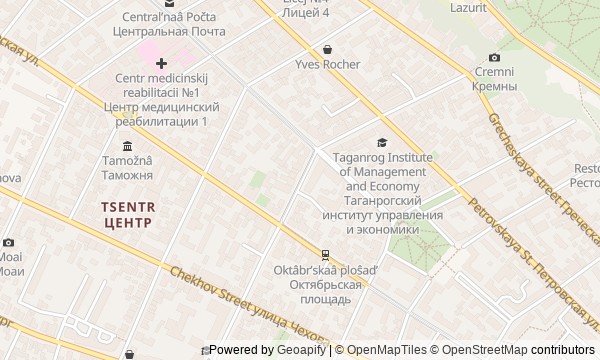
Route map
About the walk
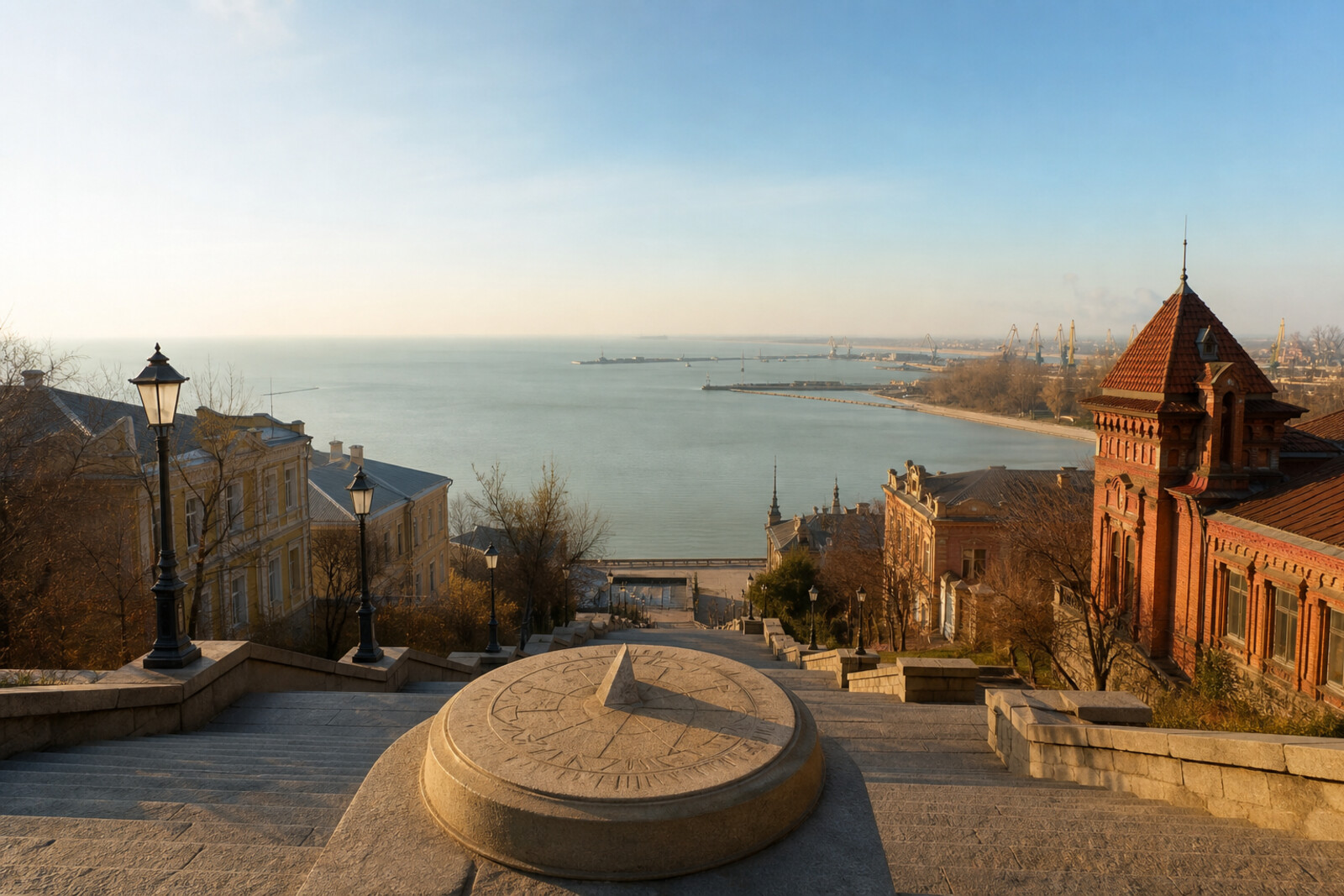
You will begin at the family shop near the former market, step into the gymnasium and Alferaki Palace, then follow old streets to a whitewashed wing and a red-brick house above the bluff. From there, the route descends the Stone Staircase to the water, runs beside the port, and ends at the cape before a bronze Peter the Great facing the harbor.
This is more than a walk through Anton Chekhov's addresses. You will see Taganrog through its merchant families, school circles, city museums, and sea trade. Sheets bearing autographs turn up in a museum stove. A teenager once barred from becoming a musician is brought in for music at home. A promenade turns out to have been a freight road.
The story moves from a small human detail to what it set in motion, separating reconstructed interiors from original buildings. By the end, you will be able to explain why literary Taganrog cannot be separated from the descent to the port and the figure above the Sea of Azov.
Why this order
The shop and the gymnasium come one after the other: first you will see Anton Chekhov's duties at home, then the school where he was already acting on his own. After the gymnasium, you enter Alferaki Palace: the story of a young man gives way to that of the city museum, whose founding Anton Chekhov also helped bring about. Chekhov's Birthplace Museum follows for the sharp contrast between ceremonial halls and a cramped wing, and between creating a museum and accidentally saving its relics. From the wing, the road leads to Tchaikovsky House: another family space becomes the place where someone else's fate was decided, while also bringing the route to the edge of the cape. The Stone Staircase then takes the journey literally downward—from residential streets to the former port strip. Below, Pushkinskaya Embankment picks up the staircase's trading story and carries you along the piers. The monument comes after the port: only from here can you see which harbor the bronze figure faces and why it was placed at the tip of the cape.
Those who want to connect Anton Chekhov with the city of his youth Fans of intimate museums and family stories Those who value the journey from old streets to the sea
Those not planning to enter several museums Those who find a long descent and climb on stairs difficult Those looking only for a short walk along the embankment
Before you go
The route combines museum interiors, city facades, a garden, stairs, and an open shore, so check exhibition availability for your chosen day before you set out. For the outdoor section, wear comfortable non-slip shoes, bring wind protection, and take a charged phone with headphones. The Stone Staircase requires steady footing; decide in advance whether the descent suits you, and do not attempt it in bad weather. Do not rush to buy admission to every museum automatically: choose the interiors that matter most to you, and treat the other stops as architectural and urban ones.
When to go
Give the first half of the route more attention than the distance suggests: small details and the tightness of the rooms matter at the shop, the gymnasium, and Chekhov's Birthplace Museum. Alferaki Palace makes a natural midpoint, after which the story noticeably gathers pace and heads toward the sea. The last three stops are best visited in daylight, leaving time for an unhurried descent, a pause by the water, and a final look from the monument toward the port.
Backup plan
If museum interiors are unavailable, keep the route in the same order: at the Chekhov Shop Museum, the gymnasium, Chekhov's Birthplace Museum, and Alferaki Palace, look at the facades and listen to the stories outside rather than trying to replace the exhibitions with guesswork. Tchaikovsky House and the upper platform by the Taganrog Sundial will still prepare the transition to the port theme. If the steps are wet, icy, or physically unsuitable, skip the descent and choose a safe detour using a current map; the sea horizon can be read from above as well. It is important to finish at the monument to Peter the Great even on a shortened route—only there do the Chekhov and Peter lines finally meet.
Route conditions
Surface. Paved — 362 m (data covers 7% of the route)
Stairs. Flights: 1, 121 m in total
Access. Wheelchair — no; stroller — limited (stairs)
Facilities. Toilets — 3
Elevation. Ascent — 49 m; descent — 52 m
OpenStreetMap extract of July 4, 2026: database data, not a check on the ground. Data © OpenStreetMap contributors, ODbL licence
Walk plan
Open in maps ↗- 1
Chekhov Shop Museum
Here, the family business turns into a story of a succession that never came to pass and a new family breadwinner. - 2
A. P. Chekhov Literary Museum and Gymnasium Garden
This stop will show Chekhov among his classmates and the price the gymnasium students were prepared to pay for a friend. - 3
Alferaki Palace
This grand family home extends the route from the writer’s biography to the history of the city museum. - 4
Chekhov's Birthplace Museum
The small annex shows just how accidental the preservation of Chekhov's memory proved to be. - 5
Tchaikovsky House
This stop takes you beyond the Anton Chekhov theme to another family and one decisive musical choice. - 6
Stone Staircase and Taganrog Sundial
The descent links the city's mercantile geography with the defense of the seashore. - 7
Pushkinskaya Embankment and the Port Horizon
Here you will see how a cargo road by the harbor became a waterfront for strolling. - 8
Monument to Peter the Great
The finale brings together the chosen site for the harbor and the long fate of the monument erected above it.
Route features
Everything you need stays in the browser
Progress, saves and your trip plan are stored on this device.
Add Guide On Map to your home screen so the walk opens outside the browser.
How we handle sources, maps and corrections: our editorial standards