 Guide On Map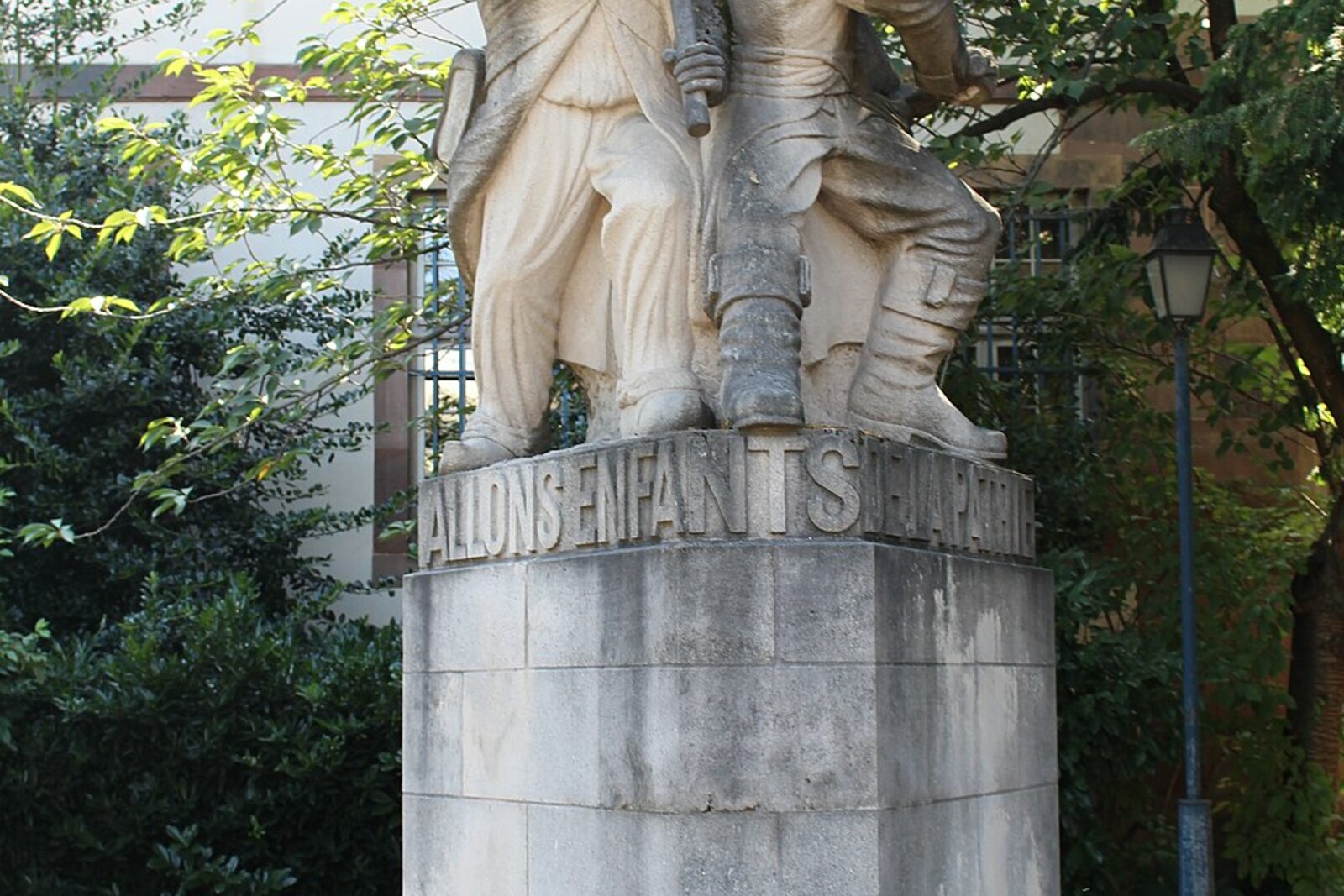
Look around first
What to notice
- Two stone volunteers
- The flag in the figures' hands
- A line from the anthem on the pedestal
- Two bronze medallions on the façade of the Bank of France
The story of the place
In seventeen forty, Marshal François-Marie de Broglie, who commanded the royal troops in Alsace, ordered the horse market here to be turned into a promenade lined with linden trees. It retained the name Broglie and the space's elongated shape. Today, trade still takes place here at the weekly market, and rows of festive stalls are set up before Christmas.
At the city hall, two stone volunteers hold the staff of a single flag. The first line of the French anthem is carved into the pedestal: “Forward, sons of the Fatherland.” The sculptor Alfred Marzolff created this monument after the First World War; it was unveiled on July fourteenth, nineteen twenty-two. The composition included bronze portraits of two people: the song's author, Claude Joseph Rouget de Lisle, and the man who commissioned it, Strasbourg mayor Philippe-Frédéric de Dietrich.
On April twentieth, seventeen ninety-two, revolutionary France declared war on a monarch of the House of Habsburg. Strasbourg stood at the border, and the Army of the Rhine was based here. Mayor de Dietrich needed a song that soldiers could march out to. He turned to Rouget de Lisle, a captain in the engineering corps: Rouget de Lisle made his living as an officer, but had already written poetry and music for city celebrations.
Over one night, Rouget de Lisle composed the words and melody of the “War Song of the Army of the Rhine.” It was performed at de Dietrich's home the following day. A later famous painting shows the author singing with his hand raised, but a family letter preserves a different scene. De Dietrich himself sang the new piece in his tenor voice, while his wife, Louise-Sibylle, arranged the music for harpsichord and other instruments and began copying out the parts. For those gathered, it was a successful marching piece, still without the name La Marseillaise.
One copy reached François Mireur, a volunteer from Montpellier. On June twenty-second, he sang it at a patriotic banquet in Marseille; the following day, a local newspaper printed the text. Volunteers from Marseille learned the song and carried it with them to Paris. Parisians heard it from the arriving southerners and began to call it “the song of the people of Marseille,” then La Marseillaise.
For its first performers, the revolution ended more harshly. De Dietrich sought to preserve the constitutional monarchy. After the king's fall, he was accused of conspiracy, and even an acquittal in court did not bring him freedom: on December twenty-ninth, seventeen ninety-three, the former mayor was executed in Paris. Rouget de Lisle protested de Dietrich's arrest, lost his officer's post, and then spent almost a year in prison. While the author was in custody, republican armies performed his song; in seventeen ninety-five, it was declared the national anthem.
The monument was placed on Place Broglie because in nineteen twenty-two, the first performance was believed to have taken place at an evening gathering in the de Dietrich family mansion, which stood here on the site of the present Bank of France. Later, archivists discovered that the mayor had rented another house—on Rue des Charpentiers, beneath the present number seventeen. The exact address of that historic evening remains disputed, and the building on the square to which the earlier version was tied no longer exists.
In nineteen forty, the National Socialist administration ordered Marzolff's monument smashed. Forty years later, craftsmen from the Fondation de l'Œuvre Notre-Dame restored the stone volunteers from a surviving plaster model. The two bronze medallions from the earlier composition are now mounted on the façade of the Bank of France: de Dietrich and Rouget de Lisle remain opposite the stone copy of the monument created for their song.
Useful on site
The square and monument are accessible from outside without a schedule; city events and markets may alter the routes through them.
Checked: June 24, 2026. Check the official source before visiting.This stop is entirely outdoors. Walk around the monument to take in the whole composition, and look for the medallions separately—they are not on the monument itself.