 Guide On Map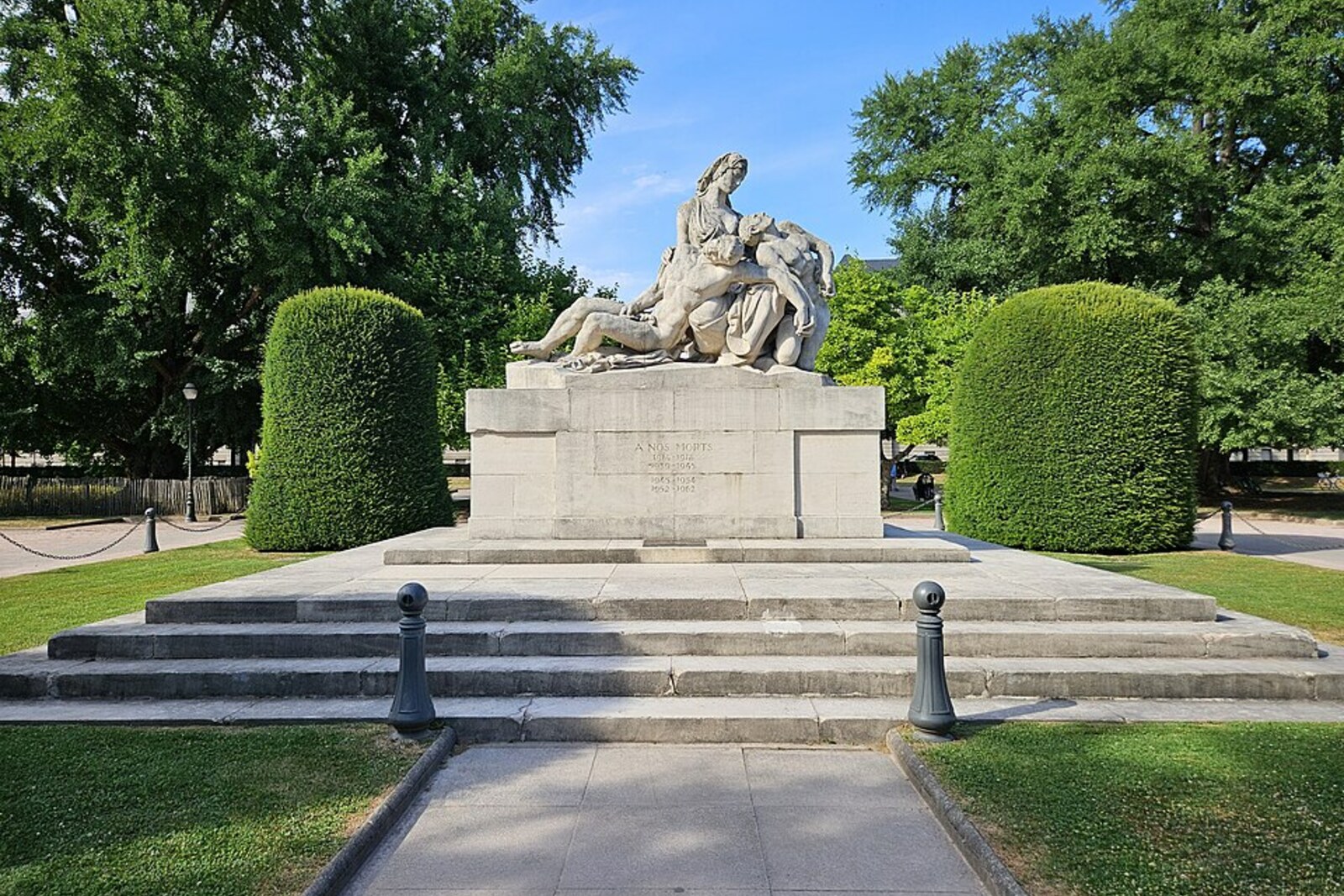
Look around first
What to notice
- Female figure with two sons
- The touching hands of the figures
- The inscription “To Our Fallen”
- Circular garden
The story of the place
Place de la République was assembled as the central hub of the Neustadt, a district laid out on the site of Strasbourg’s dismantled fortifications. Around the circular garden stand institutions, the former emperor’s palace, and an avenue to the university: this whole ensemble was conceived for a city with capital ambitions. The garden survived several renamings, and only the head remains of the equestrian statue that once stood here; it is now kept at the Strasbourg Historical Museum.
At the center of the circular garden, a woman holds two dying sons on her lap. They are naked, with no weapons beside them. Their bodies face in different directions, but the brothers’ hands touch. The pedestal bears only the words: “To Our Fallen.” It does not say for which country they died.
That omission begins with the square itself. After the Franco-Prussian War of eighteen seventy to eighteen seventy-one, Alsace was annexed to the German Empire. The German administration dismantled part of Strasbourg’s fortifications and began building the Neustadt—a New City intended for a capital role. Institutions, the emperor’s palace, and an avenue to the university converged here. The square was named Kaiserplatz—the Emperor’s Square.
In nineteen eleven, an equestrian statue of Wilhelm I, King of Prussia and the first German emperor, was installed in the circular garden. During his reign, Alsace passed to Germany, so his figure marked precisely the turning point after which this whole district arose.
During the night from November twentieth to twenty-first, nineteen eighteen, German units were already leaving Strasbourg, while French troops had not yet entered. Townspeople pulled Wilhelm down from his pedestal, beheaded the statue, and hammered the bronze with sledgehammers. Municipal workers later took the torso away to be melted down; the head disappeared. The following year, Kaiserplatz received its present name—Place de la République, that is, the French Republic to which the city had returned.
But the French formula “died for the fatherland” was not suitable here for a memorial to the fallen. At the beginning of the First World War, Strasbourg’s residents were German subjects: some were conscripted into the German army, while other Alsatians went to the French as volunteers. Members of one family could find themselves under different flags, and the graves of those killed often remained far from home.
There was no permanent city memorial for another eighteen years. In nineteen thirty-six, Henry Lévy, a former first deputy mayor and owner of large mills, formed a committee to finally give families a place for shared mourning. The committee included veterans, war widows, disabled people, and Catholic, Protestant, and Jewish representatives. The city, businesses, and private donors raised the money.
The committee commissioned the sculptor Léon-Ernest Drivier. In nineteen eighteen, he had created the official bust of victorious France; here he was to portray a city for which one side’s victory did not bring both sons back. Drivier removed the uniforms from the figures. At the unveiling, Henry Lévy explained: before Mother Strasbourg lay brothers whom annexation had separated into two armies and brought together as opponents in war. Hence their joined hands and the short inscription without a country’s name.
A royalist newspaper responded with attacks on Lévy’s Jewish origins and on the business through which he made his living—the milling enterprises. This did not stop the memorial. On October eighteenth, nineteen thirty-six, it was unveiled by Albert Lebrun, President of France. Less than half a year later, Henry Lévy died.
In nineteen forty, the square was renamed Bismarckplatz, but the sculpture was left intact. Since nineteen forty-five, it has once again been Place de la République. Nothing remains of the square’s equestrian statue: the torso was melted down, and Wilhelm’s head, found many decades later, is now kept at the Strasbourg Historical Museum. In the circular garden, a little to one side of the former imperial pedestal, wreaths are laid for the two sons without uniforms.
Useful on site
The square and memorial are accessible outdoors without a schedule; individual buildings around it have their own access hours.
Checked: June 24, 2026. Check the official source before visiting.The square is large, so walk around it and view the ensemble from several sides. When crossing the roadways, use regular crossings.