 Guide On Map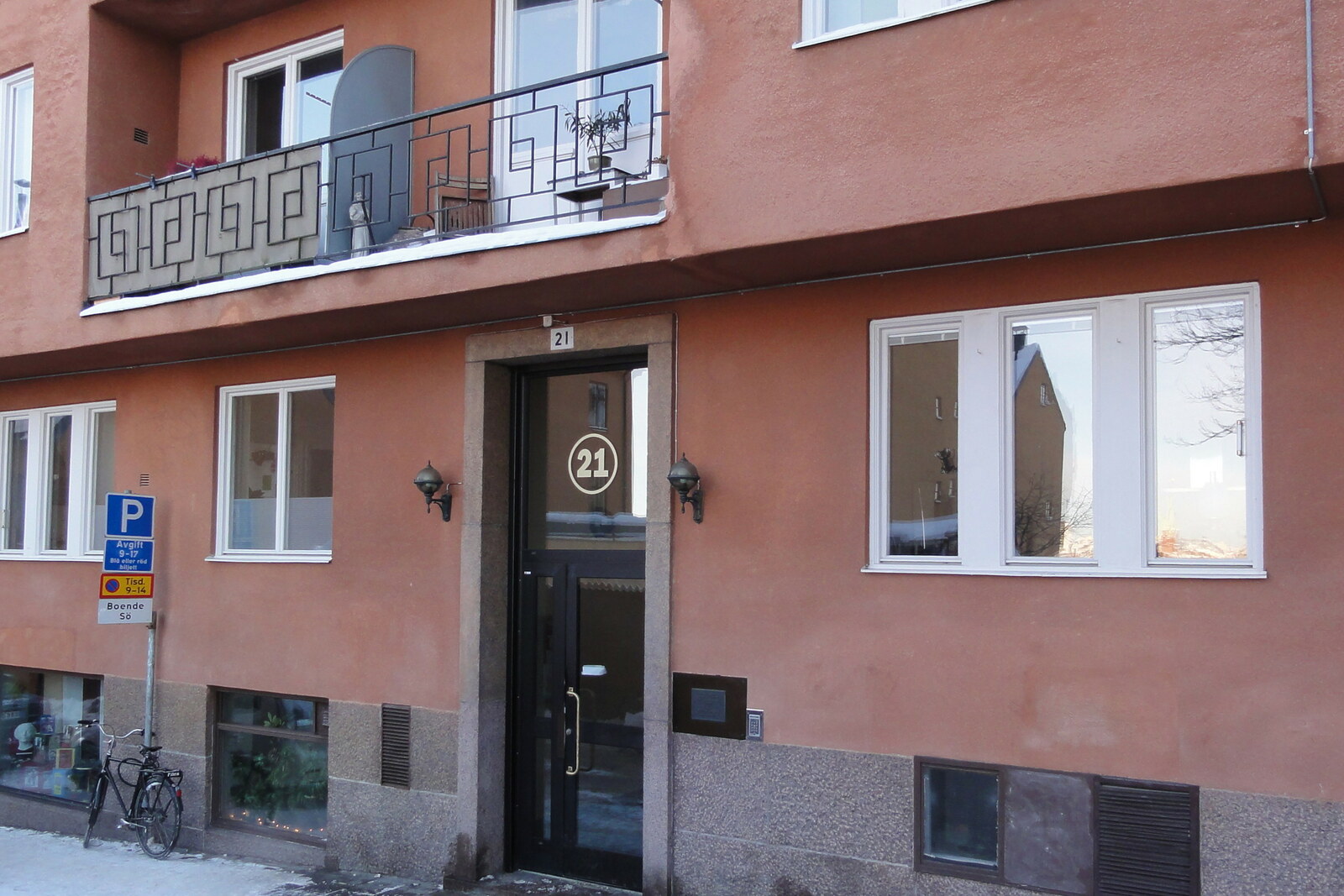
Look around first
What to notice
- Bronze bust
- Smooth facade of house number 21
- Park slope
The story of the place
The slope here is given over to a small park, and opposite it runs the even facade of house number twenty-one on Bastugatan. This house was intended for people of modest means, so most of its apartments were made one-room. One of them became a writer’s study and was preserved as a museum, while his bronze bust stands in the park.
In nineteen forty, city planners created a children’s and scenic park here. It was called Mariatrappan—“Maria’s little garden.” Two eighteenth-century houses on this site had been demolished two years earlier. Its current name came from the man in the new building opposite.
In the autumn of nineteen thirty-four, Ivar Lo-Johansson moved into number twenty-one Bastugatan—the son of agricultural laborers and a writer campaigning for the abolition of the statar system. Statars were family workers on large estates. The man was hired for a year, his wife also had to work, and a substantial part of their pay came in food and housing. The family was left with almost no money; debt to the owner could tie it to the same estate for another year. Along with their work, people risked losing their home.
Lo-Johansson himself grew up in such a family, worked as a farmhand and a bricklayer, and then began earning money from books. The house on Bastugatan was built during the economic crisis specifically for residents of modest means: most apartments here were one-room. Ivar rented one such apartment to live in, and later turned a second one on the same floor into a study.
From this room, he traveled through rural regions, collected testimony, and wrote for the newspaper of the agricultural workers’ union. The two-volume Statars and other books about people whom city readers usually saw only as anonymous servants on an estate were written here. Lo-Johansson showed the consequences of annual hiring through the fate of the whole family: the wife’s work, dependence on the owner’s credit, moves, and evictions.
The books supported the trade union’s campaign, but it was not a writer’s decree that abolished the old system. Representatives of the landowners and the Swedish Agricultural Workers’ Union concluded a collective agreement. From the first of November nineteen forty-five, statar employment ended: rural workers began receiving cash wages and were no longer required to give the owner the labor of their whole family together with an annual contract.
Lo-Johansson lived on Bastugatan for fifty-six years, until his death in nineteen ninety. After that, the park opposite was given his name, and his one-room working apartment was preserved and opened as the Ivar Lo-Johansson Museum. A bronze bust was installed in the park in nineteen ninety-one, although the sculptor Nils Möllerberg had created the portrait as early as nineteen forty-five—the very year the statar contract disappeared. In the park, the young Ivar remains in a shirt, tie, and jacket, while behind the smooth facade opposite is the nearly unchanged room where he worked.
Useful on site
A city route stop; access to the elevator, church, museum, and theater varies, so check the current rules on the official pages or on site.
Checked: date not specified. Check the official source before visiting.The story can be read directly from the street. The working apartment is a museum, but the possibility of entering it must be checked separately.