 Guide On Map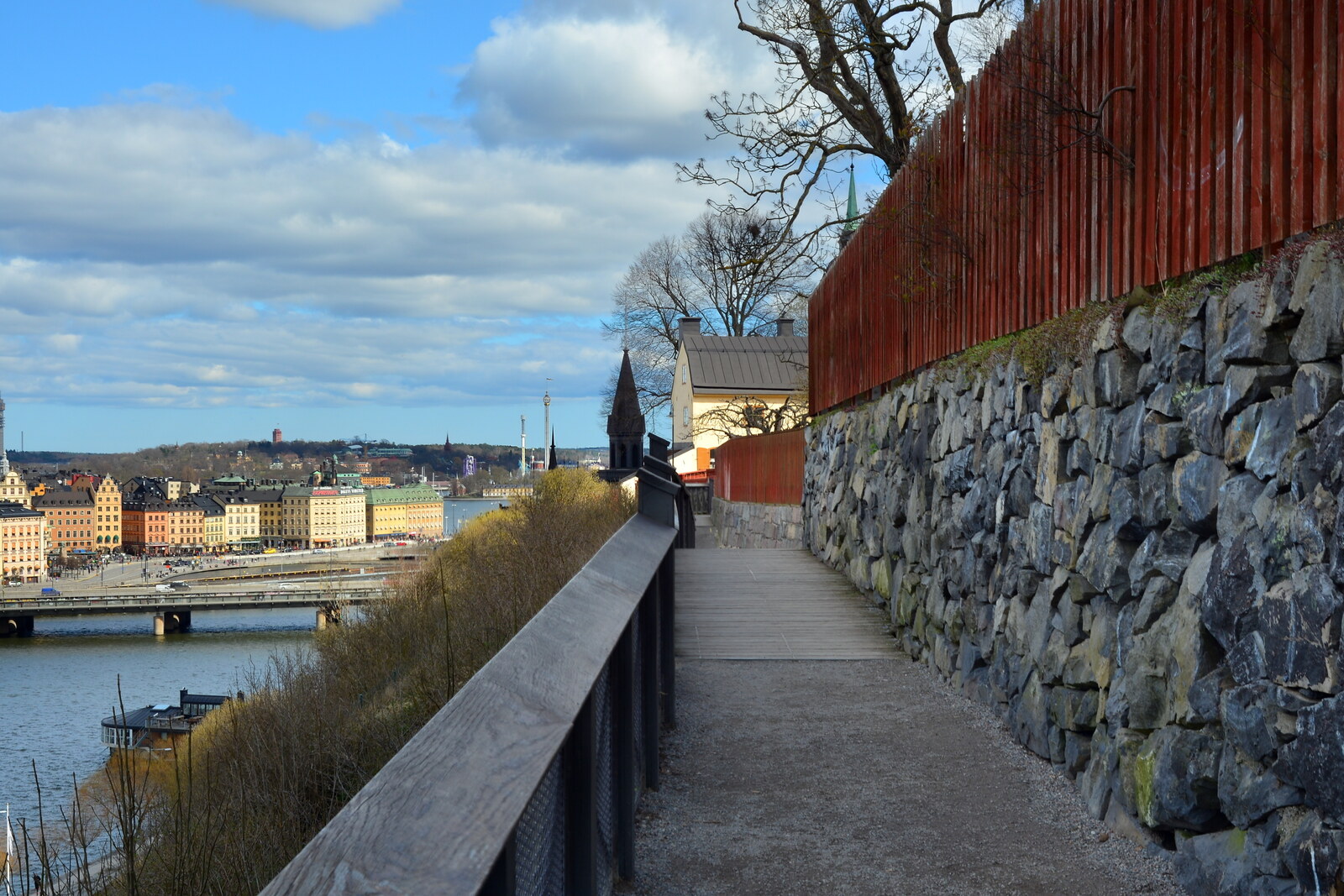
Look around first
What to notice
- Black wooden fence
- Retaining walls
- Terraces
- Benches
The story of the place
Monteliusvägen runs for four hundred sixteen meters along the outer edge of Mariaberget, above Riddarfjärden. Platforms and benches are set along the passage, while the slope beneath it is supported by retaining walls that had to be restored during construction. Materials were brought up here by cranes from the Södra Mälarstrand waterfront at the foot of the cliff: the cramped courtyards above were unsuitable for machinery. The path is named after an archaeologist who grew up and lived his whole life nearby.
The black wooden fence along Monteliusvägen was put up because of the people who lived on its other side. Before the path appeared, the strip beside the northern facades of Bastugatan was listed as parkland, but residents of the neighboring houses used it as private gardens. There was a view of Riddarfjärden from here, but outsiders could not reach the cliff edge without going between the houses.
In nineteen seventy-seven, the municipality approved a plan to preserve the old buildings of Mariaberget and provided for a public passage along the cliff. Residents risked losing the familiar boundary between garden and city: passersby were to be right outside their windows. They were also concerned about the long black fence, which changed the appearance of the slope from the water. Construction was delayed for almost twenty years.
After discussions, the landscape architect Hagman changed the route. He moved the path beyond the retaining walls, to the outer side of the slope. The houses remained higher and farther away, while passersby were separated by the very fence that residents had opposed. Materials were not brought through the cramped courtyards: they were lifted by cranes from Södra Mälarstrand, at the foot of the cliff. The project cost fourteen million kronor—twice the original estimate—but at the same time, the builders restored the worn retaining walls.
The path opened in August nineteen ninety-eight. Residents kept the enclosed space beside their houses, while everyone else gained four hundred sixteen meters of uninterrupted passage along the cliff, with terraces and benches above Riddarfjärden. This is how the place came to be used: people come here not for a single lookout point, but to walk along the boundary between residential courtyards and the shared city view.
Monteliusvägen was named after Oscar Montelius, an archaeologist and state antiquarian who learned to date prehistoric finds by changes in their form and by the objects found with them. His connection to this part of Stockholm was personal: Montelius was born, lived his whole life, and died nearby, in the house at S:t Paulsgatan eleven.
Today, the houses stand behind the black fence, the path runs outside the retaining walls, and the name of a neighboring resident stretches along the cliff from Kattgränd to the eastern exit onto Bastugatan.
Useful on site
A municipal route point; access to the lift, church, museum, and theater changes, so check the current rules on the official pages or on site.
Checked: date not specified. Check the official source before visiting.The path is narrow: do not block the way, and let oncoming people pass. Move slowly on wet or icy decking.