 Guide On Map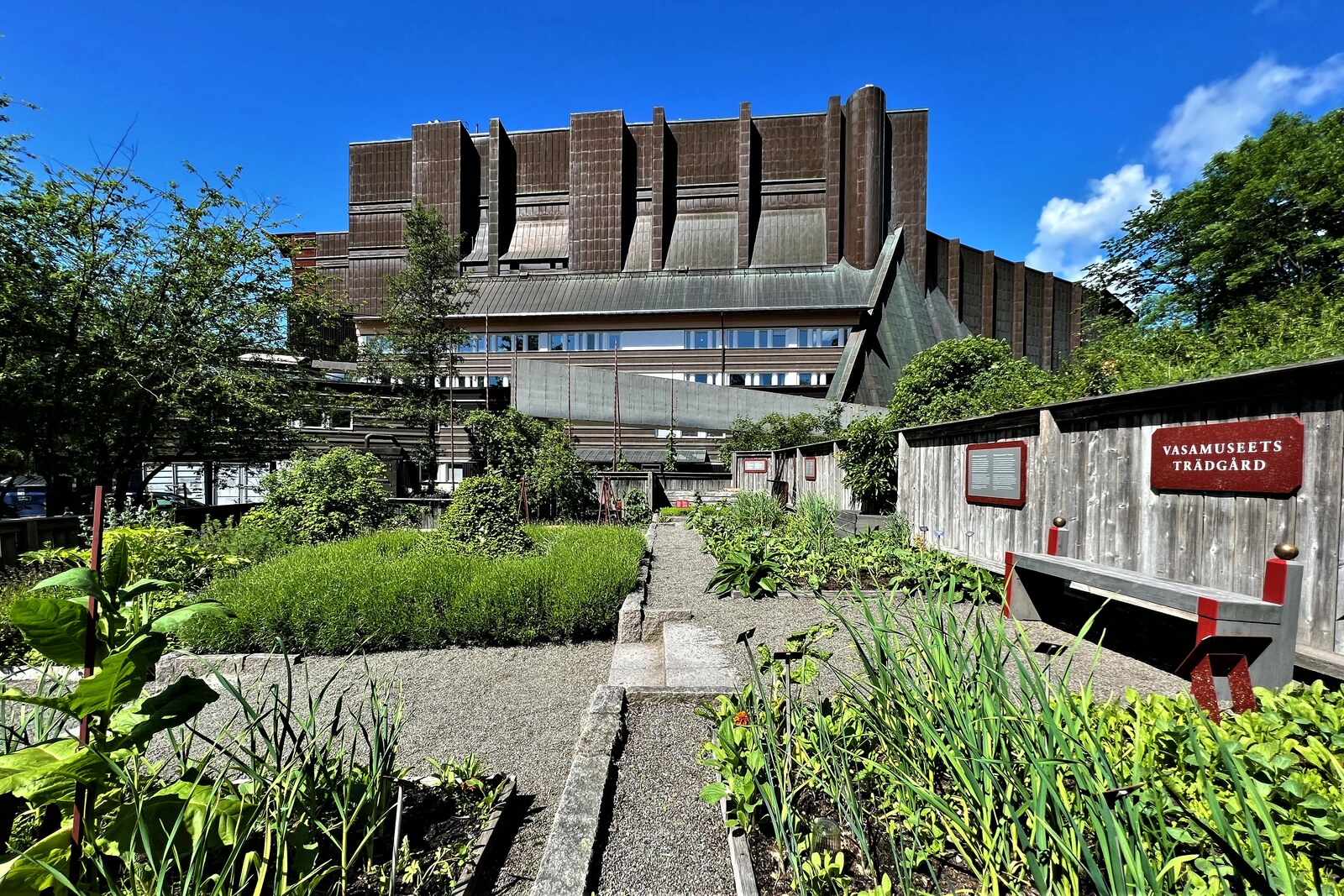
Look around first
What to notice
- The ship’s wooden hull
- Two rows of gunports
- The gilded sheaf on the stern
- The pontoon beneath the ship
The story of the place
The museum occupies the old ship-repair dock of Galärvarvet on Djurgården and was built around the royal warship Vasa. The tall wooden hull retains almost all of its seventeenth-century structure, while two rows of square gunports indicate two artillery decks. A reinforced-concrete pontoon remains beneath the vessel, having become the museum floor and explaining the hall’s unusual layout. On the stern, a gilded sheaf between cherubs is visible—the emblem of the dynasty that gave the ship its name.
In the summer of sixteen twenty-eight, thirty sailors ran across the upper deck of the ship that now stands inside the museum. Captain Söfring Hansson, responsible for preparing the new royal vessel, ordered them to run from side to side: this was how they tested how severely the ship rolled.
Vice Admiral Klas Fleming watched the test. He needed to send the delayed vessel to the fleet, and King Gustav II Adolf was already urging the sailors on. After several runs, Vasa heeled so far that people became frightened: the ship could capsize right at the quay. Fleming stopped the test but did not cancel the departure. He did not report the discovered flaw to the king.
The king ordered Vasa for the war against the Polish–Lithuanian Commonwealth and personally approved the design. The name came from an old Swedish word meaning a sheaf or a bundle of twigs: this was the emblem borne by the House of Vasa. On the stern, a gilded sheaf between two cherubs served in place of the ship’s nameplate.
The vessel was designed by the experienced shipwright Henrik Hybertsson. Calculations that could determine a large ship’s stability in advance did not yet exist; shipwrights relied on experience and on the proportions of earlier vessels. Vasa ended up with a superstructure that was too high and heavy above the water, on a narrow underwater hull. This could have been corrected by removing some of the armament, widening the hull at the waterline, or removing the upper deck. The test with the sailors showed that a correction was necessary. But Hybertsson had already died by then, the king was waiting for the ship, and Fleming ordered preparations for the voyage.
On August tenth, Vasa set off from Stockholm Castle. Sailors, their wives, and their children were aboard: the guests were to be put ashore in Vaxholm before the ship continued to the fleet. After a farewell gun salute, the gunports on both battery decks were left open.
At first, a light gust of wind heeled the vessel, and it righted itself. Near Tegelviken, the next gust arrived. The port side sank so low that water poured through the lower gunports. Hansson ordered the sails to be spilled of wind and the ports closed, but there was no longer time to reach them on the sharply tilted deck. About twenty minutes after the voyage began, Vasa settled on the bottom. It had traveled about one thousand three hundred meters. About thirty people died, mainly those trapped inside.
Hansson left the ship among the last. He was dragged underwater but managed to surface in his heavy, soaked clothing. Before the captain had time to dry off, he was taken into custody. The king, who was with the army in Prussia, demanded that those responsible be found.
At the inquiry, Hansson described the dangerous rolling. The shipwrights replied that they had built according to a design approved by the king. It would have been convenient to name Hybertsson as the main culprit, but the dead shipwright could neither be questioned nor punished. Fleming was not even summoned to the hearing. In the end, no one was punished: Hansson later supervised the same naval shipyard, and the shipwright Hein Jacobsson continued building royal ships until his retirement.
Almost all this physical evidence from the inquiry is inside the museum. About ninety-eight percent of Vasa’s wooden structure dates from the seventeenth century. The two rows of gunports also survive; diver Per Edvin Fälting felt them on the bottom of Stockholm Harbour in nineteen fifty-six.
Anders Franzén approached him—an engineer working with fuel in the Swedish Navy, who spent his free time in archives and searching for old ships. Franzén expected that shipworm had not destroyed the oak in the weakly saline water of the Baltic Sea. For three summers, he lowered a homemade sampling tool from a boat borrowed from the navy. On August twenty-fifth, nineteen fifty-six, a piece of blackened oak became stuck inside the tool. Fälting, a professional diver, descended after it and, in complete darkness, identified by touch a wooden wall with two levels of square openings.
Franzén was not seeking to recover guns or individual carved figures. He persuaded the military, archaeologists, officials, and a salvage company to raise the hull whole and turn it into a museum exhibit. Divers under Fälting’s leadership washed six tunnels beneath the vessel, threaded steel cables through them, and moved the hull into shallow water in eighteen stages. On April twenty-fourth, nineteen sixty-one, Vasa emerged above the water.
The ship was placed on a reinforced-concrete pontoon. Then restorers impregnated the wet wood with polyethylene glycol for seventeen years so that it would not shrink and crack as it dried, and for another nine years they gradually reduced the humidity of the air. Throughout this time, Vasa stood in a temporary museum nearby.
Galärvarvet on Djurgården, where an old ship-repair dock remained, was chosen for the permanent building. In December nineteen eighty-eight, Vasa was enclosed in a protective casing and towed on its pontoon across the water into the unfinished museum. The wall on the water side was left open. When the ship entered the dock, the water was pumped out and the opening was walled up. The floor beneath Vasa is still the same pontoon on which the raised hull was placed in nineteen sixty-one.
Useful on site
September–May daily 10:00–17:00, Wednesdays until 20:00; June–August daily 08:30–18:00. Closed December 24 and 25; December 31 10:00–15:00; January 1 10:00–17:00.
Checked: June 29, 2026. Check the official source before visiting.You can only see the ship properly from inside, so plan the visit separately and do not try to squeeze it into a short break. Without entering, the stop still connects the museum palace with the nearby naval memorial area.