 Guide On Map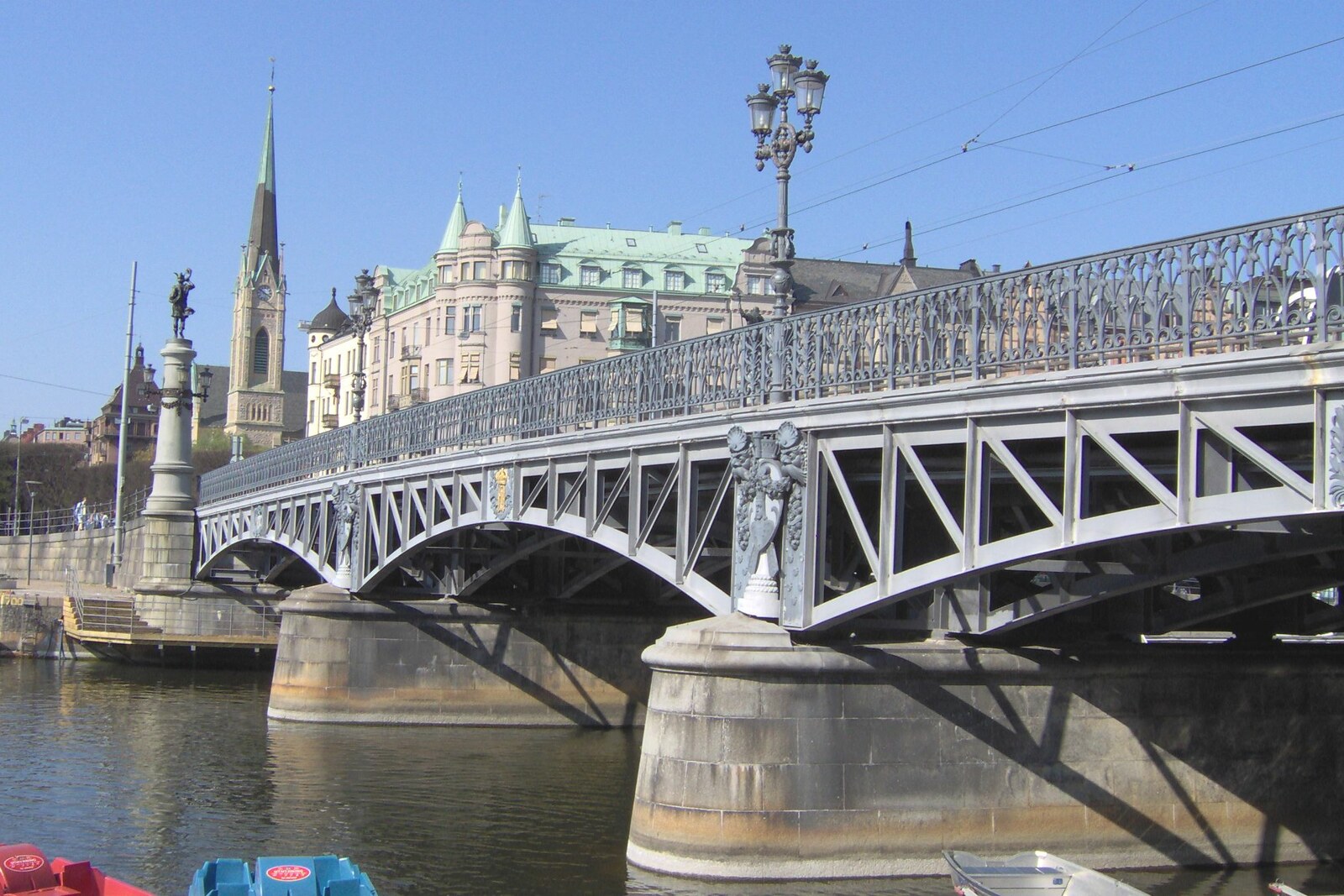
Look around first
What to notice
- Three iron spans
- Granite columns with four sculptures
- The figure of Heimdall with a horn
- Tram tracks
The story of the place
Four Norse gods stand on granite columns: Frigg and Heimdall with a horn on the city side, Freyja and Thor with a hammer on the other. Beneath them runs an iron crossing with three spans, wide enough for two tram tracks and broad sidewalks. It was assembled before the General Art and Industrial Exposition of Stockholm (1897), when the city needed a spacious entrance. The exposition pavilions were later dismantled, while trams and pedestrians still cross the bridge.
The name “Djurgårdsbron” means “the bridge of Djurgården,” and Djurgården itself was named after the royal game park. In fifteen eighty-one, King Johan III brought ten reindeer here and later added red deer. A century later, Karl XI ordered the hunting grounds to be enclosed by a fence: the animals were kept inside, while predators and poachers were kept outside. Guards stood watch at the gates, and an entrance fee was charged. The crossing here led from the city to one of the entrances to the enclosed royal park.
In seventeen thirty, King Fredrik I wanted a carriage road to Djurgården and ordered a new wooden pontoon bridge to be built. It was called Fredrikshovsbron, after the nearby royal estate of Fredrikshov. A bridge toll was collected from pedestrians, riders, and carriages.
Fifteen years later, the king himself inspected the crossing he had commissioned. He was traveling to Djurgården with a large retinue and many horse-drawn carriages. Under their weight, the poorly built bridge broke apart and partly sank beneath the water. The king, his companions, and the people in the carriages ended up in the cold, and at the time far-from-clean, Djurgårdsbrunnsviken.
The royal dip did not lead to the crossing being replaced immediately. The bridge’s owner, Stenberg, the inspector of Djurgården, repaired the structure, and it remained standing until the beginning of the nineteenth century. Only in eighteen twenty-five did Djurgårdskassan buy the dilapidated bridge and take the expenses upon itself.
The present-day Djurgårdsbron appeared before the General Art and Industrial Exposition of Stockholm (1897). The city engineers needed a wide entrance capable of carrying pedestrians, carriages, and trams at the same time. Carl Fraenell designed an iron bridge with three spans, Erik Josephson decorated the piers and candelabra, and workers at Bergsunds Mekaniska Verkstad made the metal parts. Its width of eighteen meters was enough for two tram tracks and broad sidewalks. After the exposition closed, most of the pavilions were dismantled, but the bridge was left in place.
The sculptor Rolf Adlersparre placed four Norse gods on granite columns. On the city side stand Frigg and Heimdall with Gjallarhorn. It is the bridge itself that explains the choice of Heimdall: in Norse mythology, he guards Bifröst, the crossing between Earth and the world of the gods. On the Djurgården side stand Freyja and Thor with the hammer Mjölnir.
The wooden Fredrikshovsbron, which threw its commissioner into the water, has long been gone from here. In its place, trams cross a three-span bridge under Heimdall’s protection.
Useful on site
Pedestrian access around the clock, no tickets required. Vehicle access to Djurgården is restricted seasonally on weekends and public holidays.
Checked: June 29, 2026. Check the official source before visiting.The bridge can be viewed without entering a building. Do not linger on the roadway or tracks: for details and photographs, choose the edge of the sidewalk without obstructing the flow.