 Guide On Map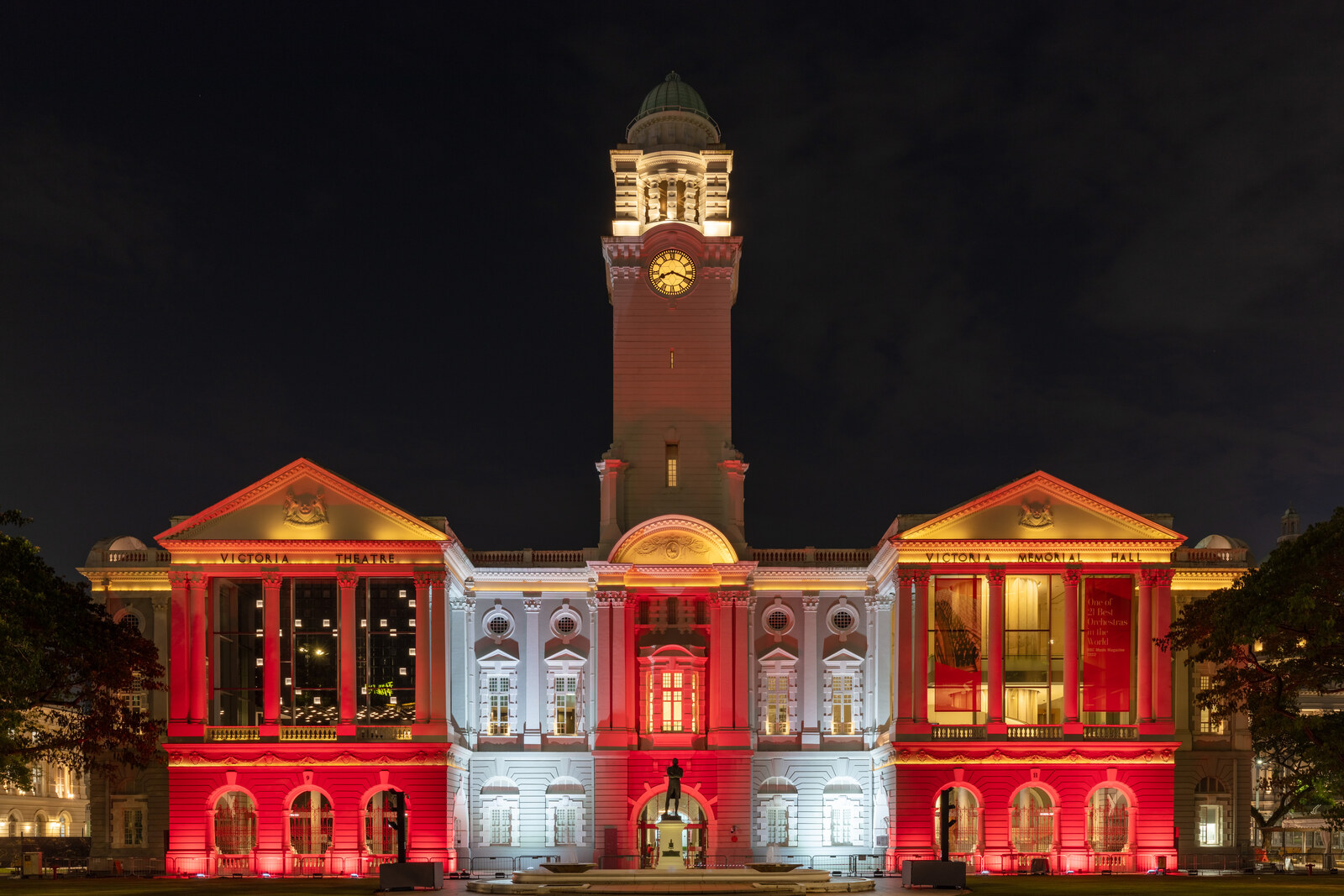
Look around first
What to notice
- Two symmetrical buildings
- Clock tower
- Theatre façade
- Concert hall façade
The story of the place
At the clock tower, two nearly identical façades meet, although the buildings on either side were constructed for different municipal needs. One building was erected as a public memorial hall in memory of Queen Victoria; residents, the colonial administration, and the municipality provided the money for it. The neighboring building housed City Hall, which was later converted for a theatre stage and given the same façade. The tower was then built between the two buildings, linking two independent structures into the Victoria complex.
The two symmetrical buildings before you appeared at different times. One hosts performances; the other, concerts and chamber programs by the Singapore Symphony Orchestra. The theatre building began as City Hall and was completed in eighteen sixty-two.
The name “Victoria” appeared after the death of the British Queen Victoria, during whose reign Singapore remained a British colony. Governor Frank Swettenham proposed building a public hall in her memory. Residents contributed one hundred twenty-nine thousand local dollars, while the colonial administration and the municipality added one hundred thousand each. The memorial hall opened in nineteen oh five. The old City Hall was then converted into a theatre with the same façade, and a clock tower was built between the two buildings. The present concert hall is the former Queen Victoria Memorial Hall.
But an event that could have happened only here is connected with another reopening of the theatre. In nineteen fifty-eight, after a major renovation, the City Council of Singapore decided to commission its own song for a ceremonial evening. Its theme was the municipal motto “Majulah Singapura” — “Onward, Singapore.”
The commission went to Zubir Said, a composer at Cathay-Keris Film Productions. He earned his living writing music for Malay films; he received no fee for this song. Zubir wrote the melody quickly, but struggled longer with the words. The text had to be in Malay, understandable to people from different communities, without rare or overly literary expressions. He asked an acquaintance for advice and separately had the language checked by a specialist.
On September sixth, nineteen fifty-eight, the choir and orchestra of the Singapore Chamber Ensemble gave the first performance of “Majulah Singapura” on the stage of the renovated theatre building. The song was intended for city ceremonies, but a year later it acquired a different fate. Singapore gained self-government, and Deputy Prime Minister Toh Chin Chye, responsible for the new state symbols, was looking for a short anthem in Malay. He chose Zubir's song, but asked for it to be shortened.
Someone had cut the score without the composer's consent. Zubir saw the altered version on a card sent to schools and, on October fourteenth, nineteen fifty-nine, wrote to the foreign minister that the shortening, in his view, spoiled the composition. That same day, the Legislative Assembly was to approve this version, but the vote was cancelled — perhaps precisely after Zubir's letter. The composer himself removed eight bars, and on November eleventh his revision was adopted. On December third, the song became the anthem of self-governing Singapore and, after the proclamation of independence in nineteen sixty-five, the country's national anthem.
Today, the shortened revision is performed. The first version, heard in the theatre building before you, was eight bars longer.
Useful on site
Treat this as an outdoor stop. The square and approaches are accessible as public urban space; entry inside depends on the schedule of performances and events.
Checked: July 1, 2026. Check the official source before visiting.Viewing the façades does not require entry. The interior spaces function as an active cultural venue, so access inside depends on the program and separate tickets.