 Guide On Map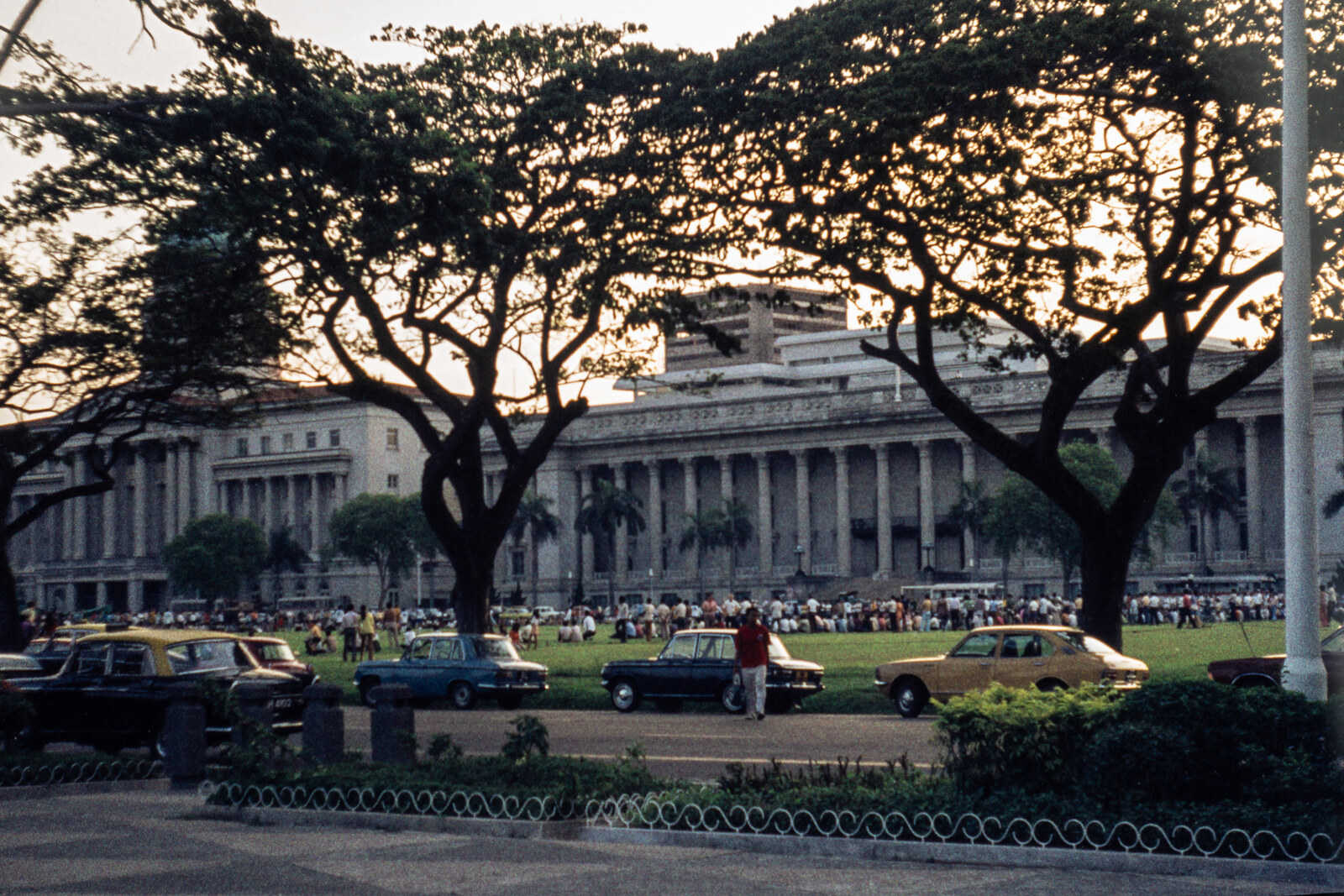
Look around first
What to notice
- The grass of Padang
- The broad City Hall staircase
- The City Hall colonnade
- The dome of the Former Supreme Court
The story of the place
Padang means field in Malay, and this purpose shaped the entire district at the river mouth: the colonial administration leveled the open land and grouped institutions and clubs around its edges. The broad grassy space accommodated parades, sports matches, and large ceremonies, while official decisions were made across the road in City Hall. Its building is now connected to the Former Supreme Court by passageways and a shared atrium; National Gallery Singapore operates beneath the dome and behind the colonnade. The chamber on the third floor of the City Hall Wing has been preserved, and St Andrew's Road still separates its staircase from the field.
On the morning of September twelfth, nineteen forty-five, people occupied the roofs around Padang and even the base of the Supreme Court dome. Thousands of Chinese, Malays, and Indians waited for the Japanese delegation to be led along St Andrew's Road. Three and a half years earlier, Allied soldiers taken prisoner and European residents had been gathered on this same field before being sent to camps. Now Allied units stood on the grass, and residents had come to see the procession in reverse.
Japan had already announced its surrender, but the troops in Southeast Asia had to be made subject to that decision by a separate document. General Seishiro Itagaki, who commanded Japan’s Seventh Area Army in Singapore, was to sign it on behalf of his ill superior, Field Marshal Hisaichi Terauchi. Admiral Louis Mountbatten, the Allied supreme commander in the region, arrived to accept the surrender of the land, naval, and air forces.
First, Mountbatten received the salute of the troops formed up on Padang and inspected the guard of honor. Then Itagaki was led across the field and up the broad staircase of City Hall—the name then used for what is now the City Hall part of National Gallery Singapore. The crowd booed the Japanese officers. After the mass executions, hunger, and fear of the occupation years, people could do this for the first time without expecting punishment.
In the main chamber, Itagaki signed eleven copies of the instrument of unconditional surrender. The entire procedure took nine minutes. The Japanese representatives stood, bowed, and went back out to the staircase. Mountbatten announced the surrender from those same steps. For the Japanese units, this meant disarmament and captivity; for the residents, the occupation ended, and the British Military Administration took over the governance of the island.
The arrangement of the ceremony explains Padang’s purpose. Its name means “field” in Malay. Colonial officials cleared and leveled the open land at the river mouth, then placed government buildings and clubs around it. There was enough space here for a parade and a crowd of many thousands; across the road stood the staircase for a public announcement and the chamber where the decision received signatures. That is why both sports matches and state ceremonies were held on this grass.
Today, the former City Hall is connected by passageways and a shared atrium to the Former Supreme Court beneath its dome. Since two thousand fifteen, both buildings have been occupied by National Gallery Singapore, with Singapore and Southeast Asia’s largest public collection of modern art. The Surrender Chamber has been preserved on the third floor of the City Hall Wing. The signatures were placed behind the colonnade on the right; people waited on Padang; and St Andrew's Road still runs between the field and that staircase.
Useful on site
Padang is accessible as an open urban space when there are no events or closures. National Gallery Singapore is open daily 10:00—19:00, last entry at 18:30; part of the permanent gallery is closed until the end of 2027.
Checked: July 1, 2026. Check the official source before visiting.First, remain at the edge of the field and take in the distance between the grass and the ceremonial staircase. The stop’s story can be read from outside; plan a visit to the gallery as a separate part of the day.