 Guide On Map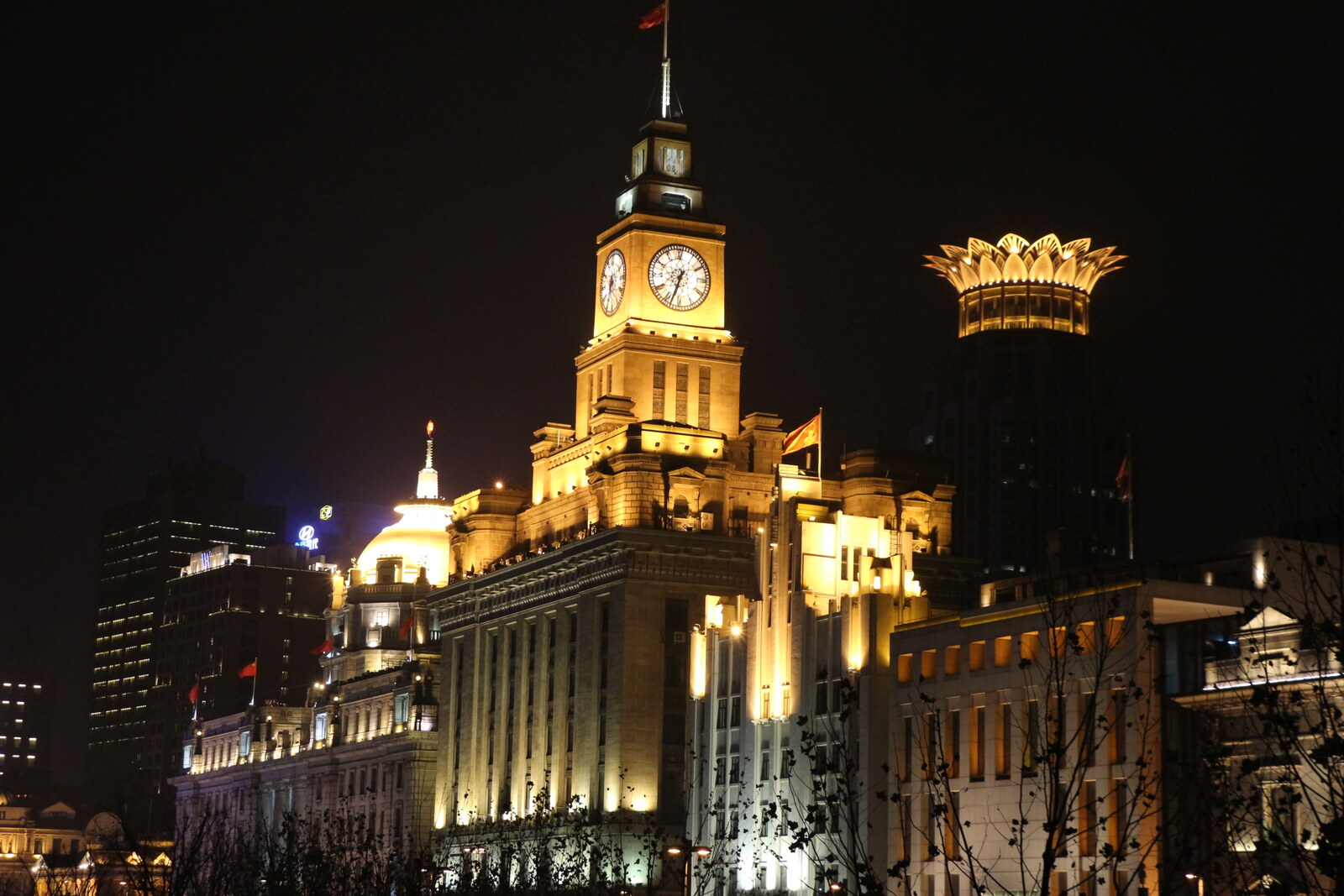
Look around first
What to notice
- Four clock faces of the Customs House tower
- Customs House tower
- Octagonal banking dome
- Mosaics of eight cities
The story of the place
By nineteen fifty-six, the building with the dome had already ceased to be the headquarters of The Hongkong and Shanghai Banking Corporation. City institutions were moving into its halls, and the former banking interior was being converted into offices and reception rooms. Mosaics remained above the octagonal lobby: the sun, the moon, classical deities, and eight cities where the bank did business—Shanghai, Hong Kong, Tokyo, London, New York, Bangkok, Paris, and Calcutta.
Some of those involved in the conversion proposed knocking down the images: they reminded people too clearly of the former owner and its international trade. The decision was to be proposed by Chen Zhi, the chief architect of the municipal planning administration. He was responsible for adapting the building to its new service and knew that a treated mosaic could withstand long isolation. Chen Zhi proposed covering it with a thick layer of fiber-reinforced plaster and paint. Before work began, the entire dome was photographed; then the images disappeared beneath the finish.
They remained hidden for more than forty years. When the building was transferred to Shanghai Pudong Development Bank in nineteen ninety-seven, workers began removing the coverings and found the colored mosaic beneath them. It was cleaned and restored. During the restoration, the symbols of the former bank were replaced with the emblems of the new one, so the dome retained the old map of banking cities, but without the former owner's name.
At the neighboring Customs House tower, the reason for its appearance was accounting. Tonnage duty was charged to merchant ships by the day: if a ship remained in port after midnight, another day was added to the bill. Ships' clocks showed different times, and captains argued with customs officers over whether midnight had arrived. The clock readings above the Customs House were then made the common standard. The first tower mechanism appeared here as early as eighteen ninety-three.
For the new Customs House building in nineteen twenty-seven, a much larger clock with four faces and five bronze bells was commissioned. The mechanism was made in England after the model of the clock at the Palace of Westminster. The minute hand, more than three meters long, weighs nearly fifty kilograms, and the mechanism must be wound every three days. For many years, this was done by the only clock keeper, Wei Yunshi: he climbed the tower, wound the weights, and corrected deviations in its timekeeping.
Above the Customs House, the four clock faces are still visible—the ones once used to settle a dispute over an extra day of port duty. Beneath the neighboring banking dome, the eight cities that lay under a layer of plaster for forty years are open again.
Useful on site
Open urban space; choose a viewing point that does not obstruct pedestrian flow.
Checked: date not specified. Check the official source before visiting.The best view is from outside at some distance; the mosaics are inside an operating building and are not part of the required walk.