 Guide On Map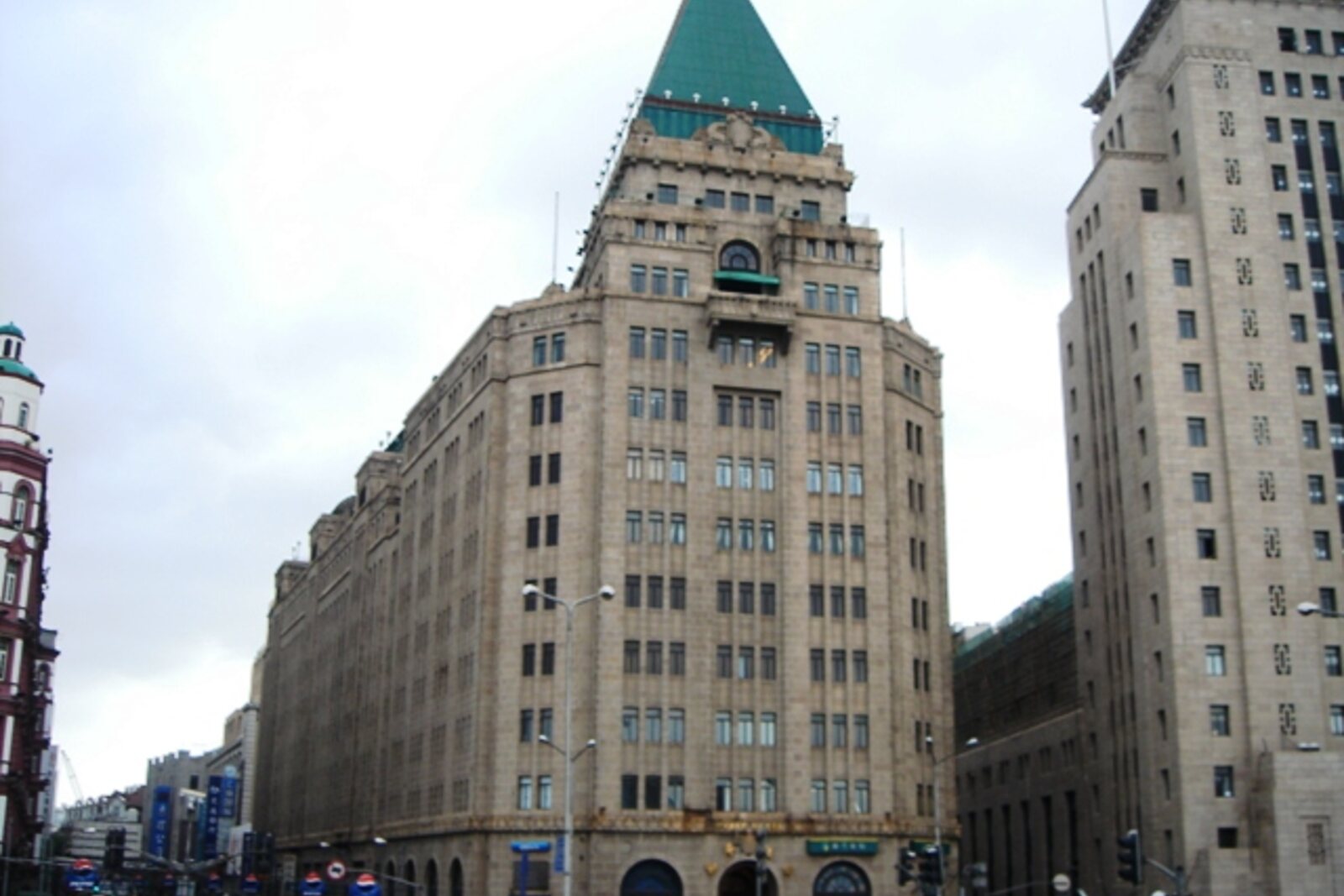
Look around first
What to notice
- Green pyramidal roof
- Northern façade of the Peace Hotel
- Southern hotel façade
- Two buildings on either side of Nanjing Road
The story of the place
The green pyramidal roof marks the northern one of two hotel buildings facing each other at the corner of Nanjing Road. They once accommodated guests separately; later, the city brought both sections under a single hotel sign, extending it across the street. After reconstruction, they were again assigned different purposes, but the two façade lines still hold this intersection together as a single place.
The building with the green pyramid on the north side of Nanjing Road is today’s Fairmont Peace Hotel. In nineteen twenty-nine, the Cathay Hotel opened here. The Palace Hotel already stood opposite. These names will be needed for the story that unfolded simultaneously in both buildings and on the roadway between them.
On August fourteenth, nineteen thirty-seven, the Battle of Shanghai was in its second day. Residents of the northern districts fled to the International Settlement—the foreign-administered part of the city, considered safer. The Bund was overcrowded. Some people sought shelter, while others climbed onto roofs and terraces to watch the air battle over the Huangpu.
Chinese pilots were trying to sink the Japanese flagship Izumo, which was moored by the Japanese consulate. They made their attacks on the ship under antiaircraft fire and in thick cloud. The bombs missed their target. After the catastrophe, the command maintained that shrapnel had damaged the bomb racks and wounded the pilots. Later research considers an error by the crews more likely: only a few seconds remained for aiming, and the aircraft were flying too high.
At four twenty-seven, the Palace Hotel clock stopped in the blast. The first bomb fell in front of the entrance to the Cathay Hotel and tore a crater more than a meter deep into the roadway. The second pierced the roof of the Palace Hotel and passed through several floors. The third destroyed part of the Cathay Hotel’s seventh floor. About one hundred fifty people were killed, and more than four hundred thirty were wounded. There were so many casualties precisely here because one of Shanghai’s busiest intersections—the start of its main shopping street—stood beside the river target.
Surviving guests and passersby began carrying the wounded into the lobbies of both hotels. Volunteers placed them in their own automobiles and drove them to hospitals. Firefighters had to raise a ladder to the upper floors of the Palace Hotel: its internal staircase had been destroyed. More than four hundred casualties were taken to Lester Chinese Hospital alone.
In nineteen fifty-six, the city administration reopened the former Cathay Hotel as a hotel and gave it the name Peace—that is, “peace.” Nine years later, the former Palace Hotel was joined to it, and one hotel occupied two buildings on either side of Nanjing Road. After reconstruction, the two hotels were separated again: the name Peace remained with the northern building with the green pyramid, while the southern building became a hotel and an artists’ residence.
The craters before the northern entrance and the destroyed staircase of the southern hotel have long been gone. Both buildings have survived, with the three bombs having fallen between them.
Useful on site
Open urban space; choose a viewing point that does not obstruct pedestrian flow.
Checked: date not specified. Check the official source before visiting.The hotel operates under its own rules; do not consider the bar, rooms, and other interiors a freely accessible part of the route, and plan them separately.