 Guide On Map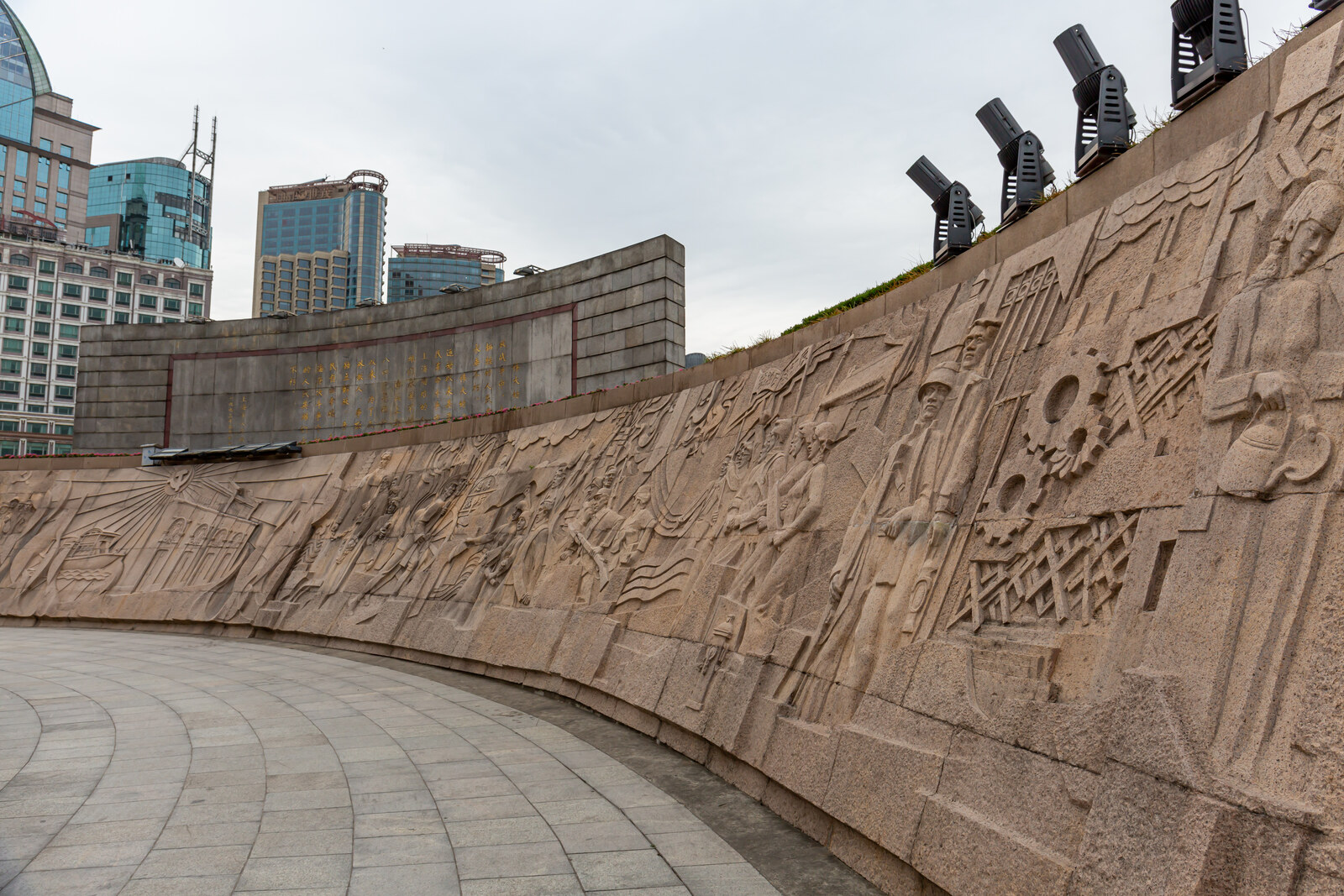
Look around first
What to notice
- Three granite columns
- Granite relief
- Descent to the memorial square
- Foundation stone in the flowerbed
The story of the place
Huangpu Park at the mouth of Suzhou Creek opens onto the memorial square. Above it rise three granite pylons, grouped like rifle barrels; at their base, a relief shows participants in the wars and revolutions to whom the Monument to the People's Heroes is dedicated. This was once a public garden on land transferred to the foreign municipal council for recreation without a commercial purpose. The old gates and signs have disappeared, while the foundation stone for the future memorial has been preserved in the flowerbed by the descent.
In the summer of eighteen eighty-six, Yan Yongjing came to the gates of this garden with six Chinese pastors. They held Bibles in their hands: this was their peaceful protest against rules that barred Chinese people from entering. Yan served as a pastor and taught at a missionary college; this was how he earned his living. He sought to ensure that Shanghai's Chinese residents could use the park, whose upkeep was paid for in part from their taxes.
At the time, the park was called the Public Garden. The site at the mouth of Suzhou Creek was Chinese state land. In eighteen sixty-eight, it was transferred to the foreign municipal council without compensation, on the condition that it would be a noncommercial place of recreation. Yet the published rules allowed foreigners and Chinese servants accompanying their masters to enter, while leaving all other Chinese people outside the gates.
The famous sign, “Chinese and dogs not allowed,” in that form was most likely a later wording. Documents confirm something else: the ban on dogs and bicycles was one clause, while the ban on Chinese entry was a separate one. For a person who was not allowed in, the order of the clauses changed nothing.
Yan Yongjing and his companions began with letters. In eighteen eighty-one, they reminded the municipal council that Chinese residents paid fees toward the garden's upkeep. Four years later, eight Shanghai pastors, doctors, and merchants demanded that the humiliating rules be removed. Their first demands were cautious: the activists were prepared to accept even special passes and separate visiting days. The council issued a limited number of permits and then created a separate garden for Chinese people nearby. Yan refused to regard this as a solution and stopped taking part in public ceremonies on the Bund, where Chinese members of the public were assigned a place on the other side of the road.
He died in eighteen ninety-eight and never saw the gates here opened. Newspapers, trade associations, and Chinese members of municipal commissions continued the dispute. Only in the summer of nineteen twenty-eight did a meeting of taxpayers abolish the racial restriction. Chinese people gained the right to buy admission tickets. A ticket cost ten copper coins and soon doubled in price, so regular walks remained more accessible to people with steady incomes. Huangpu Park became free much later.
The memorial standing here is not dedicated to those who fought for entry to the garden. The inscription “Monument to the People's Heroes” refers to people killed in armed and revolutionary struggle from eighteen forty to nineteen forty-nine. Three sixty-meter granite columns, shaped by the architects like clustered rifle barrels, mark three major periods: after the First Opium War, after the May Fourth Movement, and during the War of Liberation. The granite relief below shows participants in anti-British protests, revolutionary organizations, resistance to Japan, and the battles for Shanghai.
Chen Yi, the first mayor of the new Shanghai, personally laid the stone for the future memorial here in May of nineteen fifty. Construction was halted, and the project was taken up again thirty-four years later after an appeal from forty-seven city deputies. Nearly a million people donated money for the structure. The tower was unveiled in nineteen ninety-four, and Chen Yi's first stone was preserved in the flowerbed by the descent to the memorial square. The old gates and former sign are no longer here.
Useful on site
Open urban space; choose a vantage point that does not obstruct pedestrian flow.
Checked: date not specified. Check the official source before visiting.Choose a quiet spot by the path: pedestrian traffic around the memorial and the exit to the waterfront changes constantly.