 Guide On Map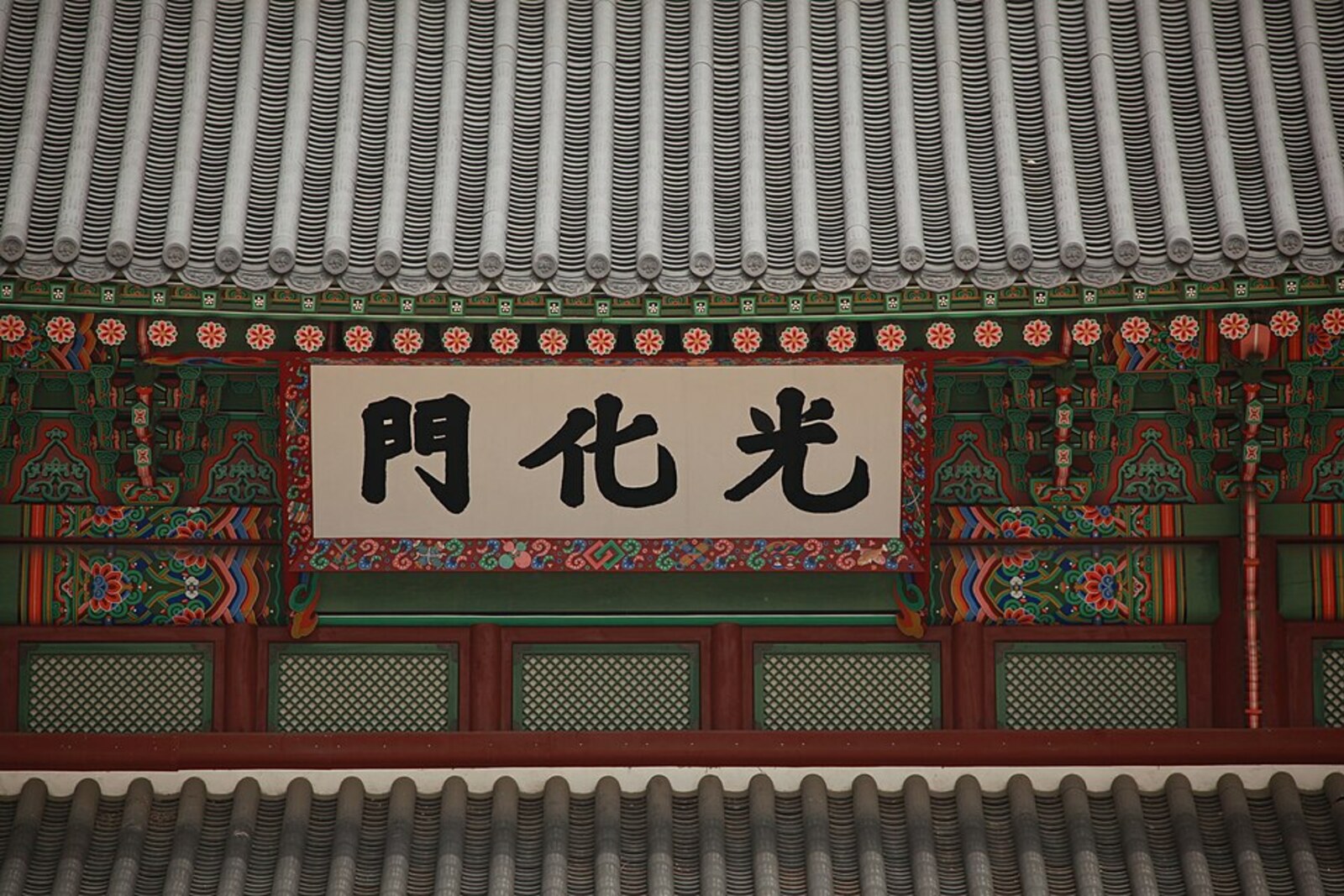
Look around first
What to notice
- Three stone arches
- Granite base
- Wooden tower
- Name plaque
The story of the place
Gwanghwamun Gate is the main southern gate of Gyeongbokgung Palace. Its three stone arches assigned people according to rank: the central one was reserved for the king, while the heir and officials used the side arches. Royal departures and official processions onto Yukjo-geori began here. In fourteen twenty-six, King Sejong instructed the scholars of the Hall of Worthies to determine the names of the palace gates. For this entrance, they chose Gwanghwamun Gate. The word “gwanghwa” referred to the beneficial transformation that the ruler's virtue was meant to spread across the country.
The first gate was built in thirteen ninety-five. It burned down with the palace in fifteen ninety-two, and a new tower was erected only more than two hundred seventy years later, under King Gojong. It was this structure that became an obstacle for officials of the Japanese colonial administration.
In the early nineteen twenties, an enormous building for the Japanese Government-General of Korea was being erected behind the gate. Gwanghwamun Gate blocked its facade from the main street. The officials intended to dismantle the gate so that the new administrative building could occupy the position at the end of the avenue.
Yanagi Muneyoshi, a Japanese philosopher and art critic, sought to have the demolition canceled. He wrote about art, collected Korean ceramics, and often came to Korea; two years after this dispute, Yanagi would open the Korean Folk Art Museum in Gyeongbokgung Palace. His way of defending the gate was an article.
In the summer of nineteen twenty-two, Yanagi wrote a text entitled “For One Korean Building Threatened with Disappearance.” He suggested that the Japanese imagine the reverse scene: Korea had annexed Japan, a Korean Government-General had been erected in Edo, and an old castle was being demolished for the sake of its facade. The Korean newspaper Dong-A Ilbo printed the article for five consecutive days. Colonial censors cut out this comparison; Yanagi then published it in the Japanese journal Kaizō.
The article strengthened the protest against demolition, and the administration backed down. Yanagi preserved the building, but he could not preserve its purpose. In nineteen twenty-six, builders dismantled Gwanghwamun Gate and reassembled it north of the palace's eastern gate. A direct approach to the Government-General opened at its former location. The main palace entrance ceased to be an entrance.
The wooden tower over which Yanagi had argued was destroyed by shelling in nineteen fifty; only the stone lower part remained of the relocated gate. In nineteen sixty-eight, President Park Chung-hee ordered Gwanghwamun Gate returned to the southern side of the palace. The wooden superstructure was replaced with reinforced concrete, and the president himself wrote the Korean name for a new plaque. At the ceremony, he ordered that monuments henceforth be restored in concrete so that they would stand for a thousand years.
Builders aligned the gate with the former Government-General building, which was then occupied by government institutions. As a result, Gwanghwamun Gate stood aside from its former location and was turned by almost four degrees in relation to the palace buildings. Thirty-eight years later, the concrete tower was dismantled. Nine of its large parts were transferred to the Seoul Museum of History.
Restorers erected the present gate from granite and wood and returned it to the palace axis in nineteen ten. Yanagi's tower is no longer here, nor is Park Chung-hee's concrete tower. The three passageways stand once again in their former place, and above them is the name that Sejong's scholars gave the main gate almost six centuries ago.
Useful on site
Gyeongbokgung Palace schedule: November–February 09:00-17:00, March–May and September–October 09:00-18:00, June–August 09:00-18:30; last entry one hour before closing, closed on Tuesdays.
Checked: June 28, 2026. Check the official source before visiting.You can view the gate and platform from outside; the rest of the route runs through Gyeongbokgung Palace, which requires separate entry. Do not linger in the passageways, and follow the palace signs.