 Guide On Map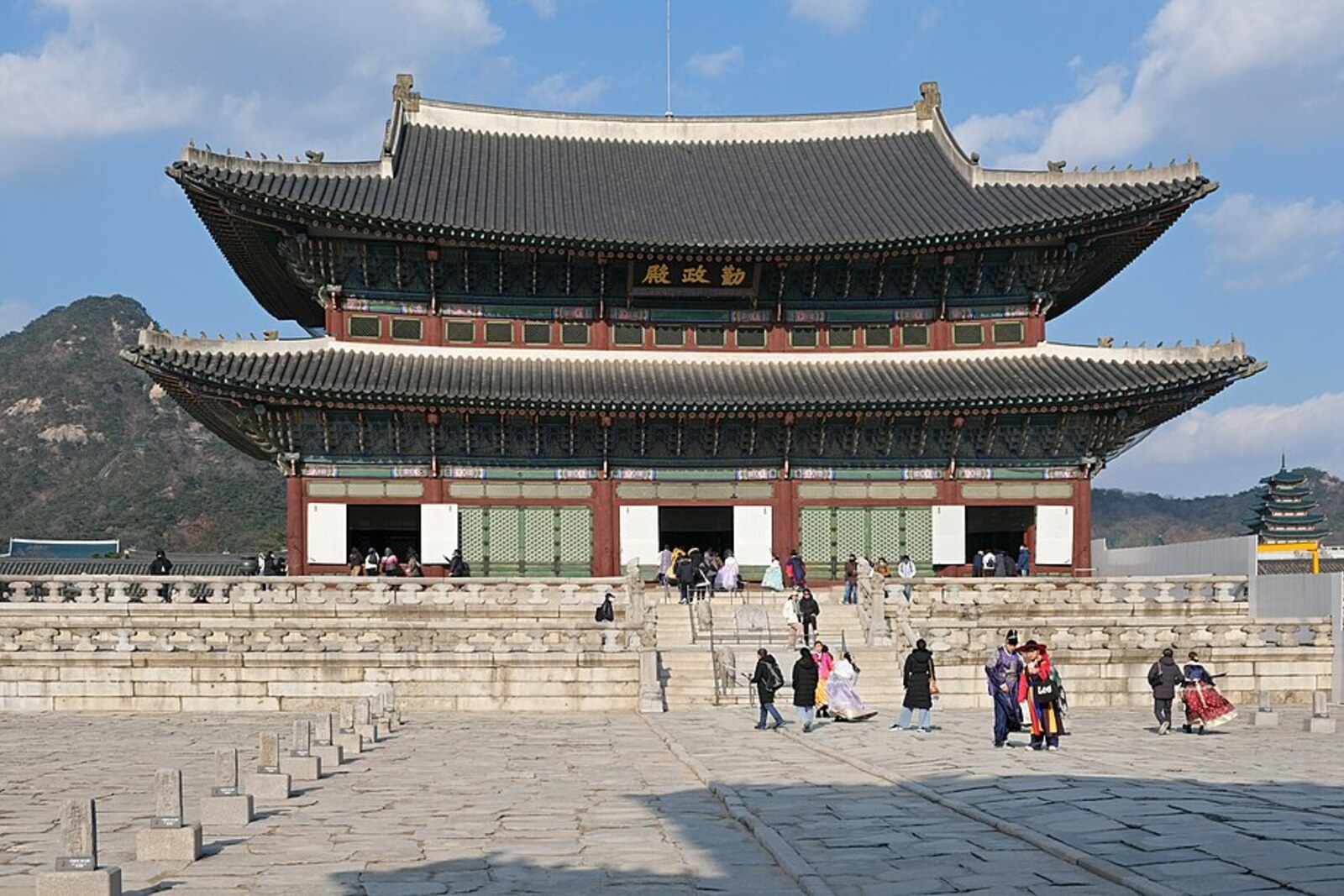
Look around first
What to notice
- The throne
- The screen with the sun, moon, and five peaks
- The stones marking officials’ ranks
- The monarch’s road
The story of the place
Geunjeongjeon Hall translates as “Hall of Diligent Governance.” It is the main throne hall of Gyeongbokgung Palace. The king sat inside, before a screen with the sun, moon, and five peaks; officials lined up in the courtyard beside stones marking their ranks. Envoys were received here, New Year’s greetings were offered, and monarchs were installed on the throne. Everyday reports were handled in another room. In Geunjeongjeon Hall, officials gave an already adopted decision the form of a ritual binding on the entire country.
In June fourteen fifty-five, Grand Prince Suyang used this courtyard to become king. His nephew Danjong had inherited the throne three years earlier, as a twelve-year-old boy. Senior dignitaries led by Kim Jong-seo were meant to help him. Suyang, the young monarch’s uncle, sought the throne for himself. In fourteen fifty-three, his men attacked Kim Jong-seo’s house and killed its master. Suyang then told his nephew that he had prevented a conspiracy, obtained an order in the king’s name, and summoned the remaining opponents to the palace. They too were killed there. After that, Suyang took positions that gave him control over appointments of officials and over the army.
On the day of the abdication, he secured the exile of relatives and courtiers on whom Danjong might still have relied. Then, in the boy’s name, it was announced that he was too young for affairs of state and wished to transfer the throne to his uncle. As was customary, the ministers asked him to reconsider. Suyang fell to his knees, wept, and began to refuse. These refusals were part of the ceremony: the new monarch had to show that he had not sought the throne and had yielded only to the general request.
Then the great state seal was demanded. Seong Sam-mun was sent for it—a royal secretary and scholar whom the previous monarch had entrusted with helping Danjong. His court position gave him a salary, status, and access to documents; now that same position forced him to serve the removal of the king whom he was supposed to support. The chronicle notes that, when the order was given to bring out the seal, the ministers exchanged glances and their faces changed.
Seong Sam-mun handed the seal to a eunuch, who carried it to Gyeonghoeru Pavilion, beyond the ceremonial courtyard. Danjong himself handed it to his uncle. Suyang refused once more while lying prostrate, then accepted the seal, put on a winged hat and a robe with dragons. A court orchestra had already been set up in the courtyard of Geunjeongjeon Hall, officials had written edicts of abdication and accession, and dignitaries had taken their places according to rank. Suyang came out before them as King Sejo. In the edict composed in Danjong’s name, the murder of his advisers was called the salvation of the country, and the transfer of the throne the young monarch’s voluntary choice.
After the ceremony, Seong Sam-mun was entered among the meritorious supporters of the new king, although he had not taken part in the coup. Such a title promised official and material privileges. A year later, he rejected this safe role. Together with other courtiers, Seong Sam-mun planned the murder of Sejo during a reception for foreign envoys and Danjong’s return to the throne. One of the conspirators betrayed the plan. Seong Sam-mun and his companions were executed; dozens of people died in the case concerning the restoration of the former king.
After the conspiracy was uncovered, Danjong was stripped of the title of retired monarch, exiled to Yeongwol, and died in exile in the autumn of fourteen fifty-seven. The records differ in the details: Sejo’s annals claim that the former king took his own life, while later accounts speak of poisoning or strangulation by order from the capital.
The wooden Geunjeongjeon Hall, where Sejo received officials’ congratulations, burned down in fifteen ninety-two. The present hall was built in eighteen sixty-seven. The rank stones in the courtyard also belong to the reconstructed ceremonial arrangement, not to that day. The arrangement of the participants has been preserved: the throne rises above the courtyard, the monarch’s road runs through the middle, and on both sides are marked the places of the officials who, in fourteen fifty-five, gave the seizure of the throne the appearance of a lawful accession.
Useful on site
Following Gyeongbokgung Palace hours: November-February 09:00-17:00, March-May and September-October 09:00-18:00, June-August 09:00-18:30; last entry one hour before closing, closed on Tuesdays.
Checked: June 28, 2026. Check the official source before visiting.View the layout from the permitted paths, and do not go beyond the barriers for a symmetrical shot. The hall’s interior is usually viewed from outside, so look for the main details in the arrangement of the courtyard.