 Guide On Map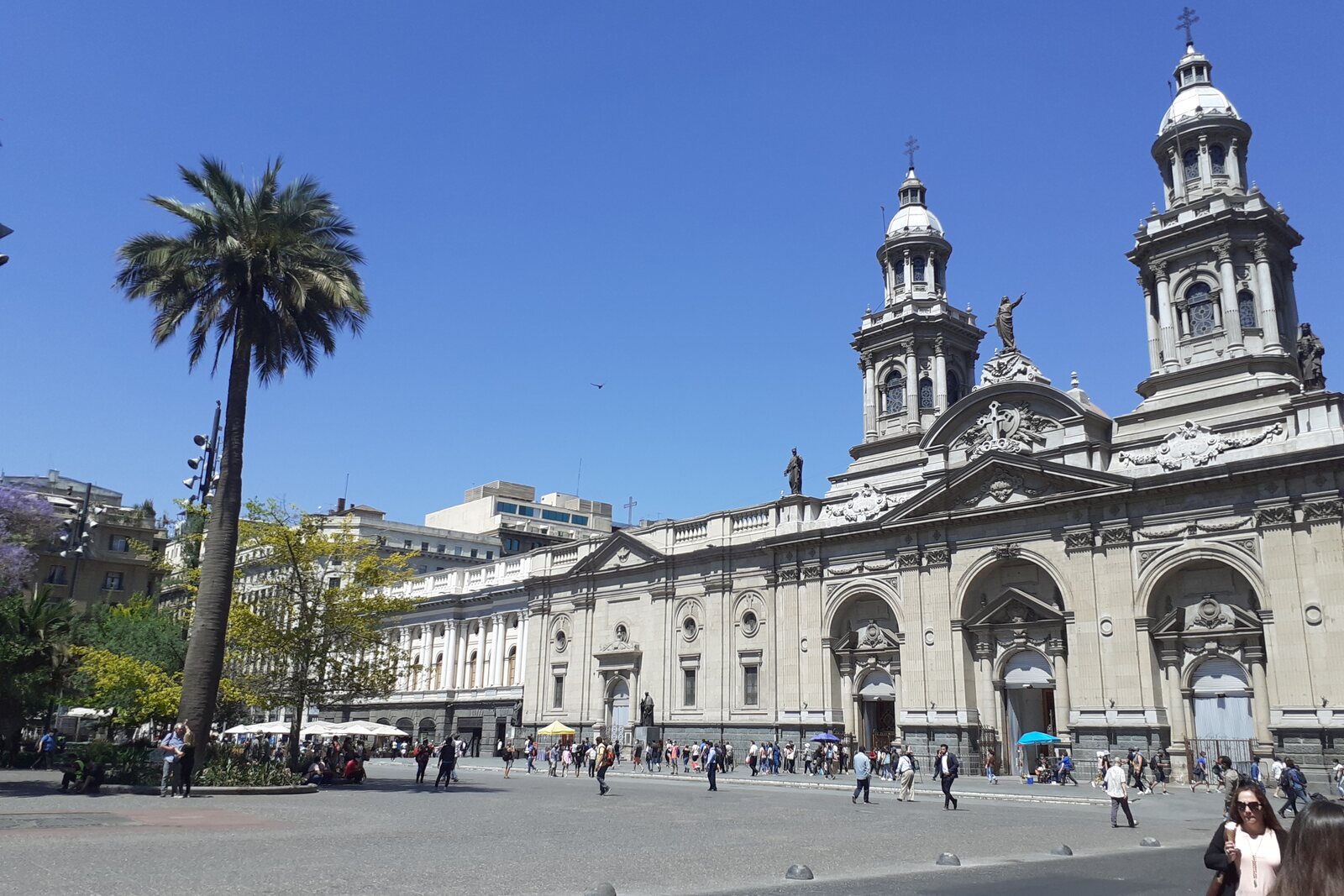
Look around first
What to notice
- Bronze rider
- Scroll in his hand
- Zero-kilometer marker
- Rectangle of the square
The story of the place
The rectangle of Plaza de Armas and the zero-kilometer marker mark the starting point of Santiago's grid of straight streets. Space was left around the square for the main church, the governor's house, and the cabildo, the council of Spanish settlers; orders were publicly announced here, and city plots were assigned. The land beneath this layout was already occupied: early documents mention a large tambo beside the square, a local building for administration and storing supplies.
In the hand of the bronze rider in the square is a scroll. It is Pedro de Valdivia, commander of the Spanish detachment, who needed a permanent city to establish a foothold in the Mapocho River valley. The scroll depicts the act founding Santiago. The real document did not survive the city's first year.
On February twelfth, fifteen forty-one, Valdivia declared the founding of Santiago de Nueva Extremadura. The surveyor Pedro de Gamboa, responsible for laying out the settlement, set out straight streets and left an open square in the middle—Plaza Mayor, the main square. On its western side, a plot was set aside for the main church; on the northern side, for the governor's house and the cabildo, the council of Spanish settlers. Residents gathered here, orders were publicly announced, and city plots were assigned. The street grid began here; that is why Santiago's present-day zero kilometer is located in this very square.
Gamboa was laying out the city on occupied land. Documents from the first months mention a large tambo near the square—a local building for administration and storing supplies that had existed before the Spaniards arrived. The valley's residents were losing land and food, while Valdivia demanded that they supply the new city. When resistance began, he seized several local leaders so that they would not join the uprising, then left with most of the horsemen for the Cachapoal River.
On September eleventh, Michimalonco, the leader of local forces who wished to reclaim the seized territory and free the captives, attacked Santiago. Houses of wood, sun-dried brick, and reeds caught fire. The defenders retreated to the fortification near the central square. Allied Indians brought from Peru fought alongside the Spaniards—without them, there would have been even fewer defenders.
In the fortification was Inés de Suárez, Valdivia's companion and the settlement's only Spanish woman. She bound the wounded and tried to preserve the remaining supplies. The captive leaders heard the battle and began calling to the attackers. Inés decided that freeing them would finally break the defense, and ordered the captives killed. One later chronicle claims that she herself took up a sword; other testimony does not allow us to establish with confidence who dealt the blows. The killing itself was confirmed by participants in the expedition during Valdivia's trial. The bodies were carried out to the square.
The attackers did not withdraw immediately. The battle continued into the daylight hours, and its outcome was decided by a cavalry charge by the Spaniards and their allies, in which Inés took part. Michimalonco's forces withdrew without freeing the captives. The settlement survived, but almost all of Santiago burned. Valdivia later listed what food remained: two sows, a piglet, a hen, a rooster, and two handfuls of wheat. From these supplies, the defenders would have to breed livestock again and sow the fields.
After the attack, the Spaniards rebuilt the city as a military camp. Plaza Mayor received the name Plaza de Armas—the square where residents were expected to gather with weapons. The open rectangle was retained, and the administrative buildings were put up again along its edges.
The fire also destroyed the first record of Santiago's founding, along with the list of houses and lands that had been distributed. Paper arrived from Peru only two years later. In January fifteen forty-four, the scribe Luis de Cartagena drew up the act again from witnesses' accounts. It is this reconstructed text that is kept in the National Archive of Chile.
The bronze Valdivia holds a document whose original burned here during Michimalonco's attack. And the name beneath his horse's hooves has remained from the time when the open square at the center of a barely built city had to be surrounded by fortifications.
Useful on site
The square is best viewed from its perimeter and from the center; in a dense crowd, keep an eye on your belongings and do not block the way near the monuments.