 Guide On Map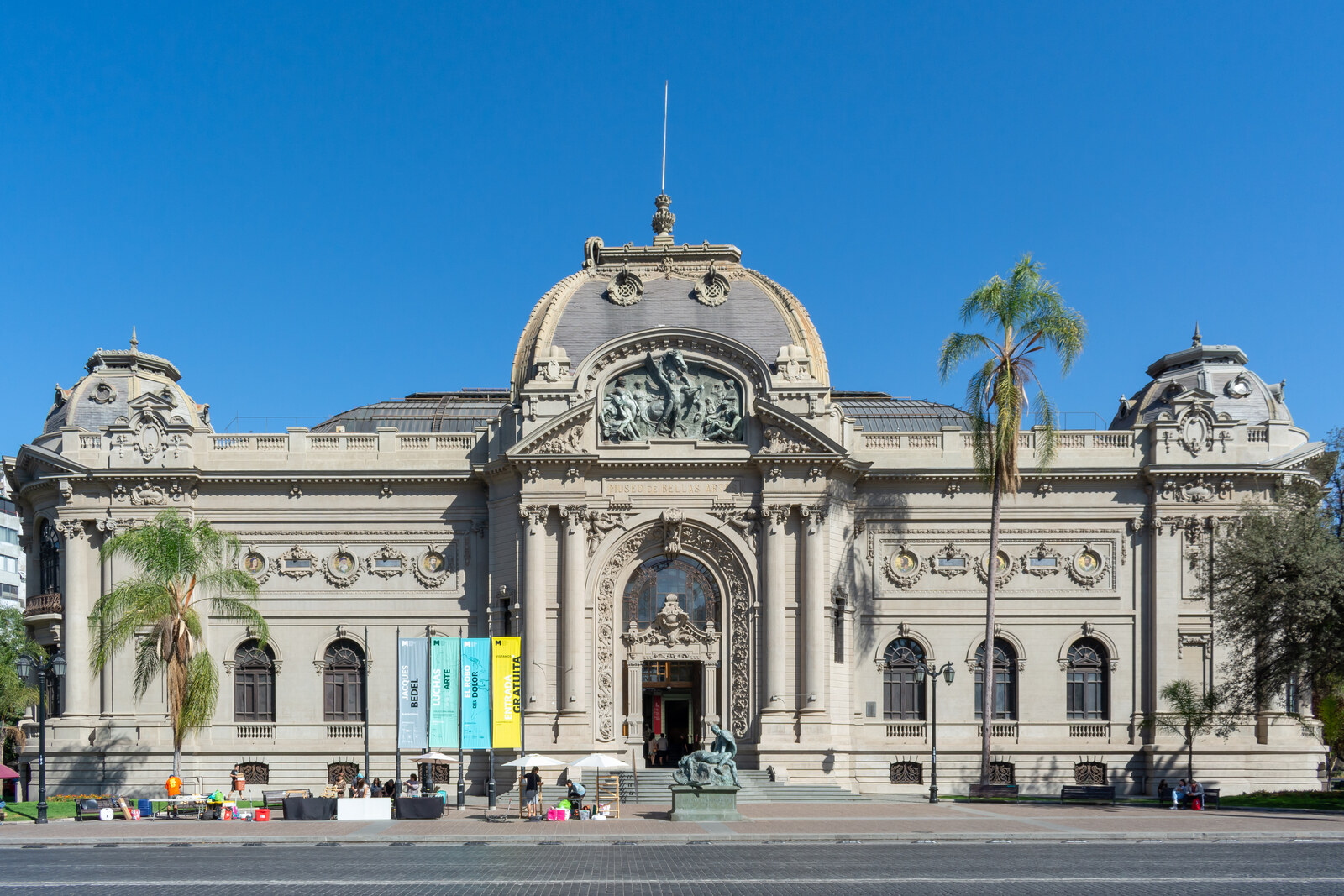
Look around first
What to notice
- French façade
- Main entrance
- Exhibition galleries
The story of the place
Behind the French façade, since nineteen ten, is the state collection of Chilean and foreign art. Yet one of the Chilean National Museum of Fine Arts' most important exhibitions existed for forty-two years only in crates, documents, and the memories of its organizers.
In September nineteen seventy-three, the museum's director, Nemesio Antúnez, was preparing to receive works by José Clemente Orozco, Diego Rivera, and David Alfaro Siqueiros. Antúnez himself earned his living through painting and printmaking, and he worked to ensure that the museum showed contemporary Latin American art. Under him, the galleries hosted concerts, film screenings, and exhibitions by young artists. The Mexican collection was meant to be the main international event in this program.
The installation was entrusted to Fernando Gamboa, a Mexican specialist whose profession was selecting works and building state exhibitions from them abroad. Over three days, he distributed one hundred sixty-nine works through these galleries: one hundred twenty-eight by Orozco, thirty-four by Siqueiros, and seven by Rivera. Part of the museum's European collection was taken down to make room for them. The opening was set for September thirteenth.
On September eleventh, a military coup took place. Gamboa tried to reach the exhibition, which had already been installed, but an armed carabinero would not let him leave the hotel. A few days later, forty shots were fired at the palace from tank weapons. The bullets damaged two paintings from the Chilean collection. By then, the Mexican works had been taken off the walls and packed into twenty-seven crates.
Antúnez summoned the artist and photographer Sergio Berthoud to document the holes and the damaged canvases. The director did not get to see the finished photographs: he resigned and left for Europe, where he taught painting in London. Together with Antúnez, Gamboa secured the removal of the collection from the country. The crates were sent to Mexico on the same plane on which relatives of the late President Salvador Allende were leaving the country. All the works were returned to their owners.
In nineteen ninety, Antúnez again became head of this museum. He did not live to see the exhibition of Orozco, Rivera, and Siqueiros. It opened here in two thousand fifteen: seventy-six works were hung in the galleries Gamboa had prepared forty-two years earlier. The exhibition was called “The Postponed Exhibition.”
The paintings then returned to Mexico. In the library of the Chilean National Museum of Fine Arts, there remains a catalog printed for the opening that never took place in nineteen seventy-three. On its pages, the preview is still scheduled for September thirteenth.
Useful on site
Tuesday–Sunday 10:00–18:30; last entry 18:20. Admission is free; advance booking is not required. Closed on Mondays and on public holidays specified by the museum.
Checked: June 29, 2026. Check the official source before visiting.The façade and outdoor sculpture can be viewed without entering. It is worth stepping into the central hall for the dome if the museum is open; leave the exhibition as a separate choice.