 Guide On Map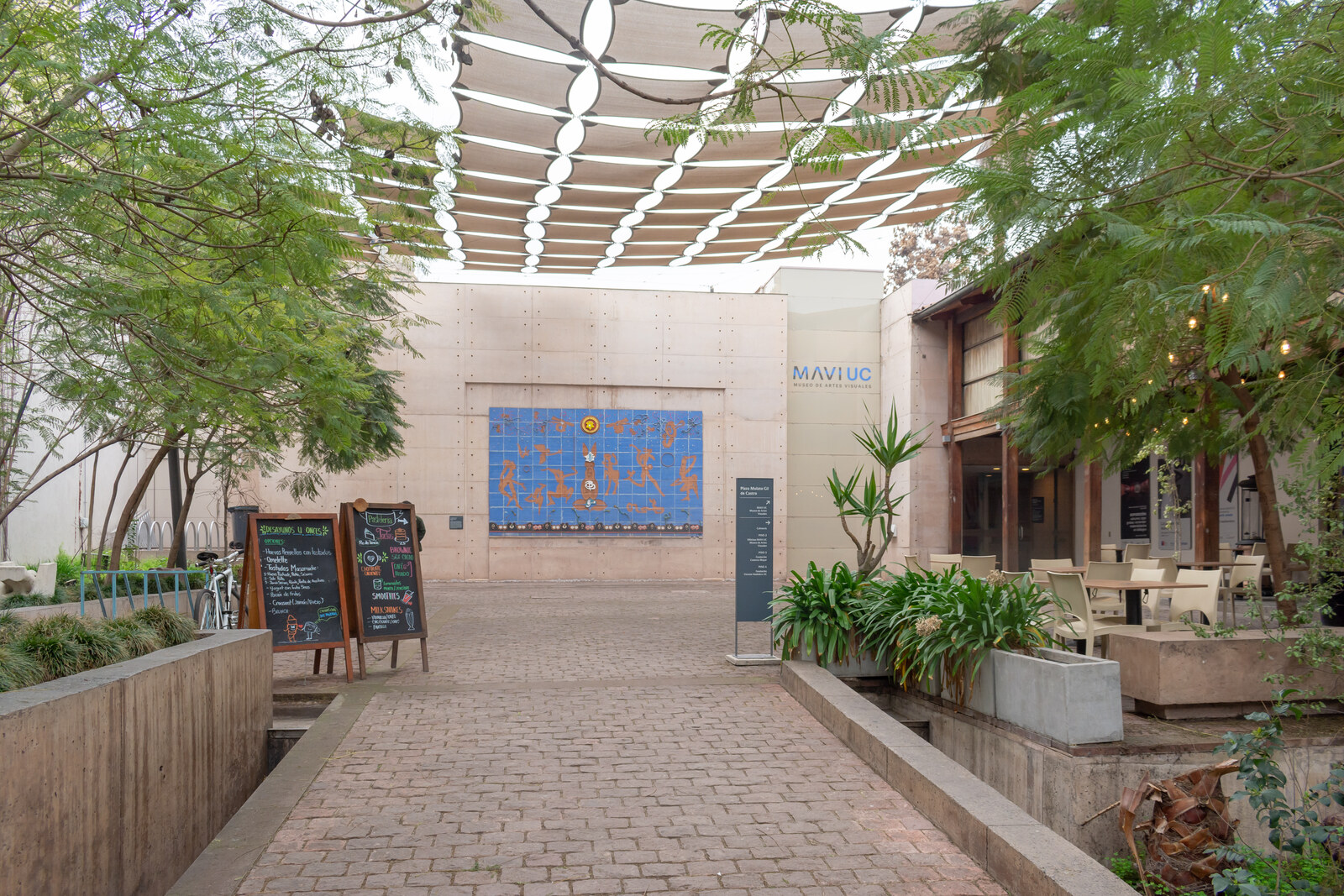
Look around first
What to notice
- The square’s courtyard
- Preserved façades
- The Debutante made of ceramic plates
- Entrance to the MAVI UC Museum of Visual Arts
The story of the place
A small inner courtyard opens between the old façades, and behind it stands the MAVI UC Museum of Visual Arts, the museum of visual arts at the Pontifical Catholic University of Chile. Contemporary art is shown here, and works by young artists are accepted through its own competition, so the collection continues to grow. The large The Debutante remains on the façade—a ceramic panel of one hundred thirty-five colored plates.
This square is younger than the buildings around it. As late as the late nineteen seventies, this was a neglected lot used as a parking area; a multistory parking garage was planned for the site. Entrepreneurs Manuel Santa Cruz and Hugo Yaconi proposed a different use. They invested money earned in trade and gas supply in restoring an old mansion and the neighboring façades. Architects Ignacio Cruz and Walter Biggemann preserved their outlines, turned the interiors toward a shared courtyard, and on October twenty-ninth, nineteen eighty-one, the square opened with workshops, exhibition halls, and cafés.
It was named after José Gil de Castro because the old mansion was thought to have been his home. Documents more reliably confirm something else: the artist’s home and workshop were in this neighborhood, at the foot of Santa Lucía Hill, on what is now Victoria Subercaseaux Street. The byname “Mulatto Gil,” carried into the square’s name, was apparently not used by the artist himself, and his contemporaries did not call him that. In marriage records, he is listed as a free pardo—the term used in Spanish possessions for a person of African descent. His mother, a Black slave, was freed shortly before her son’s birth; José’s older brother remained a slave until adulthood.
For Gil, portraiture was a craft, a livelihood, and a way to escape the position assigned by his origins. During his first years in Santiago, he persistently described himself as a “portrait painter”: portraits were valued more highly than an ordinary painter’s work and brought the artist into the homes of wealthy patrons. During the Spanish Reconquest, Gil painted King Ferdinand VII, royal officials, and families that supported the monarchy.
In February eighteen seventeen, José de San Martín’s army won at Chacabuco, and the circle of patrons changed within a few weeks. That same year, Gil finished his last portrait of Ferdinand VII and began a large series of portraits of José de San Martín and his officers. The new states needed recognizable faces of their leaders, and Santiago had almost no portrait painters of his caliber. Gil received many commissions; at the end of that same year, he was enlisted as a captain in a battalion of free men of color. Later, he painted Bernardo O’Higgins, followed José de San Martín to Lima, and through this connection entered the circle of republican patrons there. The faces by which the liberators of South America are now recognized largely came from his workshop by Santa Lucía Hill.
Santa Cruz and Yaconi did not turn the house attributed to the artist into a memorial museum. First, they exhibited their own collection of archaeological objects here. Then Chilean artists of the nineteen eighties began meeting in the square’s workshops and cafés, and the owners began buying their works. Santa Cruz bought a painting by Roberto Matta from gallerist Carmen Waugh; the collector’s acquaintance with the artist grew into a friendship. For the square, Matta created The Debutante—a large ceramic panel of one hundred thirty-five polychrome plates, made in Faenza, Italy, in nineteen ninety-five.
When the collection of contemporary art no longer fit in private homes, Santa Cruz and Yaconi decided to open it to the public. Architect Cristián Undurraga incorporated the museum into the already established courtyard, and on April eleventh, two thousand one, the MAVI UC Museum of Visual Arts opened here. Later, it began accepting works by young artists through its own competition, so the collection continued to grow within the museum itself.
After the founders stepped away from their work, their families looked for a way to keep the collection, the building, and the square together. In two thousand twenty-one, they transferred all of this to a joint foundation with the Pontifical Catholic University of Chile; family representatives remained on the board, and the museum received its current name, the MAVI UC Museum of Visual Arts. The Debutante, commissioned by the founders, is on its façade. In the spring of two thousand twenty-six, students, teachers, and restorers completed a six-month restoration of all one hundred thirty-five ceramic plates.
Useful on site
Museum: Tuesday–Friday 10:00–18:00; Saturday–Sunday 11:00–19:00; public holidays 10:00–18:00; closed Monday. Last Sunday of the month—admission for a voluntary contribution.
Checked: June 29, 2026. Check the official source before visiting.The square and the work at the entrance can be viewed from outside. Plan a visit to the MAVI UC Museum of Visual Arts collection separately and check access in advance.