 Guide On Map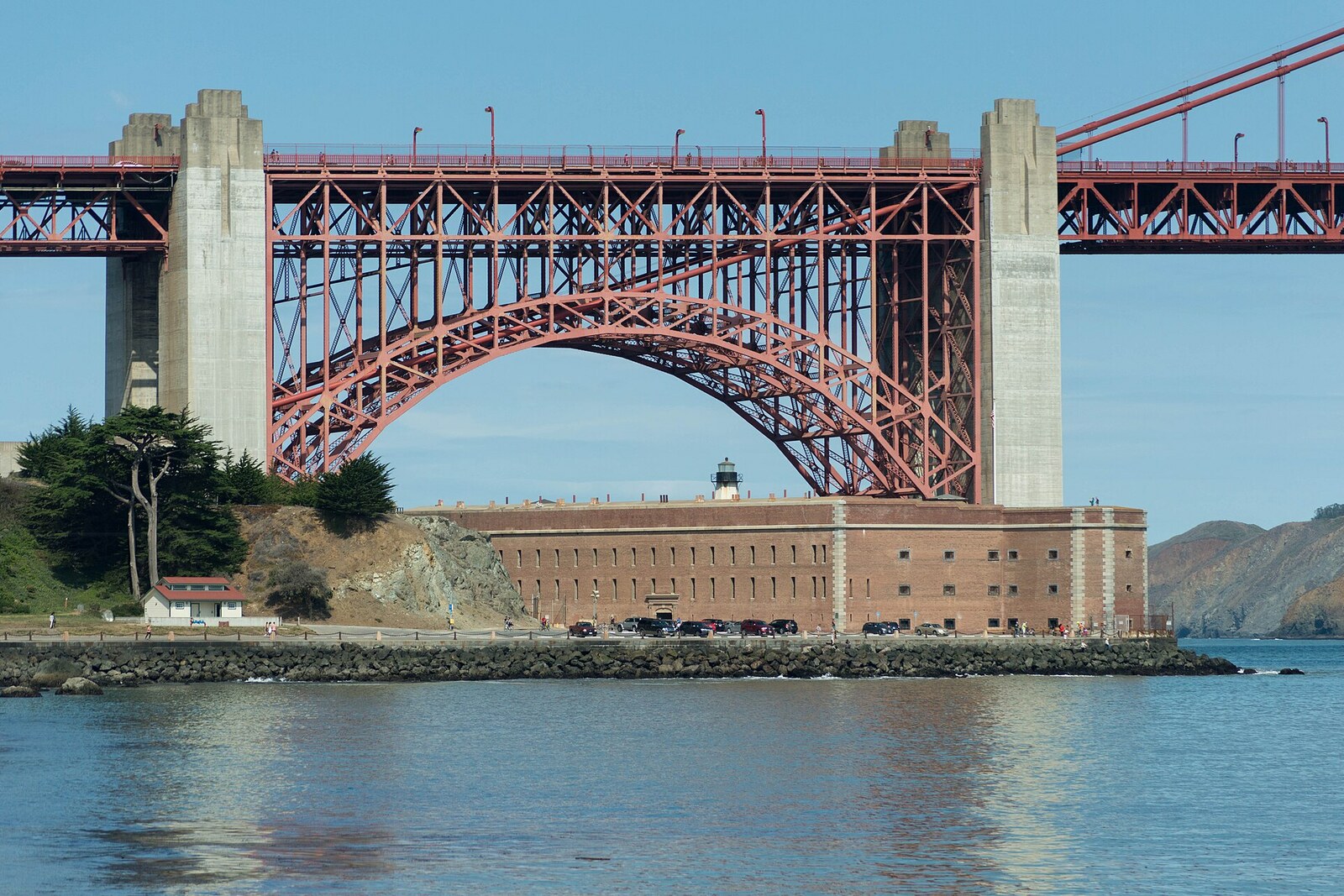
Look around first
What to notice
- Red-brick casemates
- Inner courtyard
- Steel arch above the fort
- Concrete pier south of the fort
The story of the place
The fort on the headland at the entrance to the bay kept ships bound for rapidly growing San Francisco in its sights: army engineers expected to stop the enemy in the strait itself. To place guns right at the water's edge, they cut away about twenty-three meters of rock, and then around two hundred workers laid eight million bricks over eight years to create three tiers of vaulted casemates. The red-brick vaults and inner courtyard retained the form of the garrison, although its guns were not needed in battle. At the beginning of the twentieth century, the guns were removed, and the rooms successively housed barracks, schools, and storehouses.
A separate steel arch, ninety-seven meters long, runs above the brick walls. It supports the southern approach to the Golden Gate Bridge. This arch was not part of the original design: a massive concrete pier was to be built on the site of Fort Point to hold the tensioned cables, and the old fort was to be demolished.
The military chose this headland for the same reason bridge builders later came here: this is where the bay narrows into the Golden Gate. In the mid-nineteenth century, gold was shipped out through it and goods were brought in for rapidly growing San Francisco. Army engineers wanted to stop an enemy ship at the entrance to the bay.
The guns had to be placed almost at the water's edge. A cannonball could then be fired on a low trajectory, so that it would skip off the surface of the bay and strike a ship. To make such a shot possible, builders cut away about twenty-three meters of rock. Around two hundred people, including ruined gold prospectors, earned their living here through masonry work for eight years: they laid eight million bricks and built three tiers of vaulted gun rooms—casemates.
The fort was completed in eighteen sixty-one. At the same time, fighting in the east of the country showed that rifled guns could penetrate brick fortresses. The garrison stood watch and drilled at the guns, but not once did it fire at an enemy from here. By the beginning of the twentieth century, the army had removed all one hundred two guns and sold them for scrap. Barracks, schools, and storehouses were housed inside. To the bridge designers, the empty fort looked like a convenient place for a pier.
Joseph B. Strauss was the hired chief engineer of the Golden Gate Bridge, Highway and Transportation District: he was responsible to the board of directors for the final design and construction of the crossing. After inspecting the empty casemates, Strauss rejected demolition. He no longer saw any military value in the fort, but considered its masonry valuable enough to preserve as a future monument.
To do this, the engineers on his team moved the southern pier several dozen meters and inserted another bridge in front of it—a steel arch above the fort. This solution complicated precisely the section that could have been cleared with a single demolition. While the arch was being assembled, the builders occupied the fort itself: cars stood in the courtyard, while offices, storehouses, and a cafeteria operated in the casemates. Some of the outer fortifications were nevertheless dismantled, and the stone seawall was taken down and then rebuilt.
In nineteen thirty-seven, cars began crossing the arch. Thirty-three years later, the United States Congress granted Fort Point national historic site status. Above the casemates designed for firing along the water remains the span added by Strauss; the concrete pier for which the fort had been intended to be removed stands farther south.
Useful on site
Interior Thu-Mon 10:00-17:00; roof closes at 16:30; outdoor area accessible 7 days; closed on Thanksgiving, Christmas, and New Year.
Checked: June 26, 2026. Check the official source before visiting.The interior is worth visiting only when the official entrance is open; if it is unavailable, the fort's exterior form and its position right at the water's edge are still easy to make out.