 Guide On Map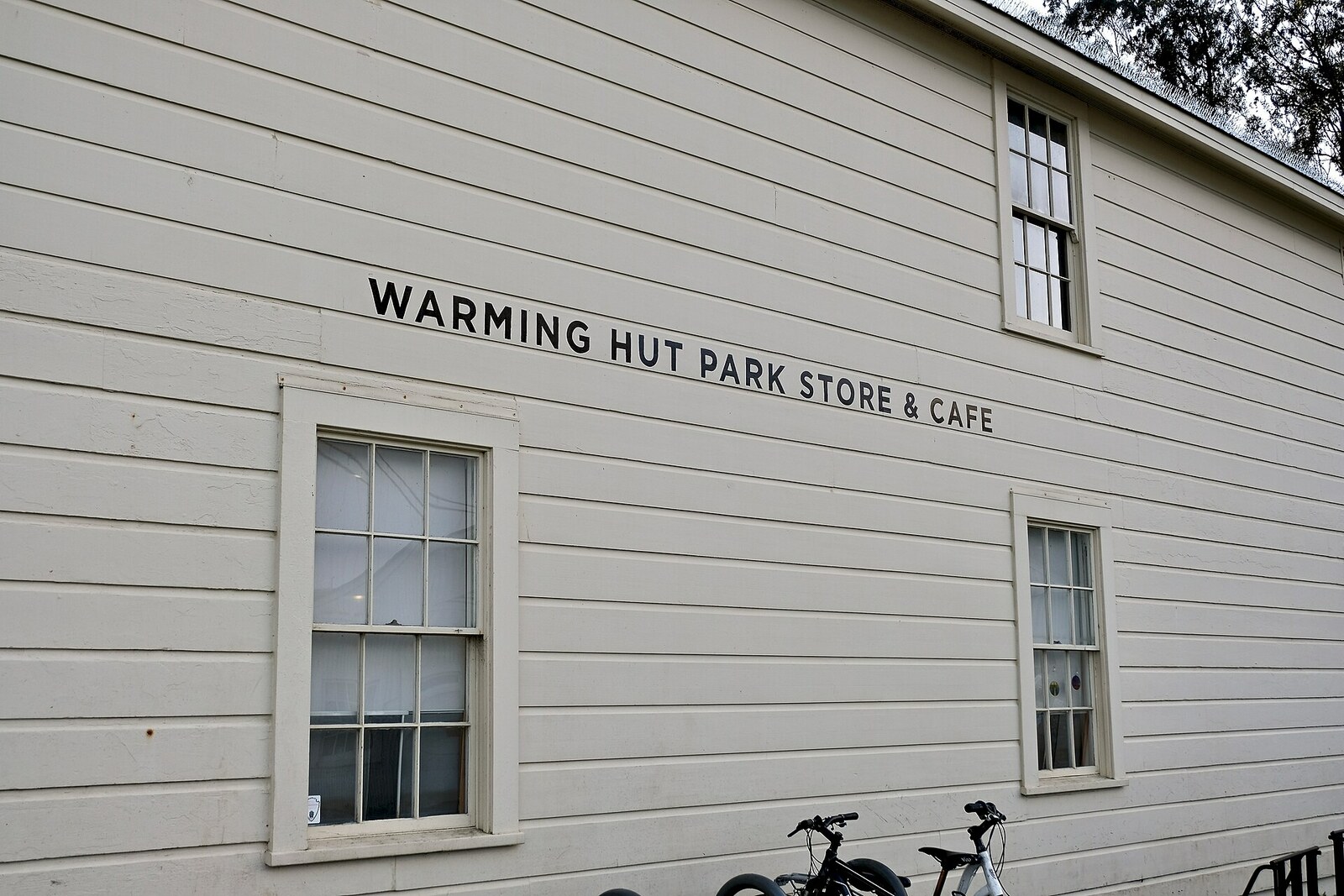
Look around first
What to notice
- The light-colored Warming Hut building
- The red roof
- The reinforced-concrete wharf
- The neighboring low buildings
The story of the place
The light-colored building with a red roof and the low structures beside it stand by a reinforced-concrete wharf that extends into the water at the narrow entrance to the bay. An army mine yard operated here: explosives were kept separately, and the assembly of dangerous charges was divided among different rooms. Finished casings were sent along narrow-gauge rails to the water, where ships took them aboard; from the area now occupied by fishermen, work was carried out for barriers across the main shipping channel. The present café occupies the former engineering storehouse, and the wharf itself has survived from its military reconstruction.
The name “Torpedo Wharf” dates from a time when a torpedo meant a mine fixed underwater. These charges were not launched from a shipboard tube: they were laid in advance across the shipping channel and detonated by an electrical signal from shore.
Until the beginning of the twentieth century, the army stored mines on Yerba Buena Island, far inside the bay. In nineteen oh three, the Coast Artillery Corps took responsibility for mine defense. Its officers needed to block the entrance to the harbor itself, so they moved the depot here, to the narrow part of the Golden Gate.
By nineteen ten, an entire mine yard stood by the shore. The building that now houses the Warming Hut café served as an engineering storehouse. Beside it were an explosives storehouse and two separate rooms for equipping mines. Servicemen on the mine crews assembled the casings, inserted the charges, connected the detonators and cables. This was their army duty; a mistake while handling explosives threatened the entire crew. That is why dangerous operations were separated among different buildings.
Equipped mines were rolled along narrow-gauge rails to the wharf and transferred to minelayers. Naval crews placed them beyond the Golden Gate, anchored them to the bottom, and ran cables to shore control panels. The operator had to wait until an identified enemy ship entered the minefield and only then close the circuit.
In nineteen forty-one, the army rebuilt the wharf in reinforced concrete so that two minelayers could be serviced here at the same time. During World War II, the crews at this depot prepared mines for the main shipping channel. Beyond the bridge were three minefields containing more than six hundred charges. No attack on San Francisco occurred, and the crews here did not have to detonate them beneath an enemy ship. In nineteen fifty, the Coast Artillery Corps was disbanded, and naval mines were transferred to the Navy.
The present wharf is that same reinforced-concrete structure from nineteen forty-one. In nineteen oh one, the engineering storehouse was adapted for the Warming Hut. Soldiers equipped mines in the neighboring low buildings, and from the area now occupied by fishermen, crews sent charges toward the shipping channel.
Useful on site
Current published hours: Sun 09:00-18:00, Mon-Thu 09:00-17:00, Fri-Sat 09:00-18:00.
Checked: June 26, 2026. Check the official source before visiting.Do not count on the café as a guaranteed stop for food; it is especially windy by the pier, so watch the edge and the wet surface.