 Guide On Map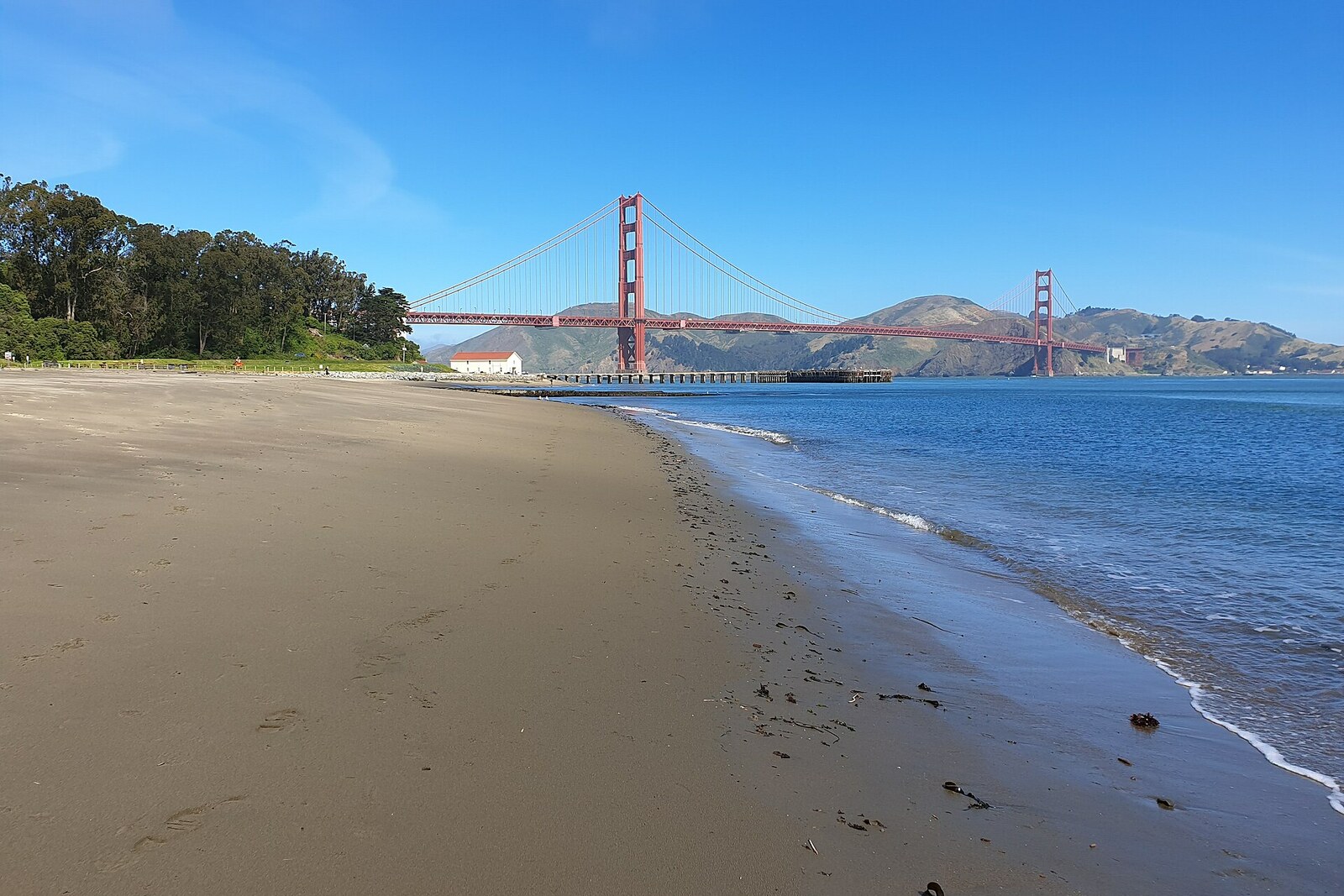
Look around first
What to notice
- Long, level lawn
- Tidal marsh
- Sandy beach
- Channel between the marsh and the bay
The story of the place
The long lawn along the bay repeats the outline of the former airfield, and a small tidal marsh lies beside it. Streams from the Presidio heights once met salty water here; the lowland was then filled with sand and silt, barracks were placed there, and a military airfield was laid out. The marsh was excavated anew only in part of the former lowland, while the channel to the bay runs through the beach and is sometimes covered with sand for several months.
On October eighth, nineteen nineteen, fifteen Army aircraft took off from the still-unnamed airfield on this shore. They headed east; another forty-six aircraft took off from Long Island to meet them. The military called it a test of reliability and endurance. They had to cross the United States and prove that aircraft were already suitable for long-distance flights, even though the pilots flew in open cockpits, navigated by railroads, and landed on poorly prepared fields.
One of the participants was Major Dana H. Crissy, commander of Mather Field near Sacramento. He lived on an Army salary: he served in the Presidio's coastal artillery and, in nineteen seventeen, transferred to aviation, hoping to make it a reliable part of the Army. Crissy volunteered to fly across the continent. His wife and two daughters were waiting for him at home. With him was a military observer, Sergeant Virgil Thomas.
On the very first day, their aircraft crashed while landing near Salt Lake City. Crissy and Thomas were killed. Only nine of the sixty-one aircraft reached the opposite coast; the test cost the lives of nine people in all. The test, conceived as proof of the reliability of flight, showed how much still lay between planning a route and arriving safely.
Major Henry H. Arnold, who commanded the Presidio airfield and was friends with Crissy, secured the naming of the shore airfield for his fallen comrade. In nineteen twenty-one, a permanent air-coast-defense station opened here: its pilots observed artillery fire, photographed the terrain, searched for forest fires, and took part in rescue operations. Crissy took off from here from an unnamed field; it was his name that returned here. Thomas's surname did not appear in the name.
The airfield itself became possible because, for the Panama-Pacific Exposition of nineteen fifteen, the city filled the tidal lowland here with sand and silt. Earlier, streams from the Presidio heights met the salty water of the bay here. After the exposition, barracks were placed on the fill, and then an airfield was laid out. By the time the Presidio was transferred to the National Park Service in nineteen ninety-four, asphalt, concrete, abandoned military buildings, and contaminated soil covered most of the shore.
The National Park Service and the Golden Gate National Parks Conservancy tasked landscape architects George Hargreaves and Mary Margaret Jones with turning the former base into a public park. The experts' requirements conflicted. The natural part of the shore had to be reconnected to the tide, while the historic appearance of the airfield had to be preserved. Restoring the marsh to its former size would have required destroying the airfield that bore Crissy's name. Leaving the entire military site in place would have left nowhere for the water to return.
The architects set aside only part of the former lowland for the marsh and restored a long, level lawn beside it in the outline of the airfield. Construction crews removed nearly ninety thousand tons of contaminated material and excavated more than two hundred thirty thousand cubic yards of earth, sand, and silt. In November nineteen ninety-nine, they cut a channel through the beach, and the tide entered the lowland for the first time in about a century. Thousands of volunteers planted about one hundred thousand native plants here. The park opened to visitors on May sixth, two thousand one.
Today’s Crissy Marsh was excavated anew and occupies only a small part of the old tidal system. The beach serves as its shifting boundary: sand sometimes blocks the channel for several months. Park staff monitor the water quality and, when it worsens, cut a ditch through the sandbar to the bay again.
Useful on site
The open Crissy Field area is part of Presidio park; restrooms, food outlets, parking, and recreational-facility tenants have separate hours and rules.
Checked: June 26, 2026. Check the official source before visiting.The shore is exposed to wind; stay on the designated paths near the marsh, and do not enter habitat-restoration areas.