 Guide On Map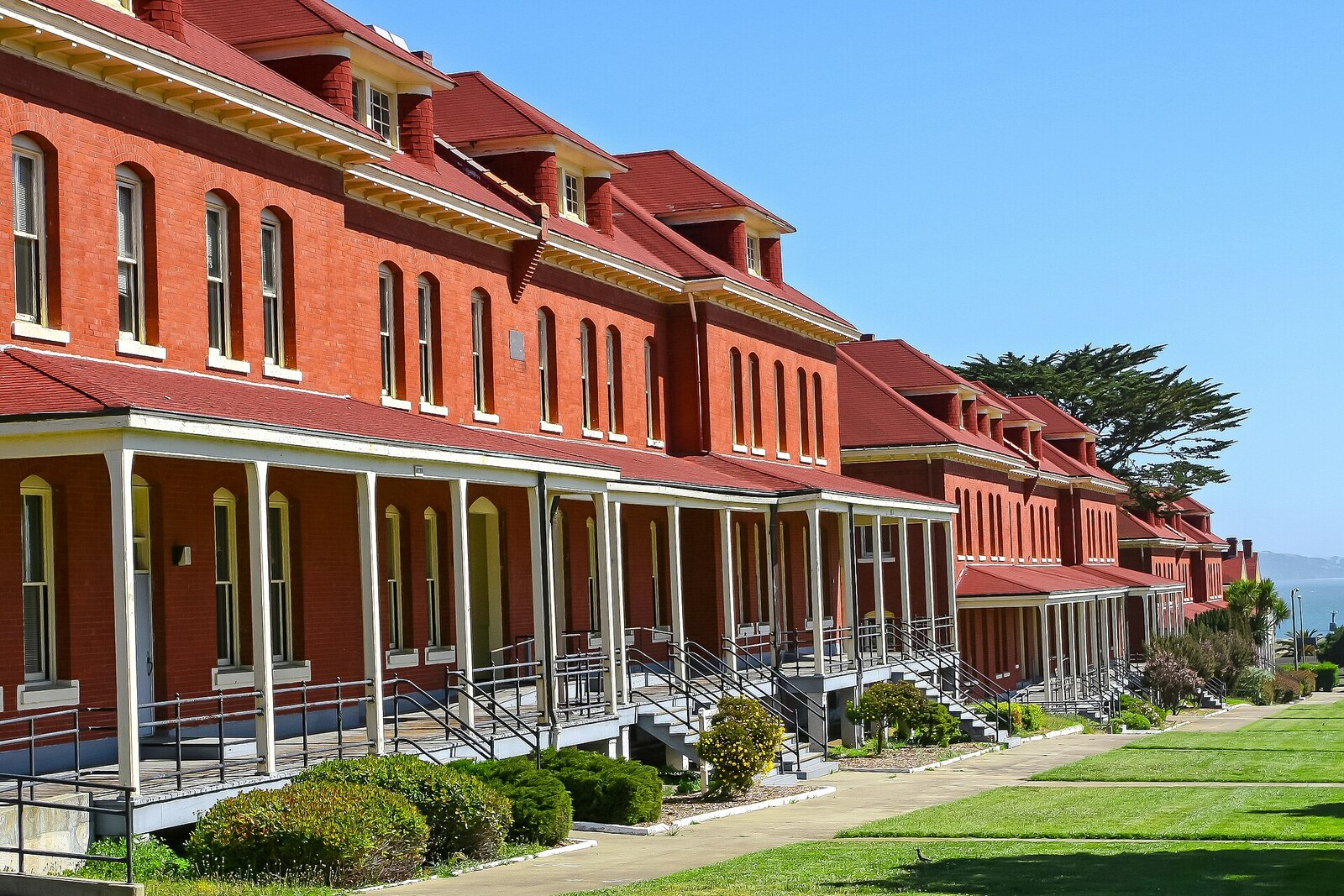
Look around first
What to notice
- Long row of red-brick barracks
- Rectangular parade lawn
- Identical building facades
- Open space of the former parade ground
The story of the place
The long grassy strip framed by uniform red-brick buildings was once a place for drill exercises and assemblies. At the end of the nineteenth century, the site was leveled, and military housing was built along its edges: day-to-day life took place in the lower rooms, while soldiers spent the night upstairs. Later, the parade ground was paved over for a parking lot; then the surface was removed and grass was returned. The former barracks are occupied by a museum, a hotel, and various institutions, while the dimensions of the open rectangle remain from the military routine.
In the autumn of nineteen fifteen, the Twenty-fourth Infantry Regiment moved into the red-brick barracks. The regiment's enlisted ranks were Black, while most of its officers were white. Such units of the regular Army were called Buffalo Soldiers. Military service was their profession and their source of pay, but Army command long avoided stationing Black regiments in large cities: it feared clashes with white residents.
The soldiers were returning from service in the Philippines and expected to spend several quiet months here. At the time, San Francisco was hosting the Panama–Pacific International Exposition—a world's fair held to mark the city's recovery after the earthquake and the opening of the Panama Canal. A significant part of the exposition occupied land next to the Presidio. A local newspaper assured readers in advance that the Twenty-fourth would be as disciplined a regiment as any other. The very appearance of that qualification shows what was expected of the soldiers and what they had to prove.
The Army housed the regiment in the Montgomery Street Barracks and then made it its public representative at the exposition. The soldiers guarded the grounds and demonstrated drill exercises, while the regimental band performed for visitors. On San Francisco Day, they accompanied the Liberty Bell—a historic bell brought from Philadelphia—from the exposition pavilion to the railroad station. For several months, people whom the Army had previously not wanted to keep near a large city met the public here daily on behalf of the Army itself.
The rest proved brief. In February nineteen sixteen, the regiment was sent to Wyoming, and several months later, on a military expedition to Mexico.
The barracks and parade ground were conceived as a single military complex. In the eighteen nineties, engineers leveled the site for formations and drills, then erected identical brick buildings along its edge: kitchens, dining halls, and recreation rooms were on the lower floors, while soldiers slept above. The word “Montgomery” in the barracks' name is their address. The street is named for John Berrien Montgomery, commander of an American warship: in eighteen forty-six, he ordered Yerba Buena—what San Francisco was then called—to be occupied and sent a detachment to take over the abandoned Mexican Presidio.
In nineteen fifty-one, the Army covered the parade ground with asphalt and turned it into a parking lot. In two thousand eleven, the asphalt was removed and lawn was laid. A museum, a hotel, and organizations now operate in the former barracks, while in front of their facades remains the same open rectangle where regiments formed up before going off duty or on a new campaign.
Useful on site
The outdoor lawn is open as part of the Presidio 24/7; Officers' Club exhibitions are usually Fri-Sun 11:00-16:00; Main Post construction is possible until Winter 2027.
Checked: June 26, 2026. Check the official source before visiting.Compare the buildings from the edge of the lawn, and do not disturb the guests and visitors of the active buildings.