 Guide On Map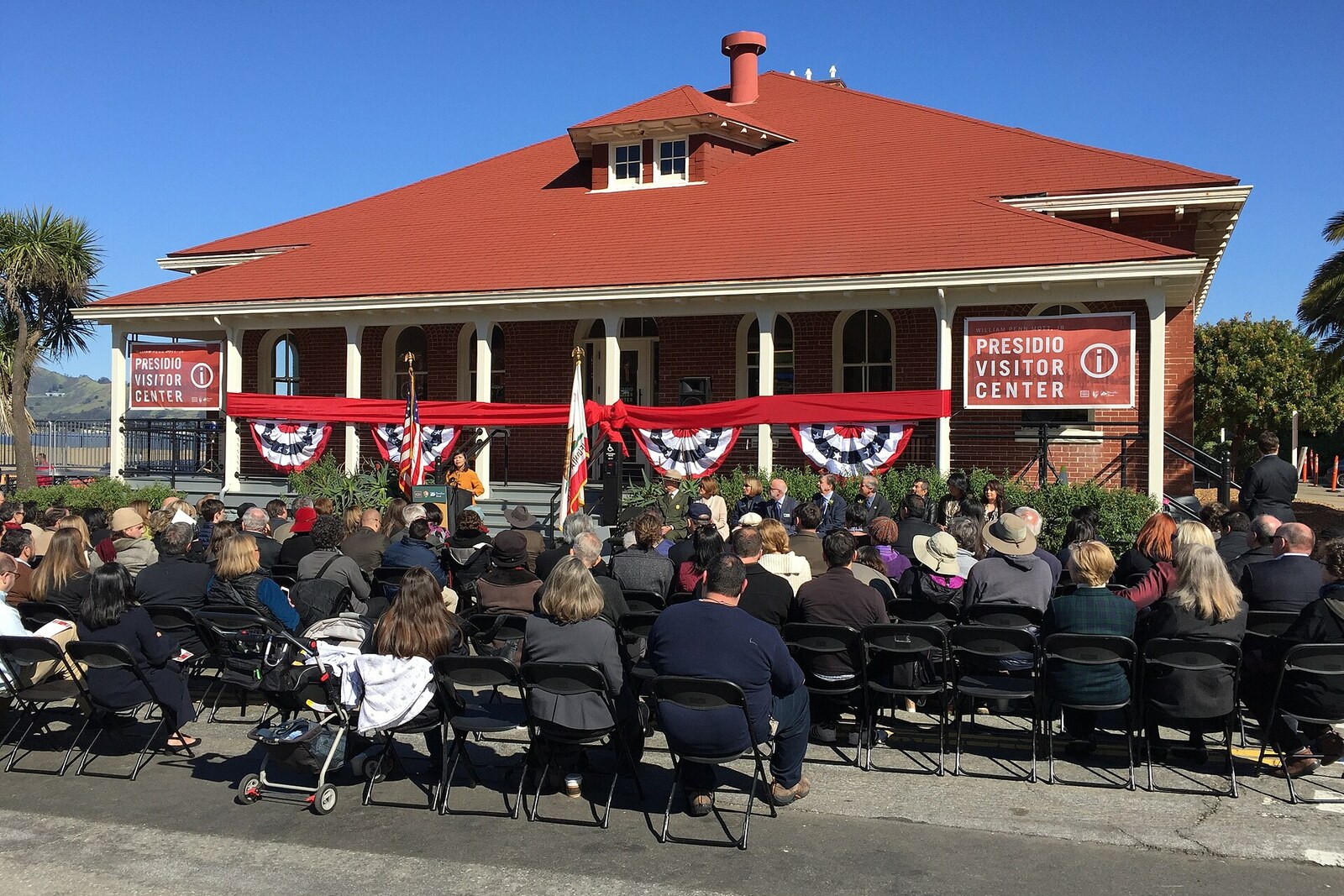
Look around first
What to notice
- Red sign bearing the name of William Penn Mott, Jr.
- Central porch
- Exposed brickwork
- Large model of the Presidio
The story of the place
At the northern edge of the main parade ground, the visitor center operates in a one-story brick former guardhouse: maps are handed out here, and visitors are helped to put together a route around the old military post. The central porch was restored after army alterations, and inside the wooden floors, wall paneling, metal ceiling, and exposed brickwork have survived. When the guard was stationed here, morning and evening cannon signals were given from here, and the cells held as many as thirty-four soldiers punished for breaking the rules. A large model of the entire Presidio now stands in one of the two former rooms; the other is devoted to the people and events of the post.
The top line of the red sign above the porch bears the name of William Penn Mott, Jr. He was a landscape architect and director of the National Park Service who worked to turn the Presidio military base into a national park open to everyone.
As early as nineteen seventy-two, the United States Congress ordered that if the military no longer needed the Presidio, the land would be transferred to the National Park Service. For seventeen years, this remained a condition for the future. In nineteen eighty-nine, the Base Realignment and Closure Commission declared the post surplus, and a practical question immediately arose: what should be done with one thousand five hundred acres of land, barracks, warehouses, roads, and homes?
That same spring, Mott lost his position as director. He was seventy-nine years old. He remained a staff member, now a special assistant to the director of the western region, with one assignment: to prepare the Presidio’s transition from the army to the National Park Service. After the director’s chair, this was work without his former rank. Mott led preparations for the new park until his death in nineteen ninety-two.
The army left two years after his death. Two more years later, the United States Congress established an organization that was to maintain and adapt the vast complex, and separately stipulated in law that the visitor center must bear the name of William Penn Mott.
The former army guardhouse was chosen for the center. The one-story brick building was erected in nineteen hundred on the northern edge of the main parade ground. The guard was stationed here, morning and evening cannon signals were given from here, and the cells could hold thirty-four people punished for violating military rules. The location suited the guard because it stood near the post’s main core. Now it is just as convenient for directing visitors among the parade ground, Crissy Field, the shore, and the road to the bridge.
In nineteen fifty-one, the military divided the former prison between a bank and a post office, removed the front porch, and cut side entrances. Over the following decades, the building was proposed for demolition several times. Presidio managers preserved it, restored the central entrance and porch, and, when creating the center, restored the former division into guardhouse and prison sections. The wooden floors, wall paneling, metal ceiling, and exposed brickwork have survived.
Today, park staff hand out maps and plan routes in these two rooms. A large model of the Presidio stands in the southern hall, while the northern hall tells about the people and events of the former post. Mott died while the army had not yet left the base; his name appeared above the porch of this guardhouse when the current center opened in nineteen seventeen—twenty-five years after his death.
Useful on site
Presidio is open 24/7; the Visitor Center is usually open daily 10:00-17:00, except Thanksgiving, Christmas and New Year's Day.
Checked: June 26, 2026. Check the official source before visiting.If the center is closed, the start is not lost: inspect the building from outside and use a map you saved in advance.