 Guide On Map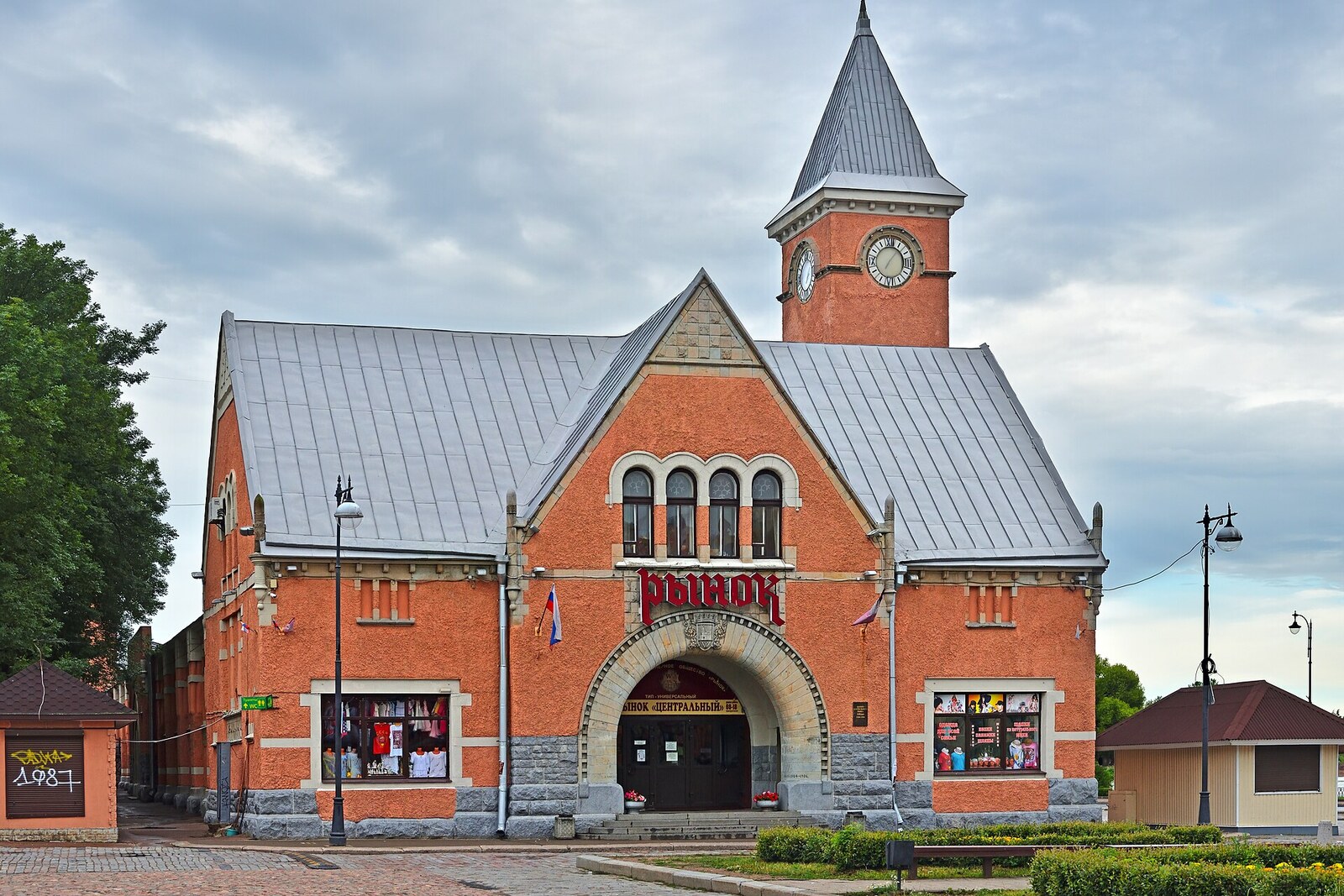
Look around first
What to notice
- Stones with carved numbers
- The long covered-market building
- The market’s small clock tower
The story of the place
Open space has remained by the former city gates, and a covered market with a small clock tower stretches along it. When old Vyborg had already expanded beyond its former boundaries, its center was still cramped: narrow streets hemmed in wooden houses, stoves, and sheds. The square was set aside for the daily food trade, and later a market with shops, a fish department for live fish, and refrigerated chambers below appeared beside it. That is why open paving and a long market building stand side by side here: one place received both a square and a roof for trade.
By six in the morning, peasants from villages around Vyborg had arrived here. Their farms earned money from vegetables, fruit, dairy products, meat, and berries and mushrooms gathered in the forest. A cart could not be parked wherever one pleased: a trader was assigned a spot, whose number was carved directly into the stone. Some of these numbers still lie in the paving.
A through lane was left clear for the carts. Sellers turned their horses with their hindquarters toward it and their heads toward the goods: the manure stayed farther from the food supplies. Meat was allowed to be sold after inspection. The square was needed not for ceremonial assemblies, but for the daily meeting of two groups dependent on one another: rural farm owners who lived by selling their harvest, and townspeople who bought food here for their homes.
Until the middle of the nineteenth century, fortifications stood on this site. They belonged to the military department, although Vyborg had long since spread beyond them. In the eighteen forties and fifties, city elders repeatedly asked in Saint Petersburg for permission to dismantle the weathered walls. The old center remained cramped, the narrow streets were poorly ventilated, and in a city of wooden houses, stoves, and sheds, any fire could spread to a neighboring block.
In eighteen fifty-nine, an imperial decree transferred the walls to the city. Two years later, a new plan by the provincial surveyor Berndt Otto Nyumalm was approved; he was tasked with laying out streets and blocks on the freed land. The city received no money to dismantle the fortifications. Officials divided the new territory into plots and sold them at auction to local merchants, artisans, and office workers. The proceeds paid for the demolition: the stone enclosure itself provided the funds for its own dismantling. The area of Vyborg designated for development grew almost sixfold, while open space remained at the former gates for a food market.
By the beginning of the twentieth century, carts and tents alone were no longer enough. In April nineteen oh six, the city opened a covered market by the square. Inside were eighty-two trading places, two shops, and a fish department with four pools for live fish; refrigerated chambers were installed in the basement. The long building with a small clock tower facing the square is that very market.
Carts are no longer parked according to numbers carved into granite. Several numbered stones remain among the ordinary cobblestones, and trade continues nearby—under the roof of the building that the city added to the market rows on the site of the dismantled wall.
Useful on site
The square is always open; the market and pavilions operate according to the current schedules of the tenants, which are best checked on site.
Checked: June 24, 2026. Check the official source before visiting.The market may keep its own trading schedule, but the main story can be clearly read from the square. Do not count on a required purchase or a break inside.